


Best 3 Nuclear Energy Stocks to Buy Right Now
Key Points
Nuclear power plants require a specific kind of fuel to function, which has only a very small number of suppliers.
The power utility business has evolved, rewarding suppliers who can meet user needs where and how they need it.
Small nuclear reactors are relatively rare right now, but one company is leading the charge to mainstream them.
- 10 stocks we like better than Vistra ›
It's actually pretty amazing when you think about it. Just a few years ago -- when renewables and clean-energy options like solar and wind were expected to finally bring an end to fossil fuels as an energy source -- nuclear power was put on the chopping block as well. The world just didn't need its environmentally risky electricity either.
Now, out of necessity, nuclear's back in vogue. The International Atomic Energy Association expects the industry's power production to more than double between 2024 and 2050 thanks to capacity additions expected between now and then, while the World Nuclear Association expects nuclear power output to triple during this time. As it turns out, renewables can't be brought online fast enough to keep up with the planet's ever-growing need for energy.
Will AI create the world's first trillionaire? Our team just released a report on the one little-known company, called an "Indispensable Monopoly" providing the critical technology Nvidia and Intel both need. Continue »
Artificial intelligence data centers are, of course, the big driver of this soaring demand. Research group BloombergNEF predicts the United States' data center industry alone is going to more than double its consumption of electricity between now and 2035, more than doubling the portion of the nation's total power production that it consumes in the process. And that's still just the beginning, if expectations of an AI-everything future are on target. Look for similar dynamics for data centers outside of the United States as well.
Sure, there are other power production options besides nuclear. Having weighed the logistics, functionality, costs, benefits, and longevity, though, the world's falling back in love with nuclear power since it effectively solves many of the problems that previous-generation nuclear energy solutions brought to the table. Chief among these problems is, of course, safety.
With that as the backdrop, here's a rundown of three of the best nuclear energy stocks to buy right now.
Cameco
Nuclear power plants need some sort of fuel -- usually uranium -- to convert heat into electricity.
That's where Cameco (NYSE: CCJ) comes in. It's not only one of the world's top suppliers of uranium. It's an integrated miner and processor, sitting on more than 400 million pounds of uranium at its four primary source sites. The company sold 21 million pounds of it last year, turning nearly $3.5 billion in revenue into net income of roughly $600 million thanks to firm uranium prices.
This is only a fraction of what's possible, though. The World Nuclear Association believes global demand for uranium is set to grow from just under 70,000 metric tons last year to about 150,000 metric tons in 2040, with an outside chance of reaching 200,000 metric tons per year by then. Cameco is perfectly positioned to plug into this growth.
Vistra
Did you know there's a very good chance the power company you pay every month didn't actually generate the electricity you use? It's true. In the name of efficiency and cost-effectiveness, many electric utilities outfits purchase wholesale power from a third-party producer to serve their own customers. Vistra (NYSE: VST) is one of those wholesalers.
This in and of itself doesn't mean much to an investor looking for a new nuclear energy holding. Most of Vistra's current power production comes from natural gas anyway, after all, with coal still a distant second in its output mix.
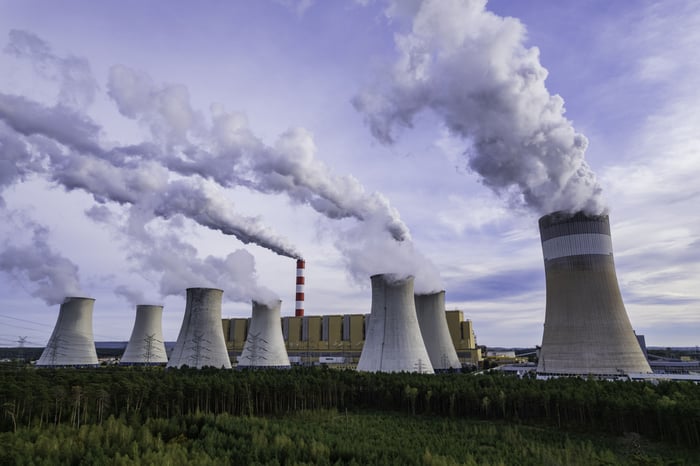
Image source: Getty Images.
That's changing, though, and in a big way. Using its flexibility as a wholesaler that can generate electricity almost anywhere it wants to, Vistra is making significant investments in its own nuclear power capacity to specifically serve data center customers that have already committed to purchasing Vistra-produced power.
For example, early this year, the company announced an agreement with Facebook parent Meta Platforms to supply the technology giant with a total of 2,600 megawatts' worth of electricity from three different nuclear power plants for the next 20 years. And just last month, e-commerce giant Amazon began planning the construction of a data center right on one of Vistra's nuclear power plant properties in Texas.
A couple of high-profile agreements isn't necessarily earth-shattering. These two deals underscore a broader dynamic, though, as well as confirm that Vistra's ability to deliver nuclear power is one that major customers believe in. It may well outperform most utility stocks for the foreseeable future, since a couple of big customer wins secure the funding Vistra needs to add production capacity, which in turn adds revenue.
NuScale Power
Last but not least, while it makes sense to locate a data center near a reliable nuclear power source, it makes just as much sense to locate a reliable nuclear power source near where the electricity is consumed.
Yes, this is possible now. Thanks to technical strides in safety and operability, so-called small modular reactors (or SMRs) capable of producing up to 300 megawatts of electricity -- enough to power a small town, a desalination facility, a refinery, and yes, AI data centers -- require only a fraction of the space needed by utility-scale power plants, allowing them to be built right where the electricity they generate is used.
Although they still require years of planning, permitting, and construction, SMRs can be up and running in a fraction of the time that new full-scale power plants need. That's why industry research outfit ABI Research expects more than 260 small modular reactors will be deployed by 2040, up from only a small handful now.
This bodes very well for NuScale Power (NYSE: SMR), which isn't the only outfit that designs and makes SMRs, but is among the furthest along in its development. Its 77-megawatt power module is the first and still only SMR to receive design approval from the U.S. Nuclear Regulatory Commission, a green light that hasn't gone unnoticed overseas, where interest in its modular nuclear power plants is also firming up.
There's still above-average risk here, to be sure, not the least of which is the fact that NuScale is unprofitable and will likely remain in the red for the foreseeable future. If you can stomach this risk, though -- and remain patient -- SMRs are a compelling nuclear power prospect.
This might help get you off the sidelines and into the game: Although it's only a 12-month price target, the analyst community says NuScale shares are worth $18.68 apiece, up 60% from the ticker's present price. That's not a bad way to start out a new trade.
Should you buy stock in Vistra right now?
Before you buy stock in Vistra, consider this:
The Motley Fool Stock Advisor analyst team just identified what they believe are the 10 best stocks for investors to buy now… and Vistra wasn’t one of them. The 10 stocks that made the cut could produce monster returns in the coming years.
Consider when Netflix made this list on December 17, 2004... if you invested $1,000 at the time of our recommendation, you’d have $503,861!* Or when Nvidia made this list on April 15, 2005... if you invested $1,000 at the time of our recommendation, you’d have $1,026,987!*
Now, it’s worth noting Stock Advisor’s total average return is 884% — a market-crushing outperformance compared to 179% for the S&P 500. Don't miss the latest top 10 list, available with Stock Advisor, and join an investing community built by individual investors for individual investors.
See the 10 stocks »
*Stock Advisor returns as of March 30, 2026.
James Brumley has no position in any of the stocks mentioned. The Motley Fool has positions in and recommends Amazon, Cameco, and Meta Platforms. The Motley Fool recommends NuScale Power. The Motley Fool has a disclosure policy.
Recommended Articles


