


Market Timing Is Overrated: Here's Why
Key Points
Investors who trade too frequently end up negatively impacting their portfolio performance.
To achieve strong long-term returns, investors must be able to handle volatility.
The smartest investors understand that time in the market is what matters most.
- 10 stocks we like better than S&P 500 Index ›
Buy low and sell high. Investors are certainly familiar with this popular adage regarding the stock market. It seems so simple. And of course, who doesn't want to be able to successfully jump in and out of stocks?
But this implies, at a high level, that you can properly time the market. While alluring, this is an extremely overrated activity. Here's why.
Will AI create the world's first trillionaire? Our team just released a report on the one little-known company, called an "Indispensable Monopoly" providing the critical technology Nvidia and Intel both need. Continue »
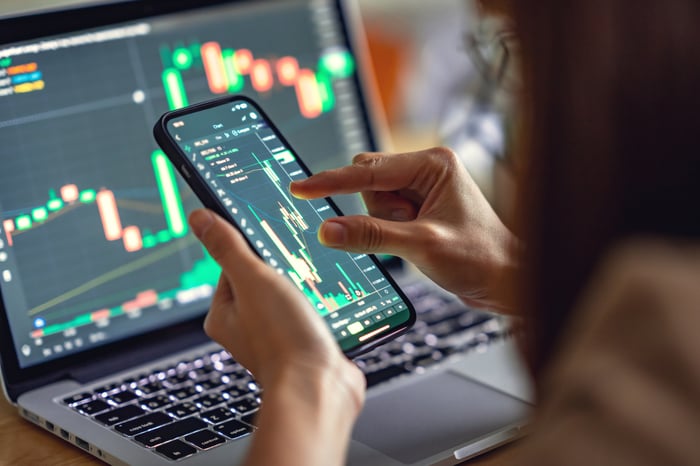
Image source: Getty Images.
More trades lead to poor performance
Some research suggests too much trading activity actually hurts returns. Investors, often overconfident in their ability to time the market, typically buy and sell at the wrong times.
Consequently, this leads to poor portfolio performance. That's because the market frequently registers its biggest gains on the days immediately following its worst declines. It's impossible to consistently avoid the worst days and capture the best ones.
Between the start of 2005 and the end of 2024, the S&P 500 (SNPINDEX: ^GSPC) generated an annualized total return of 10.4%, according to JPMorgan Chase's Asset Management division. The firm's research reveals that if you missed the 10 best days during this time, your annualized total return would fall substantially to 6.1%.
It's difficult to not want to constantly make moves to adjust your portfolio. There's an abundance of information available, driven by the internet that facilitates the creation and distribution of nonstop commentary. This means there's a lot of noise out there. It's hard to ignore this. And it's even more of a challenge to figure out the information that actually matters.
Additionally, zero-fee brokerages are common these days. This wasn't the case even 10 years ago. But thanks to the early popularity of Robinhood Markets, the rest of the industry followed suit. Greater portfolio activity can also be incentivized by having no obvious cost to trade.
Time in the market is what matters most
Charlie Munger, who passed away in 2023, was Waren Buffett's right-hand man for decades at Berkshire Hathaway. He once said, "The big money is not in the buying or selling, but in the waiting." Investors should take this to heart.
The stock market is a wonderful wealth-building tool. However, investors should get out of their own ways. The absolute best thing to do is put money to work early and often, preferably in a low-cost S&P 500 exchange-traded fund, and be patient. This allows compounding to work its magic, which can lead to fantastic results over the long term.
At the end of the day, volatility can't be avoided. And no amount of effort, like trading extensively or spending extra time researching and crunching numbers, can change this reality. Understand that being able to handle the ups and downs is a requirement for success.
The smartest and most disciplined investors know this. And that's why they stay away from timing the market as if their financial lives depend on it.
Should you buy stock in S&P 500 Index right now?
Before you buy stock in S&P 500 Index, consider this:
The Motley Fool Stock Advisor analyst team just identified what they believe are the 10 best stocks for investors to buy now… and S&P 500 Index wasn’t one of them. The 10 stocks that made the cut could produce monster returns in the coming years.
Consider when Netflix made this list on December 17, 2004... if you invested $1,000 at the time of our recommendation, you’d have $503,861!* Or when Nvidia made this list on April 15, 2005... if you invested $1,000 at the time of our recommendation, you’d have $1,026,987!*
Now, it’s worth noting Stock Advisor’s total average return is 884% — a market-crushing outperformance compared to 179% for the S&P 500. Don't miss the latest top 10 list, available with Stock Advisor, and join an investing community built by individual investors for individual investors.
See the 10 stocks »
*Stock Advisor returns as of March 30, 2026.
JPMorgan Chase is an advertising partner of Motley Fool Money. Neil Patel has no position in any of the stocks mentioned. The Motley Fool has positions in and recommends Berkshire Hathaway and JPMorgan Chase. The Motley Fool has a disclosure policy.
Recommended Articles


