


3 ETFs to Own if the U.S. Economy Slows in 2026
Key Points
Many portfolios are still very heavy in tech and growth stocks. It's time to revisit asset allocations.
With the U.S. economy showing signs of slowing, tilting your portfolio in more of a defensive direction might be a good idea.
Here are three different strategies that should be considered if you're thinking about taking some risk off the table.
- 10 stocks we like better than iShares Trust - iShares 20+ Year Treasury Bond ETF ›
The case for investing more cautiously is growing. After several years of big returns from artificial intelligence (AI) and tech stocks, investors are being more selective about where to invest.
The jobs market keeps getting weaker. Gross domestic product (GDP) growth is still positive but slowing. Inflation is still well above where the Fed wants it, and rate cuts are looking increasingly unlikely this year. That means it's time to at least consider investing beyond the S&P 500 and the Nasdaq 100.
Will AI create the world's first trillionaire? Our team just released a report on the one little-known company, called an "Indispensable Monopoly" providing the critical technology Nvidia and Intel both need. Continue »
While it's generally unwise to make major changes to your portfolio's asset allocation, tilting into more defensive asset classes to reduce your risk profile can make sense. If you're anticipating that the economy will continue to slow down here, rotating into asset classes that have a more conservative risk profile and a lower correlation to the broader equity market can help protect you on the downside.
I like three different strategies if you're considering taking this approach. Here are three corresponding ETFs.

Source: Getty Images.
1. iShares 20+ Year Treasury Bond ETF
The iShares 20+ Year Treasury Bond ETF (NASDAQ: TLT) invests in a portfolio of long-term government bonds. Since investors often rotate into assets that are perceived as safer in slower-growth environments, Treasuries often rise in value when stocks decline.
But they don't always do that. In 2022, both stocks and bonds fell together because inflation was soaring and the Fed was aggressively raising interest rates to address it. Plus, the high-interest-rate sensitivity that comes with longer duration bonds added to one of the deeper bond bear markets in history.
When bonds work, however, they can work really well. During the 2020 COVID bear market, this ETF gained more than 22% in the first quarter of the year. Over that same time, the S&P 500 was down 20%. Right when investors needed protection the most, the iShares 20+ Year Treasury Bond ETF delivered.
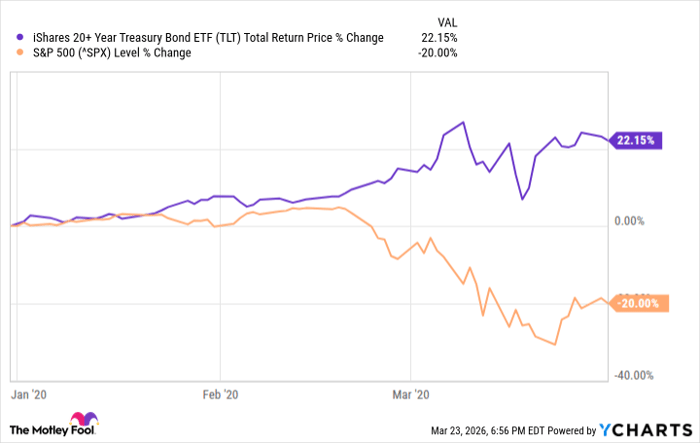
TLT Total Return Price data by YCharts.
If you want the Treasury exposure without the high-interest-rate sensitivity, consider something like the iShares 3-7 Year Treasury Bond ETF or the iShares U.S. Treasury Bond ETF.
2. iShares MSCI USA Minimum Volatility Factor ETF
If you want to stick with stocks but take a little risk off the table, a fund that actively looks to reduce portfolio volatility while maintaining capital-growth upside makes a lot of sense.
The iShares MSCI USA Minimum Volatility Factor ETF (NYSEMKT: USMV) tracks an index of U.S. stocks that, in the aggregate, have lower volatility characteristics, relative to the broader U.S. equity market. The "in the aggregate" part of its objective is important to clarify because it creates a big distinction from a portfolio of low volatility stocks.
The Invesco S&P 500 Low Volatility ETF, for example, just targets stocks with lower-than-average volatility. The objective of the iShares MSCI USA Minimum Volatility Factor ETF, however, is to create a portfolio that's optimized to produce the minimum amount of volatility possible based on historical data. It can literally consider any U.S. stock for the portfolio as long as the optimized end product is minimally volatile.
It's a unique strategy that produces a low volatility portfolio but still allows for significant potential upside capture. The iShares MSCI USA Minimum Volatility Factor ETF currently has 28% of its portfolio in tech stocks. But over the course of its 15-year history, it has been about 20% less volatile than the S&P 500. That's a pretty good balance.
3. Vanguard Healthcare ETF
The Vanguard Healthcare ETF (NYSEMKT: VHT) is more of a pure defensive-sector play. This ETF owns more than 400 companies spanning biotech, healthcare equipment, and pharmaceuticals. Since demand generally remains durable for these products and services regardless of the economic cycle, it's considered a solid defensive play in times of uncertainty.
The fact that healthcare stocks haven't done much over the past few years shouldn't be concerning. They often trail during big bull market rallies where tech and growth stocks are leading the way. It's when stocks are in a deep correction that healthcare stocks can thrive.
In 2022, when the S&P 500 was down roughly 20% and the Nasdaq 100 was down more than 30%, this ETF lost a mere 5%. This sector has demonstrated its ability to be a strong defensive play under the right conditions.
Should you buy stock in iShares Trust - iShares 20+ Year Treasury Bond ETF right now?
Before you buy stock in iShares Trust - iShares 20+ Year Treasury Bond ETF, consider this:
The Motley Fool Stock Advisor analyst team just identified what they believe are the 10 best stocks for investors to buy now… and iShares Trust - iShares 20+ Year Treasury Bond ETF wasn’t one of them. The 10 stocks that made the cut could produce monster returns in the coming years.
Consider when Netflix made this list on December 17, 2004... if you invested $1,000 at the time of our recommendation, you’d have $503,861!* Or when Nvidia made this list on April 15, 2005... if you invested $1,000 at the time of our recommendation, you’d have $1,026,987!*
Now, it’s worth noting Stock Advisor’s total average return is 884% — a market-crushing outperformance compared to 179% for the S&P 500. Don't miss the latest top 10 list, available with Stock Advisor, and join an investing community built by individual investors for individual investors.
See the 10 stocks »
*Stock Advisor returns as of March 30, 2026.
David Dierking has positions in iShares Trust-iShares 20+ Year Treasury Bond ETF. The Motley Fool has no position in any of the stocks mentioned. The Motley Fool has a disclosure policy.
Recommended Articles


