


Asian Stocks Open Sharply Lower Collectively, What Is the Reason?
TradingKey - Affected by ongoing tensions in the Middle East and rising international oil prices, Asian equity markets faced collective pressure at today's open. A-shares, Japanese, and South Korean stocks all opened significantly lower as market risk appetite cooled rapidly.
In terms of market performance, Japanese stocks led the decline, with the Nikkei 225 Index dropping sharply after the open as heavyweight technology and export sectors generally weakened. The KOSPI also opened lower, with semiconductors and cyclical stocks facing sell-offs, weighing on the index's overall performance.
Meanwhile, all three major A-share indices opened lower. Although the declines were relatively moderate, market sentiment remained notably cautious, with investors primarily staying on the sidelines. The current market trend continues to lean toward the downside.
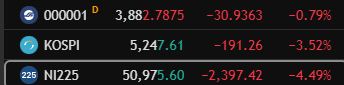
As of press time, the Nikkei 225 Index stood at 50,975.60 points, down 4.49%; the KOSPI was at 5,247.61 points, down 3.52%; and the Shanghai Composite Index was at 3,882.78 points, down 0.79%.
Looking at the driving factors, the core market disturbances still stem from the external environment. On one hand, recurring tensions in the Middle East have fueled investor concerns over energy supply disruptions, keeping Brent crude at elevated levels and further intensifying global inflation expectations. On the other hand, against a backdrop of persistent inflationary pressures, expectations for Fed rate cuts continue to cool, leading to a marginal tightening of global liquidity and exerting pressure on equity assets.
Japanese and South Korean markets are more sensitive to changes in oil prices and external demand, hence their particularly sharp reactions. Especially in the current environment of rising interest rates, growth stock valuations are under clear pressure; coupled with some capital opting for tactical safe-haven moves, this led to concentrated selling at the open. In contrast, A-shares are supported by domestic demand and policy expectations, keeping overall volatility relatively controlled, though external disturbances continue to transmit through sentiment and capital flows.
Overall, the sharp opening decline in Asian equities today essentially reflects the market's repricing of the "high oil prices + high interest rates" combination. Until geopolitical risks significantly subside, Asia-Pacific markets are likely to maintain high volatility in the short term, with performance becoming more susceptible to news-driven catalysts.
Recommended Articles


