


Eli Lilly vs Novo Nordisk: Which Obesity Drug Stock Is the Better Buy?
Key Points
One of these companies' lineup and pipeline within weight management and outside look much stronger.
Valuation does not tip the scale in the other's favor.
- 10 stocks we like better than Eli Lilly ›
Over the past year, the two leaders in the obesity drug market, Eli Lilly (NYSE: LLY) and Novo Nordisk (NYSE: NVO), have lagged broader equities, though the latter has performed substantially worse than the former. Still, analysts predict that this therapeutic area will soar over the next decade, and there is a good chance these two will maintain their edge over their peers given their pipelines. But which one is a better buy?
Comparing their weight loss portfolios
Eli Lilly's weight loss medicine, Zepbound, and Novo Nordisk's Wegovy have gone head-to-head in a clinical trial. The former emerged victorious, leading to a mean weight loss of 20.2% compared to the latter's 13.7% in the 72-week study. It's no wonder, then, that Zepbound has been gaining significant traction and now holds the lead in this market, despite Wegovy being approved more than two years before it.
Will AI create the world's first trillionaire? Our team just released a report on the one little-known company, called an "Indispensable Monopoly" providing the critical technology Nvidia and Intel both need. Continue »
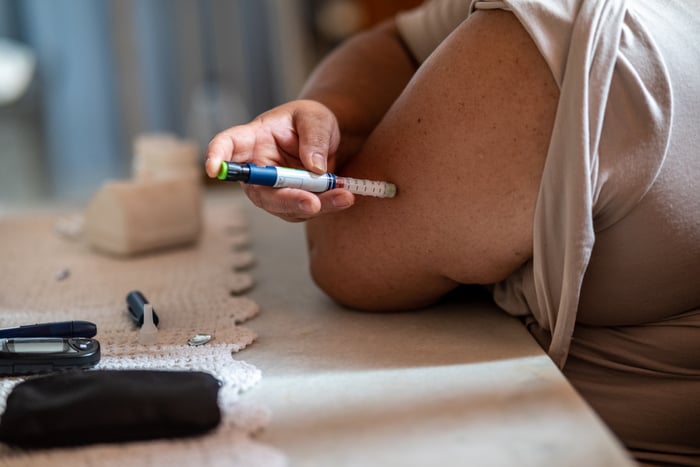
Image source: Getty Images.
That said, Novo Nordisk has been seeking to turn the tide. The company earned approval for an oral version of Wegovy -- the first oral GLP-1 indicated for weight loss -- which it launched earlier this year. And more recently, Novo Nordisk received approval for a high-dose formulation of Wegovy. That's to say nothing of the pharmaceutical giant's pipeline candidates, which include CagriSema, a next-gen anti-obesity therapy that performed even better than Wegovy in clinical studies.
Finally, Novo Nordisk is working on a medicine called UBT251 -- in partnership with a China-based drugmaker -- which mimics the action of three separate gut hormones. No such drug is approved in the U.S. yet. UBT251 recently performed very well in a phase 2 clinical trial in China. Could these efforts allow Novo Nordisk to snatch the lead back from its competitor? That's unlikely. Here's why. First, Eli Lilly is close to launching its own oral GLP-1, orforglipron, in the second quarter.
Whereas oral Wegovy is only approved for weight loss, orforglipron will also target diabetes, an indication where it beat Novo Nordisk's other oral GLP-1, Rybelsus, in a head-to-head study. So, orforglipron should prove very competitive in the oral GLP-1 market. Further, although CagriSema looks promising, Novo Nordisk's own clinical trial comparing it with Zepbound found that the latter was more effective.
Then there is Eli Lilly's own triple agonist, retatrutide, which has already performed well in a phase 3 study in weight management, where its highest dose led to a 28.7% mean weight loss -- a performance no other drug has come close to -- after 68 weeks. Eli Lilly's weight loss portfolio seems much stronger than Novo Nordisk's. So, even though both could capitalize on this growing market, Eli Lilly should remain the leader.
Beyond weight loss
What do both companies' prospects look like outside of the growing anti-obesity market? Novo Nordisk has earned some important label expansions for Wegovy, including in treating metabolic dysfunction-associated steatohepatitis (MASH), a disease linked to obesity where there is a high unmet need. It is also indicated to reduce the risk of major cardiovascular events in patients with cardiovascular disease who are either overweight or obese. That said, the Denmark-based drugmaker has little to offer beyond its core GLP-1 lineup.
That's not the case for Eli Lilly, which has several blockbuster medicines in other areas. These include Verzenio for breast cancer and Taltz, which treats several autoimmune conditions. Eli Lilly's newer launches could also, eventually, generate over $1 billion in annual sales. These include Ebglyss, a medicine for eczema, Kisunla, a therapy for Alzheimer's disease, and Jaypirca, another cancer therapy. Eli Lilly's pipeline also appears more diversified than its competitors'. It once again looks like the clear winner when we compare both companies' prospects beyond weight loss.
What about the valuation?
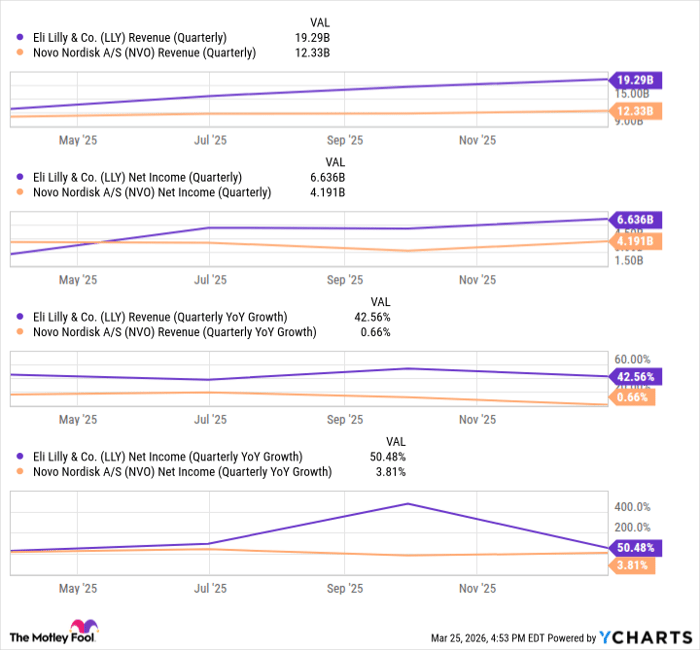
Eli Lilly has a better weight-loss portfolio and pipeline, a better portfolio and pipeline across other areas, and generates higher, faster-growing revenue and earnings.
LLY Revenue (Quarterly) data by YCharts
The choice between the two seems simple until we consider valuation. Eli Lilly is trading at 26.6x forward earnings, compared to Novo Nordisk's forward price-to-earnings of 10.9, and the healthcare sector's average of 16.9. Perhaps at current levels, Eli Lilly's shares are just too expensive, while Novo Nordisk's are a bargain.
However, even with that taken into account, Eli Lilly remains the more attractive stock, having earned a premium given its breakthroughs in weight management, strong prospects in this and other areas, and fantastic financial results. Novo Nordisk might indeed be a bargain, as the stock could bounce back as it makes solid clinical and regulatory progress over the next few years. But it is still not a better buy than Eli Lilly.
Should you buy stock in Eli Lilly right now?
Before you buy stock in Eli Lilly, consider this:
The Motley Fool Stock Advisor analyst team just identified what they believe are the 10 best stocks for investors to buy now… and Eli Lilly wasn’t one of them. The 10 stocks that made the cut could produce monster returns in the coming years.
Consider when Netflix made this list on December 17, 2004... if you invested $1,000 at the time of our recommendation, you’d have $503,268!* Or when Nvidia made this list on April 15, 2005... if you invested $1,000 at the time of our recommendation, you’d have $1,049,793!*
Now, it’s worth noting Stock Advisor’s total average return is 898% — a market-crushing outperformance compared to 182% for the S&P 500. Don't miss the latest top 10 list, available with Stock Advisor, and join an investing community built by individual investors for individual investors.
See the 10 stocks »
*Stock Advisor returns as of March 27, 2026.
Prosper Junior Bakiny has positions in Eli Lilly and Novo Nordisk. The Motley Fool recommends Novo Nordisk. The Motley Fool has a disclosure policy.
Recommended Articles


