


Recession Risks Are Rising According To Wall Street. Here's What It Means for Investors.
Key Points
Moody's Mark Zandi sees a nearly 50% risk of a recession.
High oil prices pose a wide range of problems for consumers.
The S&P 500 has recovered from every setback it's faced.
- 10 stocks we like better than S&P 500 Index ›
It's been nearly a month since the war broke out in Iran, and investors are getting jittery.
Markets have swung up and down nearly every day as it seems that there's an announcement from President Trump or a new turn in the war that moves markets. The S&P 500 (SNPINDEX: ^GSPC) is down 4.2% since the U.S attacked Iran, and oil prices have spiked as the Strait of Hormuz has been essentially shut down since the war started.
Will AI create the world's first trillionaire? Our team just released a report on the one little-known company, called an "Indispensable Monopoly" providing the critical technology Nvidia and Intel both need. Continue »
Rising oil prices make most physical goods more expensive due to higher transportation costs, and they also pinch consumers' wallets. As a result, Wall Street's prognosticators are reassessing the recession risk facing the economy.
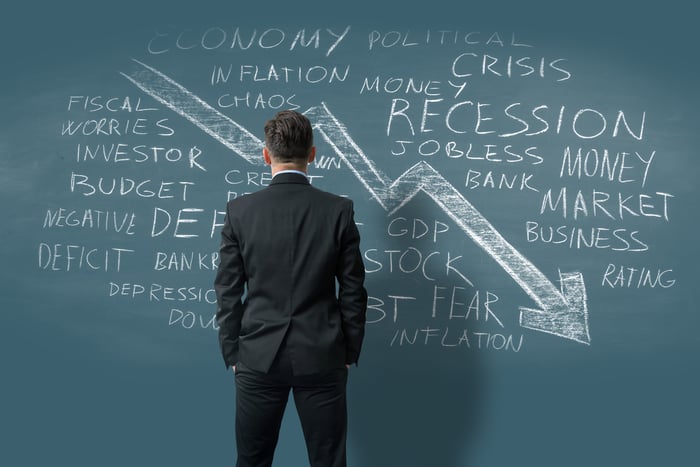
Image source: Getty Images.
The risk of a recession is growing
In recent days, several high-profile economists have lifted their odds for a recession this year.
Mark Zandi, of Moody's Analytics, now sees a 48.6% risk of a recession over the next 12 months, saying on CNBC, "Even before the conflict, I thought recession and risks were on the rise," and added that if the war goes on, a recession is more than likely in the second half of the year.
Goldman Sachs now sees a 30% risk of a recession, up from 25% last week, as chief economist Jan Hatzius noted tighter financial conditions and a diminishing fiscal boost in the second half of the year.
Even Polymarket, the prediction market, sees a significant increase in the chances of a recession, as traders on the marketplace now believe there's a 35% chance of a U.S. recession before the end of the year, up from 23% before the war started.
What it means for investors
First off, investors should be aware that there's always some risk of a recession around the corner, even when there's a roaring bull market and a rock-solid economy. For example, Fed Chair Jerome Powell frequently tells reporters that there's always an inherent risk of a recession, estimating it at around in 1 in 4.
Recessions are a normal part of the economic cycle, though they're painful for workers, consumers, and investors.
A recession has happened roughly every six to eight years since World War II, and bear markets, defined as a decline of 20% or more from a recent stock market peak, often accompany a recession, occurring about every four years on average.
While it is a normal part of investing, investors can also prepare for a recession. Hoarding cash is one tactic you can use to potentially buy stocks at a discount. Depending on your time horizon, you might also consider rotating into lower-risk, dividend-paying stocks.
No one knows if a recession will happen, but you can prepare for one. Over the long term, the S&P 500 has bounced back from every recession and gone on to set a new all-time high.
If a recession does happen, the broad-market index will eventually recover.
Should you buy stock in S&P 500 Index right now?
Before you buy stock in S&P 500 Index, consider this:
The Motley Fool Stock Advisor analyst team just identified what they believe are the 10 best stocks for investors to buy now… and S&P 500 Index wasn’t one of them. The 10 stocks that made the cut could produce monster returns in the coming years.
Consider when Netflix made this list on December 17, 2004... if you invested $1,000 at the time of our recommendation, you’d have $497,659!* Or when Nvidia made this list on April 15, 2005... if you invested $1,000 at the time of our recommendation, you’d have $1,095,404!*
Now, it’s worth noting Stock Advisor’s total average return is 912% — a market-crushing outperformance compared to 185% for the S&P 500. Don't miss the latest top 10 list, available with Stock Advisor, and join an investing community built by individual investors for individual investors.
See the 10 stocks »
*Stock Advisor returns as of March 26, 2026.
Jeremy Bowman has no position in any of the stocks mentioned. The Motley Fool has no position in any of the stocks mentioned. The Motley Fool has a disclosure policy.
Recommended Articles


