


Prediction: The Trump Bull Market Is Running on Fumes, and the Federal Reserve Will Send It Over the Edge
Key Points
Statistically, the Dow Jones Industrial Average, S&P 500, and Nasdaq Composite have outperformed with Donald Trump in the White House.
Trump's tax policies have had a direct impact on equities, with the Tax Cuts and Jobs Act permanently lowering the corporate income tax rate, spurring share buybacks.
Unfortunately, the Trump bull market rally may come to a grinding halt due to several shifts at America's foremost financial institution.
- 10 stocks we like better than S&P 500 Index ›
Looking at things objectively, stocks have soared under President Donald Trump. During his first, non-consecutive term in the White House (Jan. 20, 2017 – Jan. 20, 2021), the widely followed Dow Jones Industrial Average (DJINDICES: ^DJI), broad-based S&P 500 (SNPINDEX: ^GSPC), and technology-driven Nasdaq Composite (NASDAQINDEX: ^IXIC) surged 57%, 70%, and 142%, respectively.
Until a few weeks ago, the Dow, S&P 500, and Nasdaq were enjoying an encore performance during Trump's second term, with all three higher by double-digit percentages. But these Trump bull market gains may soon prove fleeting due to an unlikely catalyst: the Federal Reserve.
Will AI create the world's first trillionaire? Our team just released a report on the one little-known company, called an "Indispensable Monopoly" providing the critical technology Nvidia and Intel both need. Continue »

President Trump delivering remarks. Image source: Official White House Photo by Daniel Torok.
Wall Street's bull market has blossomed under Donald Trump
But before diving into what can send the stock market over the edge, it's imperative to lay the groundwork for how the S&P 500, Nasdaq Composite, and Dow Jones Industrial Average hit respective psychological milestones of 7,000, 24,000, and 50,000.
Two of the bigger bull market catalysts under President Trump have nothing to do with his policies. The evolution of artificial intelligence (AI) and the advent and early stage proliferation of quantum computing have been the wind in Wall Street's sails.
AI is being hailed as the biggest technological leap forward since the emergence of the internet in the mid-1990s. PwC's analysts believe it'll add more than $15 trillion to the global economy by 2030. If this estimate is even remotely in the ballpark, it would lead to a laundry list of potential winners in the infrastructure and application arenas.
Meanwhile, Boston Consulting Group foresees quantum computing creating $450 billion to $850 billion in global economic value by 2040. It's a more nascent technology than AI at the moment, but one with game-changing potential.
American Companies Are Buying Their Own Stocks at a Record Pace
-- Mike Zaccardi, CFA, CMT 🍖 (@MikeZaccardi) August 11, 2025
Buybacks are expected to top $1.1 trillion in 2025, led by big banks and tech firms @wsj pic.twitter.com/oRSuX9LAvi
However, the president's policies have also played a somewhat direct role in lifting equities. For example, the Tax Cuts and Jobs Act, signed into law in December 2017, permanently lowered the peak marginal corporate income tax rate from 35% to 21% (the lowest since 1939). Businesses keeping more of their income have translated into a sizable uptick in S&P 500 companies repurchasing their stock.
According to research from The Motley Fool, S&P 500 companies bought back $249 billion of their shares during the third quarter of 2025 and a cumulative $777 billion through the first nine months of last year. Estimates suggest 2025 was the first time aggregate buybacks from S&P 500 companies exceeded $1 trillion.
For established companies with steady or growing net income, buybacks can increase earnings per share and make them more fundamentally attractive to value-focused investors.
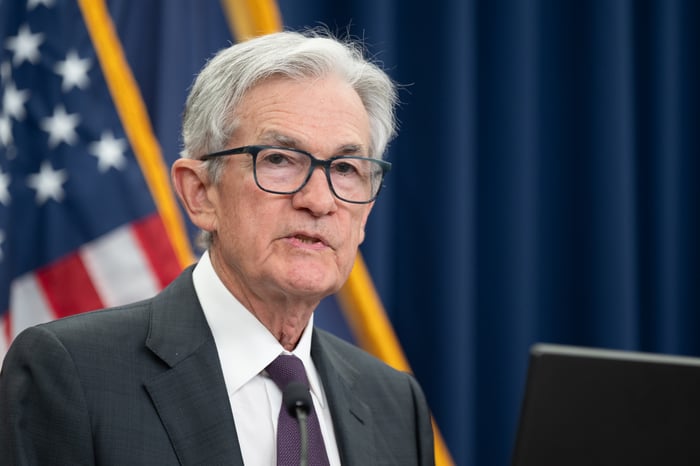
Jerome Powell's term as Fed chair ends in less than two months. Image source: Official Federal Reserve Photo.
Wall Street's foremost financial institution can abruptly halt the Trump bull market
However, the Trump bull market has been wavering in recent weeks. As of the closing bell on March 13, the S&P 500, Dow Jones Industrial Average, and Nasdaq Composite were approximately 5%, 7%, and 8% below their record-closing highs.
A historically pricey stock market appears to be teetering, and America's foremost financial institution, the Fed, may be the trigger that sends it over the edge. Specifically, there are four Fed catalysts converging into a perfect storm.
It begins with a high degree of division within the Federal Open Market Committee (FOMC), the 12-person body, including Fed Chair Jerome Powell, that's responsible for setting our nation's monetary policy. The FOMC decides if the federal funds target rate (the overnight lending rate between financial institutions) should be raised, lowered, or kept the same. It's this rate that ultimately determines whether interest rates rise or fall.
Investors are generally happy if the FOMC is on the same page. In other words, if there are no dissents when voting, all 12 members share a common monetary policy vision. Even if this vision results in the FOMC being late with its monetary policy actions, investors are satisfied.
Anna is correct below when she says:
-- Jim Bianco (@biancoresearch) September 17, 2025
"I have not seen a meeting with so much contradictions."
---
This meeting was a mess.
See the labels in the dot plot below.
One member of the FOMC thinks the Fed is going to HIKE rates this year. One (Stephen Miran) thinks it is going to cut... https://t.co/TRUQmD5I2E pic.twitter.com/qPlJGL57ln
Since July 2025 (through last weekend), all five FOMC meetings have featured at least one dissent. Worse yet, the October and December meetings had dissents in opposite directions, with one member pushing for a more aggressive rate cut and at least one other preferring no reduction in the federal funds target rate. Dissents in opposite directions are exceptionally rare and demonstrate how fractured opinion currently is at the FOMC.
Secondly, Powell's term as Fed chair ends on May 15. While the ending of his term has been telegraphed for some time, it nevertheless introduces an element of uncertainty into a variable (the Fed) that's usually viewed as a bedrock of stability for Wall Street.
President Trump's nominee to replace Powell as Fed chair, Kevin Warsh, is the third of four catalysts that can upend the Trump bull market. Though Warsh previously served on the FOMC for a shade over five years (Feb. 24, 2006 – March 31, 2011), his prior track record and commentary suggest there may be negative repercussions to his potential appointment.
"If Trump wants someone easy on inflation, he got the wrong guy in Kevin Warsh."@AnnaEconomist pic.twitter.com/FGMfeSqHpU
-- Daily Chartbook (@dailychartbook) January 31, 2026
While Warsh was one of the 12 voting members of the FOMC who helped the U.S. economy navigate the financial crisis, he was a decisive hawk. Despite rising unemployment, Warsh's focus was almost exclusively on the potential for inflation and keeping interest rates elevated to avoid higher prices. Whereas some consumers might appreciate this approach, an expensive stock market that's counting on lower interest rates in 2026 will not.
Furthermore, Kevin Warsh has been critical of the Fed's bloated balance sheet, which expanded from less than $900 billion in August 2008 to nearly $9 trillion by April 2022. Even though the nation's central bank has reduced its holdings to approximately $6.65 trillion (as of March 11, 2026), Warsh would like to see this meaningfully pared down.
The problem is that selling U.S. Treasury bonds and mortgage-backed securities would likely drive down the price for bonds and increase yields (bond prices and yields are inversely related). Warsh's desire to make the Fed a passive market participant could lead to higher borrowing rates, including mortgage rates.
The quadruple whammy for the Trump bull market is the Federal Reserve's expected response to soaring oil prices in the wake of the Iran war. Though the Fed has been in a rate-easing cycle since September 2024, the Core Personal Consumption Index (PCE) -- arguably the favorite tool used by the FOMC when making interest rate decisions -- hit a nearly two-year high in February of 3.1%.
The Fed's preferred measure of inflation (Core PCE) moved up to 3.1% in January, the highest level in 22 months. That was the 59th consecutive reading above the Fed's 2% target level. There will be no Fed rate cut next week and one could make a strong case for a rate hike. pic.twitter.com/s3GcBZvceD
-- Charlie Bilello (@charliebilello) March 13, 2026
There's a high probability that the prevailing inflation rate will rise notably in the coming months due to soaring oil prices. When compounded with a nearly two-year high for the core PCE, the table is set for the FOMC to stamp out any hope of rate cuts in 2026 and possibly even hint at rate hikes before the end of the year.
This confluence of factors from the Fed will likely be enough to tip the Trump bull market over the edge.
Should you buy stock in S&P 500 Index right now?
Before you buy stock in S&P 500 Index, consider this:
The Motley Fool Stock Advisor analyst team just identified what they believe are the 10 best stocks for investors to buy now… and S&P 500 Index wasn’t one of them. The 10 stocks that made the cut could produce monster returns in the coming years.
Consider when Netflix made this list on December 17, 2004... if you invested $1,000 at the time of our recommendation, you’d have $495,179!* Or when Nvidia made this list on April 15, 2005... if you invested $1,000 at the time of our recommendation, you’d have $1,058,743!*
Now, it’s worth noting Stock Advisor’s total average return is 898% — a market-crushing outperformance compared to 183% for the S&P 500. Don't miss the latest top 10 list, available with Stock Advisor, and join an investing community built by individual investors for individual investors.
See the 10 stocks »
*Stock Advisor returns as of March 22, 2026.
Sean Williams has no position in any of the stocks mentioned. The Motley Fool has no position in any of the stocks mentioned. The Motley Fool has a disclosure policy.
Recommended Articles


