


Look Beyond Soaring Oil Prices! If a Stock Market Crash Takes Shape Under President Donald Trump, These 2 Catalysts Are Likely to Cause It.
Key Points
Statistically, the Dow Jones Industrial Average, S&P 500, and Nasdaq Composite have rallied more with Donald Trump in the White House than under most other presidents.
Though a historic level of energy supply chain disruption has increased prices at the gas pump, soaring oil prices aren't Wall Street's biggest issue.
The historical priciness of equities, coupled with the potential for Federal Reserve turmoil, is a possible recipe for a stock market crash.
- 10 stocks we like better than S&P 500 Index ›
Statistics don't lie: the stock market has excelled with Donald Trump in the White House.
Although the benchmark S&P 500 (SNPINDEX: ^GSPC) or iconic Dow Jones Industrial Average (DJINDICES: ^DJI) have risen in 26 of the last 33 presidential terms, dating back to the late 1890s, the gains observed during President Trump's first term were among the best of any president. The Dow, S&P 500, and Nasdaq Composite (NASDAQINDEX: ^IXIC) soared 57%, 70%, and 142%, respectively, in his first term.
Will AI create the world's first trillionaire? Our team just released a report on the one little-known company, called an "Indispensable Monopoly" providing the critical technology Nvidia and Intel both need. Continue »
But history teaches us that no bull market lasts forever, and that when things seem too good to be true on Wall Street, they often are.
Headwinds have been mounting in recent weeks for the stock market, with sharply rising oil prices taking center stage. Military actions by the U.S. and Israel against Iran have led to the partial closure of the Strait of Hormuz and a historic level of energy supply chain disruption. Approximately 20% of the world's daily liquid petroleum needs pass through the Strait of Hormuz.
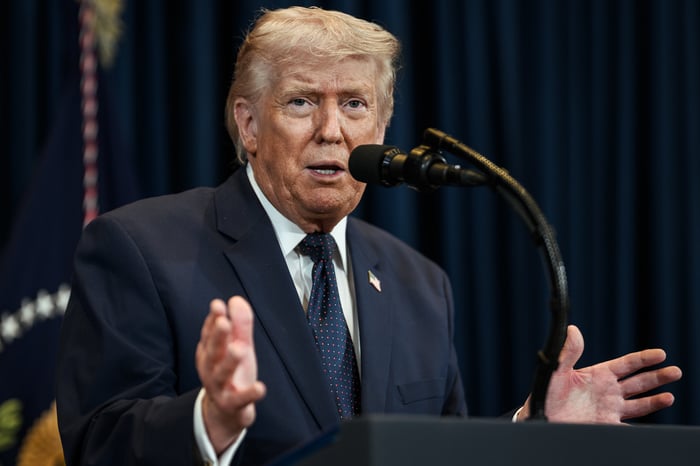
President Trump delivering remarks. Image source: Official White House Photo by Daniel Torok.
However, sticker shock at the gas pump isn't the biggest concern for Wall Street. If a stock market crash were to take shape under President Trump, two well-established catalysts are more likely to be the cause.
History doesn't mince words when it comes to a historically pricey stock market
To preface the following discussion, the past can't concretely predict the future. If a data point or correlated event existed that could always forecast short-term directional moves for the Dow Jones Industrial Average, S&P 500, and Nasdaq Composite, every investor would be using it.
Nonetheless, select data points and/or events that have strongly correlated with directional moves in Wall Street's major stock indexes are of interest.
Arguably, no variable has been cautioning of a sizable downturn in equities, if not an outright crash, than equity valuations.
While the process of valuing a stock or the broader market is going to differ from one investor to the next, the S&P 500's Shiller Price-to-Earnings (P/E) Ratio is ideal at cutting through this subjectivity. You'll also find the Shiller P/E referred to as the Cyclically Adjusted P/E Ratio (CAPE Ratio).
The beauty of the Shiller P/E is that it's based on average inflation-adjusted earnings over the trailing decade. Accounting for 10 years of earnings history minimizes the impact of recessions and shock events and ensures this valuation tool is useful across all scenarios.
S&P 500 Shiller PE Ratio hits 2nd highest level in history 🚨 The highest was the Dot Com Bubble 🤯 pic.twitter.com/Lx634H7xKa
-- Barchart (@Barchart) December 28, 2025
Though economists first introduced the CAPE Ratio in the late 1980s, it's been back-tested over 155 years to January 1871. Over this timeline, it's averaged 17.35. But for the majority of the last five months, it's bounced between 39 and 41, representing the second-priciest stock market in history.
Since 1871, the Shiller P/E has exceeded 30 on six occasions during a continuous bull market, including the present. The five prior occurrences resulted in the Dow, S&P 500, and/or Nasdaq Composite losing at least 20% of their value, and in some cases significantly more.
The CAPE Ratio has only hit 40 on three occasions, including the present. After peaking at 44.19 in December 1999, the S&P 500 and Nasdaq Composite plunged 49% and 78%, respectively, when the dot-com bubble burst. Meanwhile, a Shiller P/E of just above 40 in early January 2022 gave way to a bear market that ultimately stripped the S&P 500 of a quarter of its value.
The lone quirk with the Shiller P/E is that it doesn't tell investors when these declines will begin. However, it does have a flawless track record of foreshadowing significant declines when back-tested to 1871. The key point being that premium valuations aren't sustainable over an extended timeline.
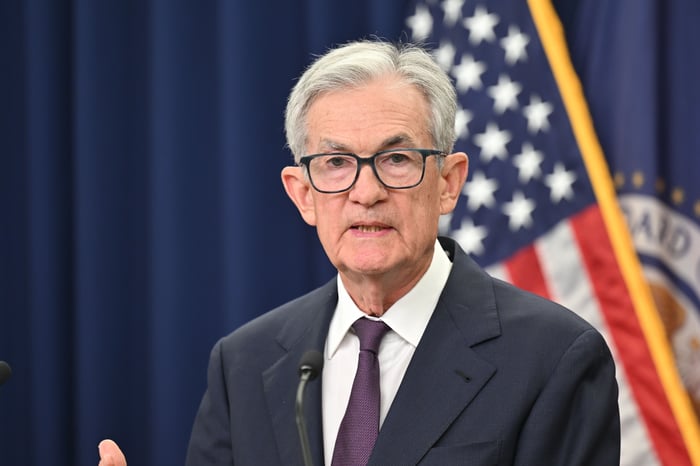
Jerome Powell's term as Fed chair ends on May 15. Image source: Official Federal Reserve Photo.
Federal Reserve turmoil can upend a Trump-fueled bull market
But a historically pricey stock market isn't the only catalyst that's threatening to pull the rug out from beneath this bull market rally. There's a real possibility that one of Wall Street's pillars, the Federal Reserve, can upend years of investor optimism.
Usually, the Fed is Wall Street's bedrock. It's the passive entity in the background that calms investors and ensures them that economic calamity isn't on the doorstep. But since the midpoint of 2025, America's foremost financial institution has turned into something of a liability for the stock market.
The first issue pertains to a historic level of division within the Federal Open Market Committee (FOMC): the 12-person body, including Fed Chair Jerome Powell, responsible for monetary policy decisions.
Powell has enjoyed the lowest dissent rate in FOMC voting of any Fed chair since 1978. That's excellent news for Wall Street, because investors have historically placed more emphasis on FOMC members being on the same page than being right or wrong with their monetary policy decisions. But since July 2025, each FOMC meeting has featured at least one dissenting opinion.
Anna is correct below when she says:
-- Jim Bianco (@biancoresearch) September 17, 2025
"I have not seen a meeting with so much contradictions."
---
This meeting was a mess.
See the labels in the dot plot below.
One member of the FOMC thinks the Fed is going to HIKE rates this year. One (Stephen Miran) thinks it is going to cut... https://t.co/TRUQmD5I2E pic.twitter.com/qPlJGL57ln
What's more, the October and December meetings had dissents in opposite directions (at least one member favored no rate cut, while another pushed for a more aggressive reduction). Opposite dissents are incredibly rare, with only three on record since 1990 -- two of which have occurred since late October 2025.
While discussion among FOMC members is healthy, persistent dissents signal a lack of a common vision, which can cost the Fed its credibility.
Potentially amplifying this historic division is the reality that Powell's term as Fed chair ends on May 15. President Trump's nominee to replace him, Kevin Warsh, would bring prior experience to the job, as well as potential unintended consequences.
Warsh was on the FOMC from Feb. 24, 2026, through March 31, 2011. While helping navigate the U.S. economy through the financial crisis, Warsh earned the label of "hawk." Put simply, he valued price stability over employment maximization and consistently focused on keeping interest rates higher to curb inflation. His voting record suggests he's not the dovish answer President Trump is looking for to push for lower interest rates.
"If Trump wants someone easy on inflation, he got the wrong guy in Kevin Warsh."@AnnaEconomist pic.twitter.com/FGMfeSqHpU
-- Daily Chartbook (@dailychartbook) January 31, 2026
Furthermore, Warsh has argued that the central bank should deleverage its $6.65 trillion balance sheet, primarily composed of U.S. Treasury bonds and mortgage-backed securities. Since bond prices and bond yields are inversely related, paring down the Fed's balance sheet and selling bonds would be expected to raise yields, and thereby boost borrowing costs.
A historically expensive stock market is counting on lower interest rates and a stable Fed. Kevin Warsh's appointment may lead to higher rates and the continuation of historic FOMC division.
Should you buy stock in S&P 500 Index right now?
Before you buy stock in S&P 500 Index, consider this:
The Motley Fool Stock Advisor analyst team just identified what they believe are the 10 best stocks for investors to buy now… and S&P 500 Index wasn’t one of them. The 10 stocks that made the cut could produce monster returns in the coming years.
Consider when Netflix made this list on December 17, 2004... if you invested $1,000 at the time of our recommendation, you’d have $494,747!* Or when Nvidia made this list on April 15, 2005... if you invested $1,000 at the time of our recommendation, you’d have $1,094,668!*
Now, it’s worth noting Stock Advisor’s total average return is 911% — a market-crushing outperformance compared to 186% for the S&P 500. Don't miss the latest top 10 list, available with Stock Advisor, and join an investing community built by individual investors for individual investors.
See the 10 stocks »
*Stock Advisor returns as of March 21, 2026.
Sean Williams has no position in any of the stocks mentioned. The Motley Fool has no position in any of the stocks mentioned. The Motley Fool has a disclosure policy.
Recommended Articles


