


Carvana Stock: Down About 35% in 2026, Is It Finally Time to Buy?
Key Points
Carvana's fourth-quarter 2025 revenue surged 58% year over year to $5.6 billion.
A massive, one-time tax benefit boosted net income, signaling management's confidence in long-term profitability.
The stock's extreme historical volatility and premium valuation combine to create a risky -- but potentially still attractive -- setup.
- 10 stocks we like better than Carvana ›
Shares of online used-car retailer Carvana (NYSE: CVNA) have experienced a brutal start to 2026. After logging astronomical gains over the past three years as it pulled itself back from the brink of financial collapse, the growth stock is down about 35% year to date as of this writing.
The steep drop comes as many high-flying growth stocks take a breather amid geopolitical conflict and uncertainty over artificial intelligence (AI).
Will AI create the world's first trillionaire? Our team just released a report on the one little-known company, called an "Indispensable Monopoly" providing the critical technology Nvidia and Intel both need. Continue »
But looking at Carvana's most recent earnings report, the underlying business is actually putting up extraordinary numbers.
So, why did shares fall despite the company reporting record results?
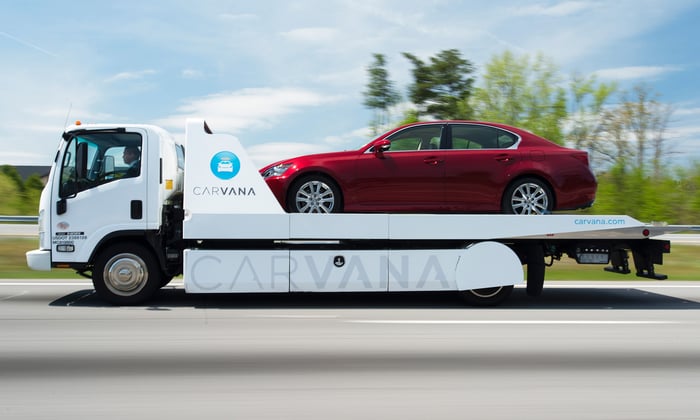
Image source: Carvana.
Rapid growth and a hidden profit signal
Highlighting the e-commerce auto platform's robust underlying momentum, Carvana's fourth-quarter revenue surged 58% year over year to $5.6 billion. The top-line acceleration was driven by a 43% year-over-year jump in retail units sold, which reached more than 163,000 for the period.
And the full-year picture is just as impressive. For the entirety of 2025, Carvana sold nearly 600,000 retail units, generating a record $20.3 billion in revenue -- a 49% increase from 2024.
"Achieving all of this at once is rare," noted Carvana founder and CEO Ernie Garcia in the company's fourth-quarter earnings release, "and speaks to the powerful positive feedback our model generates as we grow."
But the most telling signal of Carvana's financial health was an unusual item buried in the company's net income. The used-car dealer reported fourth-quarter net income of $951 million, which was positively impacted by a roughly $685 million non-cash benefit associated with the release of its valuation allowance against deferred tax assets.
What does this mean? It arguably represents a vote of confidence from management. When a company loses money for an extended period, it accumulates deferred tax assets that can reduce future tax obligations. But accounting rules require a "valuation allowance" if management believes it is unlikely the company will ever generate enough profit to use those assets. Releasing this allowance, therefore, means Carvana now believes it will be profitable enough to utilize these tax assets going forward.
Margin pressure and a demanding valuation
Of course, there is a reason some investors have hit the brakes. While Carvana's growth is accelerating, its profitability metrics recently showed some sequential weakness.
Carvana's fourth-quarter adjusted earnings before interest, taxes, depreciation, and amortization (EBITDA) came in at $511 million. While this was a significant improvement from the year-ago period, when adjusted EBITDA was $359 million, the company's adjusted EBITDA margin narrowed to 9.1% from the 11.3% it posted in the third quarter of 2025 and the 10.1% it posted in the year-ago quarter.
And another thing potentially holding some investors back from getting bullish on the stock recently is its valuation. Even after dropping about 35% this year, Carvana shares still command a steep premium. As of this writing, the stock's price-to-earnings ratio is 33.
With a valuation like this, investors are assuming Carvana can continue to grow rapidly with minimal profit margin erosion over time. Additionally, this valuation leaves very little room for a scenario in which consumer demand unexpectedly softens -- perhaps due to a sudden deterioration in the macroeconomic environment.
Still, given the company's extraordinary growth, the stock arguably deserves a high valuation. So, for investors willing to embrace these risks, is now a good time to buy?
I think starting a small position here could make sense. The company has proven its critics wrong, demonstrating that its vertically integrated, online-first model can generate real cash and scale efficiently.
That said, this is arguably a high-risk stock that has historically traded with extreme volatility. And the used-car market remains highly sensitive to interest rates. Additionally, the company still carries a meaningful debt load. For these reasons, investors who want to buy into this remarkable turnaround story should consider keeping any position in the stock small.
Should you buy stock in Carvana right now?
Before you buy stock in Carvana, consider this:
The Motley Fool Stock Advisor analyst team just identified what they believe are the 10 best stocks for investors to buy now… and Carvana wasn’t one of them. The 10 stocks that made the cut could produce monster returns in the coming years.
Consider when Netflix made this list on December 17, 2004... if you invested $1,000 at the time of our recommendation, you’d have $510,710!* Or when Nvidia made this list on April 15, 2005... if you invested $1,000 at the time of our recommendation, you’d have $1,105,949!*
Now, it’s worth noting Stock Advisor’s total average return is 927% — a market-crushing outperformance compared to 186% for the S&P 500. Don't miss the latest top 10 list, available with Stock Advisor, and join an investing community built by individual investors for individual investors.
See the 10 stocks »
*Stock Advisor returns as of March 19, 2026.
Daniel Sparks and his clients have no position in any of the stocks mentioned. The Motley Fool has no position in any of the stocks mentioned. The Motley Fool has a disclosure policy.
Recommended Articles


