


The Federal Reserve Has Become a Stock Market Liability, and President Trump's New Nominee for Chair Won't Help
Key Points
The Federal Reserve's interest rate policy decisions are getting more difficult to predict as dissent at the FOMC grows.
Chair nominee Kevin Warsh has clear policy goals in mind.
Those policies would negatively affect some stocks while positioning others to outperform.
- 10 stocks we like better than S&P 500 Index ›
Warren Buffett once wrote about interest rates: "These act on financial valuations the way gravity acts on matter." In other words, how much a stock is worth is directly affected by the risk-free rate investors can receive in the bond market. If they can get a higher risk-free return from U.S. Treasuries, investors aren't going to pay as much for a company's potential, and far from guaranteed, earnings.
That's why the Federal Reserve has garnered so much attention over the past few years. The Fed raised rates as inflation soared in 2022 and 2023, and now it's cutting rates to try to maintain high employment. In the meantime, valuations for many stocks have climbed higher. The S&P 500 (SNPINDEX: ^GSPC) trades for a forward price-to-earnings (P/E) of about 21, well above its long-term average in the high-teens. The tech-heavy Nasdaq Composite (NASDAQINDEX: ^IXIC) is even more expensive, as it's home to more growth stocks.
Will AI create the world's first trillionaire? Our team just released a report on the one little-known company, called an "Indispensable Monopoly" providing the critical technology Nvidia and Intel both need. Continue »
Valuations have had support as investors have been able to predict how the Federal Open Market Committee (FOMC) will adjust interest rates, with expectations for further cuts in 2026. But recent developments are shaking that certainty, and the Federal Reserve may be turning into a liability to the stock market.
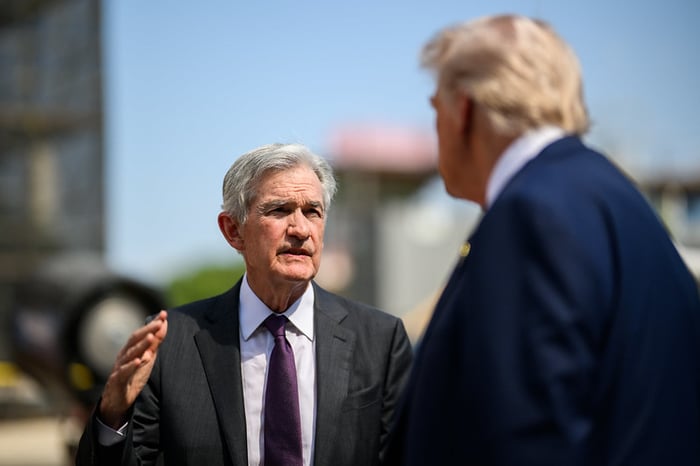
Image source: Official White House Photo by Daniel Torok.
Strong divisions in the FOMC
The Federal Open Market Committee is the body that adjusts the short-term federal funds target interest rate. It consists of 12 members: The Fed Chair and the board of governors, the president of the New York Fed, and four of the remaining 11 Reserve Bank presidents on a rotating basis. The chair, currently Jerome Powell, often gets a lot of attention, but each member has an equal say in the Fed's interest rate policies.
While investors might not like exactly how the committee uses its various tools to influence interest rates, the unified force of 12 high-level economists all agreeing provides some confidence in the Fed's actions. Occasionally, however, the FOMC experiences growing dissent among its members, which increases market uncertainty. The last five FOMC meetings have all seen at least one dissenting vote.
Dissent has come from both sides. At the December meeting, the FOMC saw three dissenting votes: Stephen Miran voted for a larger rate cut than enacted, while Austan Goolsbee and Jeff Schmid voted for no cut. The January meeting saw Miran joined by Christopher Waller in favor of further rate cuts, while the rest of the committee voted to keep rates as they were. Prediction markets expect two dissenting votes at the March meeting as well.
What's more, many FOMC members are offering so-called "soft dissents." They vote with the majority but signal opposition by submitting economic projections that point to a different path for interest rates. There's potential for those soft dissents to turn into votes against the consensus as time goes on, increasing the growing uncertainty in the Fed's future actions.
Will President Trump's nominee unite the committee?
Earlier this month, President Donald Trump officially nominated Kevin Warsh to serve as chair of the Board of Governors of the Federal Reserve. Warsh previously served at the central bank from 2006 to 2011. Warsh notably spoke out against interest rate cuts during the financial crisis, as he feared their effect on inflation.
Now, however, he's changed his tune on rate cuts, winning Trump's favor. Warsh believes the administration's tariff policies will not lead to persistent inflation. He wants to reduce the Fed's bond holdings, currently worth about $6 trillion, which he says would allow the FOMC to cut rates without affecting inflation. Mainstream economists disagree with that view, though, and it's not much of a stretch to expect some disagreement from some FOMC members.
More importantly, investors should consider what would happen if Warsh's sway over the Fed pushes its policies in the direction he favors. A lower Fed Funds target rate would lower short-term interest rates. However, selling off the bonds on the Fed's balance sheet would lead to higher long-term interest rates, including 10-year and 30-year Treasuries and mortgage-backed securities.
That's going to have a few important effects on the stock market.
First, consumers will face higher borrowing costs for big purchases like cars and homes. That reduces retail investor participation, removing significant capital from the markets.
Second, higher long-term interest rates on risk-free assets like Treasury notes should reduce earnings multiples for stocks, especially growth stocks, which are valued more on their potential earnings in the distant future.
On the other hand, some stocks could outperform if Warsh's ideal policies are implemented. Smaller companies can benefit from lower short-term borrowing costs, as they often use floating-rate debt rather than long-term bond issues to finance growth. So, the environment would especially favor small-cap value stocks.
If Warsh brings more dissent into the FOMC meetings, however, it could lead to growing uncertainty about how the committee will vote in the future. If there's one thing investors dislike, it's uncertainty. The Federal Reserve has become a liability to the high valuations in the stock market today. That could lead to a further rotation into safer assets, and multiple compression among growth stocks.
Should you buy stock in S&P 500 Index right now?
Before you buy stock in S&P 500 Index, consider this:
The Motley Fool Stock Advisor analyst team just identified what they believe are the 10 best stocks for investors to buy now… and S&P 500 Index wasn’t one of them. The 10 stocks that made the cut could produce monster returns in the coming years.
Consider when Netflix made this list on December 17, 2004... if you invested $1,000 at the time of our recommendation, you’d have $514,000!* Or when Nvidia made this list on April 15, 2005... if you invested $1,000 at the time of our recommendation, you’d have $1,105,029!*
Now, it’s worth noting Stock Advisor’s total average return is 930% — a market-crushing outperformance compared to 187% for the S&P 500. Don't miss the latest top 10 list, available with Stock Advisor, and join an investing community built by individual investors for individual investors.
See the 10 stocks »
*Stock Advisor returns as of March 16, 2026.
Adam Levy has no position in any of the stocks mentioned. The Motley Fool has no position in any of the stocks mentioned. The Motley Fool has a disclosure policy.
Recommended Articles


