


What a Potential Strategic Petroleum Release Could Mean for Oil Prices
Key Points
With U.S. gasoline prices spiking, calls are growing for President Trump to tap the nation's Strategic Petroleum Reserve.
The SPR has only been tapped four times since its creation in 1975.
The effect of a release on gas prices is probably limited to single-digit percentages.
- 10 stocks we like better than S&P 500 Index ›
With oil prices surpassing $100 a barrel and U.S. gas prices surging as a result of the war, the Strategic Petroleum Reserve (SPR) once again found itself in the spotlight as politicians began calling on the president to tap into the nation's oil reserves to increase supply and ease prices at the pump for inflation-weary consumers.
And on March 1, 2022, President Joe Biden obliged, announcing he would release 30 million barrels of crude oil from the SPR to counteract the surge in prices caused by Russia's invasion of Ukraine. On March 31, he went on to announce the additional tapping of 180 million barrels: 1 million per day for six months starting in May 2022.
Will AI create the world's first trillionaire? Our team just released a report on the one little-known company, called an "Indispensable Monopoly" providing the critical technology Nvidia and Intel both need. Continue »

Image source: Getty Images.
The same scenario is playing out today as the war in Iran disrupts oil shipments from the Middle East, resulting in a sharp spike in global oil and gasoline prices and a drop in the S&P 500. And just like in 2022, opposition politicians -- this time led by Senate Minority Leader Chuck Schumer -- have begun their calls for President Donald Trump to tap the SPR to provide relief from the high gas prices that are "already hitting families in their wallets," according to Schumer.
While the International Energy Agency announced Wednesday that its members, which include the U.S., would release a record 400 million barrels to address supply disruption, President Trump has seemed cool to the idea, and it's unclear how much the U.S. has committed to this effort. There's also the fact that the SPR was only partially replenished after the last drawdown, as both the Biden and the Trump administrations were waiting for better prices before restocking it. The SPR currently sits at about 415 million barrels (but has a capacity of 714 million barrels).
How would a potential SPR release actually affect oil prices?
A drop in the barrel
Schumer described a release from the SPR as a tool "so many other presidents have used to lower prices at the pump," but besides Biden's 2022 release, it's actually only occurred three other times since the SPR was created in 1975: in 2011 during the Arab Spring uprisings, in 2005 after Hurricane Katrina, and in 1991 during Operation Desert Storm in Kuwait.
The thing is, even the 400 million barrel release from the IEA wouldn't last long. Global oil consumption is estimated at over 100 million barrels per day. As of 2023, U.S. oil consumption was estimated at 20.3 million barrels per day. Biden's 1 million barrels per day would have increased U.S. crude supply by about 5%, while reducing the SPR's stockpile by a total of 210 million barrels -- which, of course, would eventually have to be repurchased, presumably at lower prices.
That oil also can't be released all at once: it would gradually be moved onto the global market, likely in a similar manner to Biden's 1 million barrels per day.
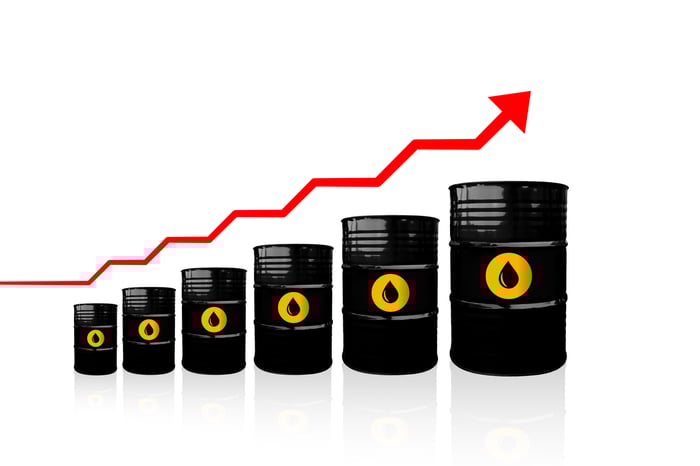
Image source: Getty Images.
The U.S. Treasury Department released a report in July 2022 suggesting that Biden's releases lowered the price of gasoline by somewhere between $0.17 and $0.42 a gallon, which would have been between about 3% and 11%, considering the average U.S. gas price ranged from about $3.80 to $5.10 a gallon during that time. However, consumers may not have noticed the impact, since crude oil and U.S. gasoline prices rose throughout May and into June 2022 before beginning a steady decline.
The average U.S. gas price currently sits at $3.48 a gallon. A 3% to 11% decrease would lower it to between $3.10 and $3.38. That would certainly bring some relief to consumers, but probably not as much as they, or the politicians representing them, would hope.
Should you buy stock in S&P 500 Index right now?
Before you buy stock in S&P 500 Index, consider this:
The Motley Fool Stock Advisor analyst team just identified what they believe are the 10 best stocks for investors to buy now… and S&P 500 Index wasn’t one of them. The 10 stocks that made the cut could produce monster returns in the coming years.
Consider when Netflix made this list on December 17, 2004... if you invested $1,000 at the time of our recommendation, you’d have $511,735!* Or when Nvidia made this list on April 15, 2005... if you invested $1,000 at the time of our recommendation, you’d have $1,140,464!*
Now, it’s worth noting Stock Advisor’s total average return is 946% — a market-crushing outperformance compared to 191% for the S&P 500. Don't miss the latest top 10 list, available with Stock Advisor, and join an investing community built by individual investors for individual investors.
See the 10 stocks »
*Stock Advisor returns as of March 13, 2026.
John Bromels has no position in any of the stocks mentioned. The Motley Fool has no position in any of the stocks mentioned. The Motley Fool has a disclosure policy.
Recommended Articles


