


This Is How Much Berkshire Hathaway Made From Coca-Cola and American Express Dividends in 2025 Alone
Key Points
Berkshire's stakes in both Coca-Cola and American Express have compounded their share prices and dividends over 30-plus years of ownership.
As Coca-Cola and American Express raise their dividends, the cost-basis yield on Berkshire Hathaway's investment keeps getting higher.
- 10 stocks we like better than Coca-Cola ›
Coca-Cola (NYSE: KO) and American Express (NYSE: AXP) are the two longest-held positions in the Berkshire Hathaway (NYSE: BRKA)(NYSE: BRKB) equity portfolio. It has owned each of these stocks for nearly 40 years, and Warren Buffett said he'd never sell them while he was CEO. Although Buffett handed over the reins to Greg Abel this year, Abel reassured investors that he's not planning to veer from Buffett's path as he takes over.
In Abel's first shareholder letter as CEO, he gave several important updates, including the dividend income from some of the company's favorite stocks. The numbers might blow your mind, and it will certainly help you understand why dividend stocks can be so valuable to a diversified portfolio.
Will AI create the world's first trillionaire? Our team just released a report on the one little-known company, called an "Indispensable Monopoly" providing the critical technology Nvidia and Intel both need. Continue »
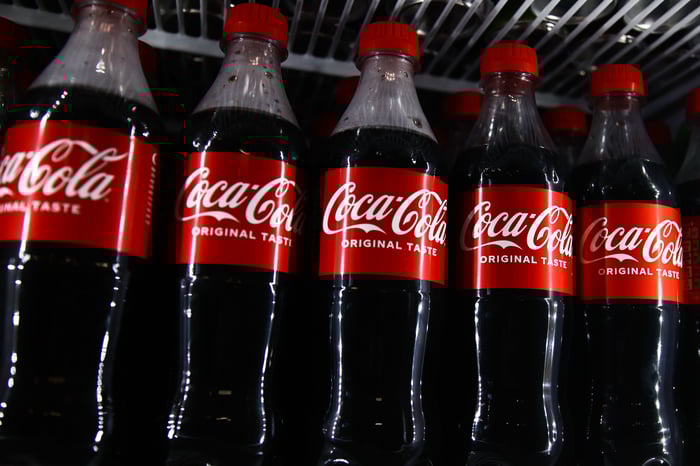
Image source: Getty Images.
Dividend yield and growth
Berkshire Hathaway first bought American Express stock back in 1964 and Coca-Cola in 1988. Since then, the company has built up its positions, especially between 1994 and 1995 when it spent about $1.3 billion on each one. Today, Berkshire's overall positions are worth $28 billion and $56 billion, respectively. Those are strong results over 30-plus years.
Both stocks have performed well, however, it's the annual dividends that make these investments incredibly lucrative. In 2025 alone, Berkshire Hathaway made $816 million in dividends from Coca-Cola stock and $479 million from American Express stock. That's in one year alone, and it keeps growing annually as the dividend is raised.
Consider that total when factoring in the cost basis of the stock: While Coca-Cola's dividend yields 2.6% at today's price, Berkshire Hathaway's yield is based on the cost at the time of purchase. The current annual dividend is $2.12 per share, and Berkshire Hathaway's cost basis per share (on its 400 million-plus shares) is $3.25 per share. That works out to a 65% cost-basis yield. With a few more years of dividend increases, Berkshire's annual dividend proceeds could exceed its entire cost basis for the stock.
It's a similar story for American Express. Berkshire owns 151 million shares, so the total cost per share is $8.60. The annual dividend is $3.80, which means its yield on cost is 44%.
This dividend income adds a lot to the holding company, since management can use it for many different purposes, including acquiring new businesses and general operations.
Not just Coca-Cola and American Express
Abel included Apple and Moody's as the other two examples of highly concentrated stocks in the portfolio. Apple's yield isn't anything special, since it has a low dividend to begin with, and Berkshire Hathaway has sold off about half of its total position over the past few years. But its cost-basis yield on Moody's stock is a powerful 42%.
Abel described these four companies as "businesses we understand well, have a high regard for their leaders, and expect will compound over decades."
Part of that compounding is dividend income, which over time may amount to more than you realize. When considering a dividend stock, look beyond the yield to growth and reliability. Coca-Cola is the classic Dividend King, having raised its dividend annually for the past 63 years. Seeing how that plays out in Berkshire Hathaway's portfolio gives you a sense of why that's so important for investors.
Should you buy stock in Coca-Cola right now?
Before you buy stock in Coca-Cola, consider this:
The Motley Fool Stock Advisor analyst team just identified what they believe are the 10 best stocks for investors to buy now… and Coca-Cola wasn’t one of them. The 10 stocks that made the cut could produce monster returns in the coming years.
Consider when Netflix made this list on December 17, 2004... if you invested $1,000 at the time of our recommendation, you’d have $534,008!* Or when Nvidia made this list on April 15, 2005... if you invested $1,000 at the time of our recommendation, you’d have $1,090,073!*
Now, it’s worth noting Stock Advisor’s total average return is 949% — a market-crushing outperformance compared to 190% for the S&P 500. Don't miss the latest top 10 list, available with Stock Advisor, and join an investing community built by individual investors for individual investors.
See the 10 stocks »
*Stock Advisor returns as of March 10, 2026.
American Express is an advertising partner of Motley Fool Money. Jennifer Saibil has positions in American Express and Apple. The Motley Fool has positions in and recommends Apple, Berkshire Hathaway, and Moody's. The Motley Fool has a disclosure policy.
Recommended Articles


