


Private Credit Is Showing Cracks. Why Index ETF Investors May Be Better Positioned Than They Think
Key Points
Bubbles tend to be fueled by credit, so when credit strains start to show up, it can be a big problem.
Investors who focus on the long term have tended to build financial wealth despite near-term volatility.
- 10 stocks we like better than SPDR S&P 500 ETF Trust ›
Blue Owl Capital (NYSE: OWL) shocked Wall Street in February when it limited redemptions from one of its private debt funds. That comes on top of the failure of private credit backed auto parts maker First Brands Group in late 2025. And more recently, concerns about AI disrupting the software sector has been top of mind, as many software companies are funded in the private credit markets.
Should you run for the hills if you have a diversified portfolio of index exchange-traded funds? No, and here's why.
Will AI create the world's first trillionaire? Our team just released a report on the one little-known company, called an "Indispensable Monopoly" providing the critical technology Nvidia and Intel both need. Continue »
Private credit risks are very real
One interesting aspect of Blue Owl Capital's troubles is that it sold $1.4 billion in investments and is returning capital to investors. However, it is a broad, structured plan put in place by Blue Owl and not one driven by the investors in Blue Owl's investment funds. There are legitimate concerns that Blue Owl sold its best investments, leaving behind undesirable loans.

Image source: Getty Images.
If Blue Owl's predicament is the canary in the coal mine, the entire private credit sector could be in for trouble. That would fit the traditional pattern of market bubbles, which are usually inflated by easy access to credit. Bubbles usually pop when it turns out that the businesses that raised capital aren't actually worthwhile investments.
Don't get caught up in the fear if you have a well-thought-out and diversified ETF portfolio. Stick to your long-term approach.
Slow and steady wins the race
As a simple example, an investment in SPDR S&P 500 ETF (NYSEMKT: SPY), the first ETF ever created, has trended steadily higher over time. And it has done so despite the dot-com bubble, the Great Recession, and a global pandemic. If you look further back to the performance of the S&P before ETFs existed, you'll see the same steady upward climb over time.
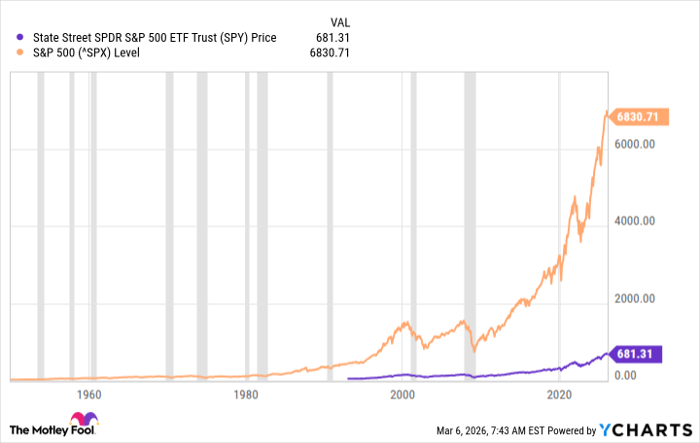
SPY data by YCharts
Downturns are difficult to live through, but they are a part of investing. If you stick with your broad-based index funds, history suggests you will make out just fine. In fact, downturns could even be viewed as a good time to add to your investment.
That said, an S&P 500 index (SNPINDEX: ^GSPC) ETF is a diversified stock portfolio, but it isn't a fully diversified investment portfolio. At the very least, you may want to consider adding a bond fund, such as Vanguard Total Bond Market ETF (NASDAQ: BND), to the mix. Bonds go up and down just like stocks, but they tend to provide more consistent returns over time. That provides valuable diversification and stability to your portfolio, helping you through the inevitable market downturns you'll face.
Stick to your ETF plan
History is clear: you shouldn't get caught up in near-term market gyrations. You should focus on the long-term. Broad-based index ETFs are an easy way to do just that. Don't give up on that plan because cracks are showing up today in private credit.
Should you buy stock in SPDR S&P 500 ETF Trust right now?
Before you buy stock in SPDR S&P 500 ETF Trust, consider this:
The Motley Fool Stock Advisor analyst team just identified what they believe are the 10 best stocks for investors to buy now… and SPDR S&P 500 ETF Trust wasn’t one of them. The 10 stocks that made the cut could produce monster returns in the coming years.
Consider when Netflix made this list on December 17, 2004... if you invested $1,000 at the time of our recommendation, you’d have $534,008!* Or when Nvidia made this list on April 15, 2005... if you invested $1,000 at the time of our recommendation, you’d have $1,090,073!*
Now, it’s worth noting Stock Advisor’s total average return is 949% — a market-crushing outperformance compared to 190% for the S&P 500. Don't miss the latest top 10 list, available with Stock Advisor, and join an investing community built by individual investors for individual investors.
See the 10 stocks »
*Stock Advisor returns as of March 10, 2026.
Reuben Gregg Brewer has no position in any of the stocks mentioned. The Motley Fool has positions in and recommends Vanguard Total Bond Market ETF. The Motley Fool has a disclosure policy.
Recommended Articles


