


Short-Term Shock or Long-Term Threat: Why the Duration of the Iran War Is the Only Market Question That Matters This Week
Key Points
The conflict in Iran has hurt markets, as oil prices have surged.
Iran has closed the Strait of Hormuz to U.S. and Israeli tankers, as well as their allies.
A prolonged conflict could hit the U.S. economy hard.
- These 10 stocks could mint the next wave of millionaires ›
While many market risks remain in the current conflict involving Iran, the U.S., and Israel, one thing is certainly clear: How long the conflict lasts remains the top question on investors' minds this week.

Image source: Getty Images.
Will AI create the world's first trillionaire? Our team just released a report on the one little-known company, called an "Indispensable Monopoly" providing the critical technology Nvidia and Intel both need. Continue »
The ongoing conflict, which has spread to other countries in the Middle East, has caused significant jitters in the market, particularly amid rising oil prices. Crude oil futures are close to $99 per barrel as of this writing, up a whopping 72% this year.
The war in Iran has certainly led to a sell-off in the stock market. However, it's been somewhat contained.
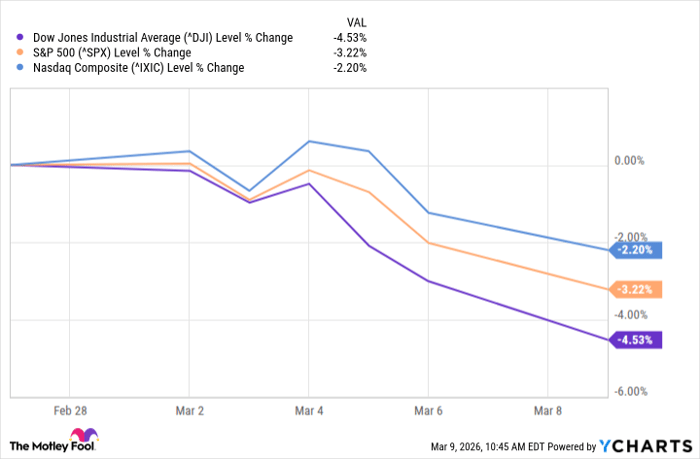
^DJI data by YCharts
As you can see above, the major indexes have all struggled, but I think most would agree it could be worse, given the instability in the Middle East and surging oil prices. Investors don't seem to think the conflict will be prolonged. However, if this consensus changes, things could get much worse.
A prolonged conflict could have big consequences for the broader market
The price of oil had fallen close to $55 per barrel earlier this year, and the outlook for oil in general was not positive heading into the year. However, everything changed once rumors began to circulate about the U.S. and Israel conducting airstrikes on Iran.
Once those officially happened, the Iranian government subsequently announced the closure of the Strait of Hormuz to ships from the U.S., Israel, and Western allies, and oil prices skyrocketed. The Strait of Hormuz is a key oil passage Iran controls and through which 20 million barrels of oil flow per day.
There have also been concerns that energy assets in the Middle East could be damaged, potentially impacting production. Higher oil prices essentially serve as a tax on consumers and can also raise the cost of doing business for corporations.
The U.S. is also currently worried about an incoming recession, after a dismal February jobs report that showed the economy lost 92,000 jobs last month, while the unemployment rate ticked up to 4.4%.
A slowing economy with higher oil prices that could meaningfully push up inflation is a bad combination, according to the prominent market strategist Ed Yardeni, who says the fears are likely to linger while the Strait of Hormuz remains closed to certain countries.
"Until then, the financial markets are likely to become increasingly concerned about a 1970s-style stagflation scenario; back then, the period of stagflation included two recessions," Yardeni said in a recent research note, according to MarketWatch.
Prior to the conflict in Iran, investors were already grappling with economic concerns, including stubborn inflation and the implications of artificial intelligence adoption.
If the conflict in Iran lasts only a few weeks, the market seems to think oil prices can at least retrace to much lower levels, if not back to where they were.
I think the situation is far too unclear for investors to have any real clarity about how things will unfold, so while investors can look for sell-offs that offer good opportunities, I would largely maintain a risk-off or conservative mindset for the time being.
Where to invest $1,000 right now
When our analyst team has a stock tip, it can pay to listen. After all, Stock Advisor’s total average return is 949%* — a market-crushing outperformance compared to 190% for the S&P 500.
They just revealed what they believe are the 10 best stocks for investors to buy right now, available when you join Stock Advisor.
See the stocks »
*Stock Advisor returns as of March 9, 2026.
Bram Berkowitz has no position in any of the stocks mentioned. The Motley Fool has no position in any of the stocks mentioned. The Motley Fool has a disclosure policy.
Recommended Articles


