


Warren Buffett Retired Having Not Purchased His Favorite Stock -- a Company He Spent $78 Billion Buying Over 6 Years -- in 19 Months
Key Points
Berkshire Hathaway's now-former billionaire boss was a net seller of stocks for 13 consecutive quarters leading up to his retirement.
Warren Buffett spent a staggering $78 billion purchasing shares of a stock that's near and dear to his heart from July 2018 to June 2024 -- but went cold turkey for his final 19 months as CEO.
Successor Greg Abel's investment philosophy is modeled after Buffett, meaning patience should pay off handsomely.
- 10 stocks we like better than Berkshire Hathaway ›
It's truly the end of an era on Wall Street. After he transformed Berkshire Hathaway (NYSE: BRKA)(NYSE: BRKB) into a trillion-dollar business over roughly six decades, billionaire Warren Buffett hung up his proverbial work coat for the final time on Dec. 31 and stepped down as the company's CEO (although he's still chairman of the board of directors).
But even though the Oracle of Omaha is no longer overseeing Berkshire's day-to-day operations or its $318 billion investment portfolio, his legacy is still being felt. For instance, the quarterly filing of Form 13Fs on Feb. 17 gave investors a look at the stocks Buffett bought and sold in his final quarter as CEO.
Will AI create the world's first trillionaire? Our team just released a report on the one little-known company, called an "Indispensable Monopoly" providing the critical technology Nvidia and Intel both need. Continue »
However, Berkshire Hathaway's full-year operating report is even more telling. The company's full-year results, released on Feb. 28, show that its now-former billionaire boss retired without having purchased his favorite stock -- a company he once spent $78 billion buying over the course of six years -- in 19 months!
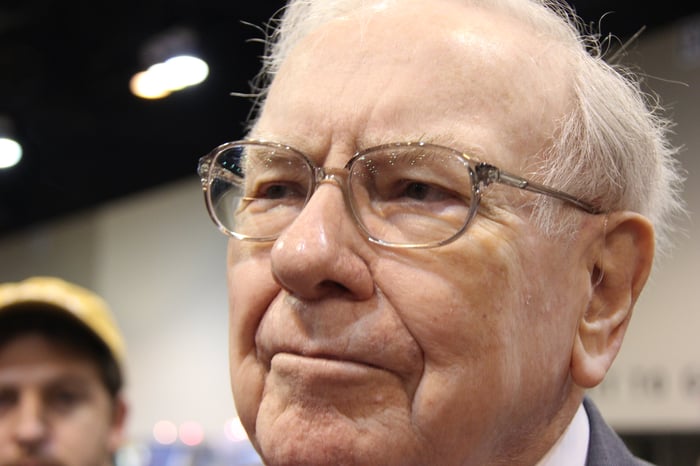
Warren Buffett retired as Berkshire's CEO on Dec. 31, 2025. Image source: The Motley Fool.
Selling was the norm for Warren Buffett's final three years as CEO
Although Berkshire Hathaway owns around five dozen companies, and these businesses, including insurer GEICO and railroad operator BNSF, generate tens of billions in annual income, it's the investment portfolio the Oracle of Omaha oversaw that typically drew the most attention.
Warren Buffett had a knack for identifying value that was hiding in plain sight. Long-term holdings in Coca-Cola, American Express, and Moody's, along with significant stakes in Apple and Bank of America, account for a large share of Berkshire's unrealized investment gains.
But Wall Street's most famous long-term investor wasn't much of a buyer of equities leading up to his retirement. According to Berkshire Hathaway's consolidated cash flow statements, Buffett was a net seller of stocks for 13 consecutive quarters (Oct. 1, 2022 – Dec. 31, 2025) until his departure. Collectively, nearly $187 billion in net stock was sold over this period.
The actions of Berkshire's former chief can be explained in one word: valuation.
Buffett was unwavering in his desire to get a good deal and would willingly sit on his hands and be patient until equity valuations made sense before deploying Berkshire's capital. His persistent net selling reflects how historically expensive the stock market has become over the last couple of years, and how challenging it's been to locate a good deal.
This is especially true of Warren Buffett's favorite stock.
The Oracle of Omaha went cold turkey on his favorite stock to buy
Based on several years of Berkshire's quarterly 13F filings, you might venture a guess that a core holding, such as Apple, Occidental Petroleum, or perhaps Chevron, is Buffett's favorite stock to buy. But no company in the $318 billion investment portfolio comes remotely close to matching the nearly $78 billion he spent from July 2018 to June 2024 buying shares of the company he holds nearest and dearest to his heart... Berkshire Hathaway.
Before July 2018, it was virtually impossible for Buffett or his now-late right-hand man, Charlie Munger, to green-light share buybacks. In order to buy back shares, Berkshire Hathaway stock had to dip to or below 120% of book value -- a level that was never reached.
However, on July 17, 2018, Berkshire's board amended the share repurchase covenants to give its billionaire boss more freedom to act. The new criteria enabled Buffett to repurchase his company's shares without any limitation as long as:
- Berkshire Hathaway has at least $30 billion in combined cash, cash equivalents, and U.S. Treasuries on its balance sheet; and
- Buffett viewed his company's shares as intrinsically cheap.
This last point was intentionally left vague to allow the Oracle of Omaha to buy shares of his favorite company when he saw value.
But between June 1, 2024, and Dec. 31, 2025, value has been nonexistent. Over this 19-month stretch, leading into his retirement, Warren Buffett didn't spend a dime to repurchase his company's stock.
When Berkshire's billionaire investor was deploying close to $78 billion over six years, his company's stock was rangebound at a 20% to 50% premium to book value. In the 19 months leading up to Buffett's departure, Berkshire Hathaway's premium to its book value rose to between 60% and 80%.
Buffett is unwavering when it comes to value -- even with his favorite stock!
Image source: Getty Images.
Greg Abel aims to pounce on price dislocations just like his predecessor
While it's probably disappointing for investors to see one of Wall Street's premier money managers enter retirement as a net seller of stocks for three years, and having not purchased his favorite stock for 19 months, being a disciplined investor and waiting for price dislocations was Warren Buffett's recipe for success.
With longtime Berkshire Hathaway executive Greg Abel succeeding Buffett as CEO, investors should expect more of the same: patience producing profits.
Abel's investment philosophy is modeled after that of his predecessor, with value being of utmost importance. In Abel's first annual letter to shareholders, he discussed share buybacks as a tool to create value, but also emphasized the importance of getting proper value for Berkshire's investments:
Share repurchases are another important capital allocation option. We will buy back Berkshire shares when they trade below our estimate of intrinsic value, conservatively determined, ensuring that repurchases enhance per-share value for continuing owners.
Following the modest swoon in Berkshire's stock on March 2, its Class A shares were trading at a 44% premium to book value. This effectively marks a two-year low and aligns with a level when Buffett was previously a buyer of his favorite stock.
Perhaps unsurprisingly, on March 5, investors learned via regulatory filings and an interview on CNBC with Abel that he had recommenced share repurchases. With $373.3 billion in cash, cash equivalents, and U.S. Treasuries on Berkshire's balance sheet, Abel has the flexibility to follow in his predecessors' footsteps and deliver value to his company's shareholders when price dislocations arise.
Should you buy stock in Berkshire Hathaway right now?
Before you buy stock in Berkshire Hathaway, consider this:
The Motley Fool Stock Advisor analyst team just identified what they believe are the 10 best stocks for investors to buy now… and Berkshire Hathaway wasn’t one of them. The 10 stocks that made the cut could produce monster returns in the coming years.
Consider when Netflix made this list on December 17, 2004... if you invested $1,000 at the time of our recommendation, you’d have $534,008!* Or when Nvidia made this list on April 15, 2005... if you invested $1,000 at the time of our recommendation, you’d have $1,090,073!*
Now, it’s worth noting Stock Advisor’s total average return is 949% — a market-crushing outperformance compared to 190% for the S&P 500. Don't miss the latest top 10 list, available with Stock Advisor, and join an investing community built by individual investors for individual investors.
See the 10 stocks »
*Stock Advisor returns as of March 9, 2026.
Bank of America is an advertising partner of Motley Fool Money. American Express is an advertising partner of Motley Fool Money. Sean Williams has positions in Bank of America. The Motley Fool has positions in and recommends Apple, Berkshire Hathaway, Chevron, and Moody's. The Motley Fool recommends Occidental Petroleum. The Motley Fool has a disclosure policy.
Recommended Articles


