


Could Oracle Be a Millionaire-Maker Stock?
Key Points
Oracle is betting heavily on AI data centers.
The company's business has become alarmingly overexposed to one major client: OpenAI.
- 10 stocks we like better than Oracle ›
The generative artificial intelligence (AI) trend has minted plenty of millionaires over the last few years. And so far, most of the best returns for investors have come from the infrastructure side of the opportunity, which focuses on supplying computing power and the hardware that AI software companies need to create and run their large language models (LLMs).
Oracle (NYSE: ORCL) operates at the center of this ecosystem. But while its shares nearly quadrupled between late 2022 and September 2025, when they hit an all-time high of $326.90, they then began what has become a steep slide as investors grew more nervous about the company's long-term strategy. Now, they are off by more than 50% from that peak. Could Oracle still be a millionaire-maker stock, or should investors consider jumping ship?
Will AI create the world's first trillionaire? Our team just released a report on the one little-known company, called an "Indispensable Monopoly" providing the critical technology Nvidia and Intel both need. Continue »
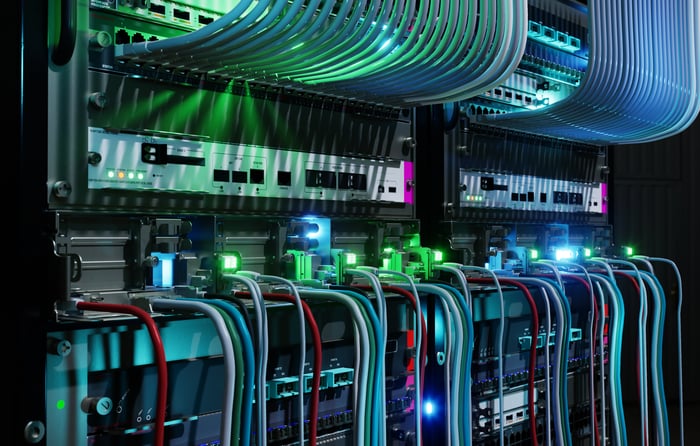
Image source: Getty Images.
What is Oracle's business model?
Despite only emerging as a major industry in the past few years, the AI economy is already quite complex. On one side, you have companies like Nvidia and Advanced Micro Devices, which create the graphics processing units (GPUs) and AI accelerators that power LLMs. On the other side, you have the software players like OpenAI and Anthropic, which use this computing power to train and run their algorithms.
Oracle acts as a middleman in this ecosystem. It buys AI hardware to build data centers, then rents out computing power through its cloud platform. This business model allows the company to tap into a massive growth opportunity without having to compete directly in the rapidly evolving market for consumer and enterprise AI software. That said, it isn't without risks.
For starters, building data centers is expensive -- really expensive. Oracle has taken on massive levels of debt to fund its infrastructure buildout. This money, and the associated interest expenses, will have to be paid back. Meanwhile, the hardware it has been spending so heavily on will age and become obsolete (recorded as depreciation expense), potentially putting a long-term drag on the company's earnings and cash flow.
The OpenAI deal put these fears in the spotlight
The uncertainty surrounding Oracle's business model came to a head in December, when the company revealed a $300 billion deal to supply computing power to ChatGPT maker OpenAI over the next few years. While such a large purchase commitment would typically be good news, investors know that Oracle will need to spend a lot on infrastructure to meet OpenAI's requirements.
Bloomberg reported that Oracle will need to build five of the largest data center complexes in the world, full of millions of expensive AI chips, and each consuming enough electricity to power a city. Management believes it can complete the work in 2027, but its balance sheet could pay the price.
Last year, Oracle had capital expenditures of $21 billion. That number is set to more than double to $50 billion this year. And this month, the company announced a plan to raise an additional raise $45 to $50 billion through a combination of debt sales and equity financing (creating and selling new units of stock). This strategy will dilute current investors by reducing their claims on the company's future profits.
Investors should probably avoid Oracle
In a typical "gold rush" situation, the companies that are oriented toward selling the equivalent of "picks and shovels" are safer bets than companies that are trying to strike gold. But Oracle's huge spending plans and reliance on debt financing make it a risky way for investors to try to bet on the AI boom. The company is also overreliant on purchase commitments from OpenAI -- a company that is dealing with its own problems of cash burn and falling market share.
Some of these challenges are already priced into Oracle's stock. With a forward price-to-earnings multiple of just 18, it trades at a discount to the S&P 500's average forward P/E of 22. That said, investors who are shopping for good deals can probably find better options.
Should you buy stock in Oracle right now?
Before you buy stock in Oracle, consider this:
The Motley Fool Stock Advisor analyst team just identified what they believe are the 10 best stocks for investors to buy now… and Oracle wasn’t one of them. The 10 stocks that made the cut could produce monster returns in the coming years.
Consider when Netflix made this list on December 17, 2004... if you invested $1,000 at the time of our recommendation, you’d have $534,008!* Or when Nvidia made this list on April 15, 2005... if you invested $1,000 at the time of our recommendation, you’d have $1,090,073!*
Now, it’s worth noting Stock Advisor’s total average return is 949% — a market-crushing outperformance compared to 190% for the S&P 500. Don't miss the latest top 10 list, available with Stock Advisor, and join an investing community built by individual investors for individual investors.
See the 10 stocks »
*Stock Advisor returns as of March 8, 2026.
Will Ebiefung has no position in any of the stocks mentioned. The Motley Fool has positions in and recommends Advanced Micro Devices, Nvidia, and Oracle. The Motley Fool has a disclosure policy.
Recommended Articles


