


1 Growth Stock Down 60% You'll Wish You'd Bought on the Dip, According to Wall Street
Key Points
Zscaler specializes in the zero-trust cybersecurity architecture, which is proving very effective in the artificial intelligence (AI) era.
The company recently expanded its flagship Zero Trust Exchange to secure the activities of AI agents.
Zscaler stock is trading at a discount to its peers, and Wall Street thinks there could be significant upside ahead.
- 10 stocks we like better than Zscaler ›
Artificial intelligence (AI) is a revolutionary technology for businesses, but it also poses serious risks. As organizations rapidly deploy AI agents to boost the productivity of their human employees, they might be unwittingly exposing their sensitive data and mission-critical applications to hackers.
Zscaler's (NASDAQ: ZS) zero-trust cybersecurity architecture is made for this moment. It was originally designed to secure corporate networks from unauthorized human access. Now, it's also being deployed to secure the activities of AI agents. This could be an enormous financial opportunity for Zscaler as AI adoption ramps up.
Will AI create the world's first trillionaire? Our team just released a report on the one little-known company, called an "Indispensable Monopoly" providing the critical technology Nvidia and Intel both need. Continue »
Zscaler stock is still trading 60% below its record high from 2021, when a frenzy in the tech markets drove its valuation to an unsustainable level. But the majority of the analysts tracked by The Wall Street Journal believe the stock is a buy right now, and their consensus price target points to significant potential upside from here.

Image source: Getty Images.
Zero-trust security is ideal for the AI era
As the name implies, a zero-trust architecture treats every connection to a given corporate network as hostile, which plugs any potential vulnerabilities. It starts at the identity layer. Zscaler's Zero Trust Exchange analyzes every employee's login credentials, along with the device they are using and their location, to determine if it's really them trying to access the corporate network, or if it's an imposter.
That is especially important for remote workers who can't be physically supervised when accessing sensitive applications, but it doesn't stop there. The Zero Trust Exchange only connects employees to the apps they need to complete their jobs. So even if hackers breach the identity layer, they can't move laterally across the network, which limits their ability to inflict damage.
Then there is Zero Trust Branch, which ties Zscaler's "Zero Trust Everywhere" philosophy together. It runs every device, warehouse, factory, and retail location through the Zero Trust Exchange to isolate it from a cybersecurity perspective. Therefore, even if one of those assets is compromised, it can't infect the rest of the organization. This is key in the AI era because attackers are constantly probing for vulnerabilities at machine speed.
Now, Zscaler is unleashing the Zero Trust Exchange on AI agents. Rather than allowing them to roam free within the corporate network, organizations can now assign them restricted access only to the specific apps or datasets required for their tasks. Again, that means even if a hacker compromises an agent, the effect will be limited.
Solid growth at the top and bottom line
Zscaler wrapped up the first half of its fiscal year 2026 on Jan. 31. It generated a record $1.6 billion in revenue for the period, which was up 25.7% year over year. Following the result, management slightly increased its full-year revenue forecast from $3.3 billion to $3.32 billion (at the high end of the respective ranges), which is a sign of the company's growing momentum.
Zscaler has around 9,400 total customers, but as of Jan. 31, management said 550 of them had adopted the Zero Trust Everywhere philosophy. That was up by a whopping 323% from the same time last year. This suggests that customers are gradually buying more of Zscaler's product suite, which is very positive.
Zscaler is also making progress at the bottom line, thanks to prudent expense management. The company still lost $45.9 million during the first half of fiscal 2026 on a generally accepted accounting principles (GAAP) basis, but after excluding one-off and non-cash expenses, it produced an adjusted profit of $328.1 million. That was up 30.5% year over year.
Is Wall Street right to be bullish on Zscaler stock?
The Wall Street Journal tracks 50 analysts who cover Zscaler stock, and 37 have given it a buy rating. Six others are in the overweight (bullish) camp, while the remaining seven recommend holding. Not a single analyst in this group recommends selling.
The analysts have a consensus price target of $237.30, suggesting Zscaler stock could rise by 57% over the next 12 months or so. The Street-high target of $335, however, implies a potential upside of 122% instead.
The consensus target might be realistic because Zscaler is much cheaper than its peers right now. Its stock trades at a price-to-sales (P/S) ratio of just 7.9, compared to 10.7 for Palo Alto Networks and 20.9 for CrowdStrike.
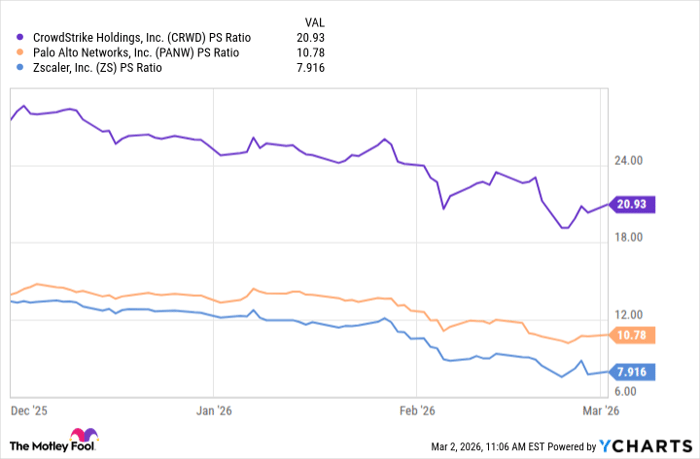
Data by YCharts.
If Zscaler stock were to hit $237.30, its P/S ratio would rise to 12.4, leapfrogging Palo Alto but remaining much cheaper than CrowdStrike. That might be achievable, since the company is growing its top line much faster than both of its peers. Its second-quarter revenue growth of 26% trounced the 15% growth produced by Palo Alto and the 22% growth generated by CrowdStrike in their most recent quarters.
All else being equal, a company growing faster than its competition would normally command a premium valuation, not a discounted one, so I think there is certainly scope for upside from here. As a result, I think Wall Street is right to be bullish on Zscaler's prospects.
Should you buy stock in Zscaler right now?
Before you buy stock in Zscaler, consider this:
The Motley Fool Stock Advisor analyst team just identified what they believe are the 10 best stocks for investors to buy now… and Zscaler wasn’t one of them. The 10 stocks that made the cut could produce monster returns in the coming years.
Consider when Netflix made this list on December 17, 2004... if you invested $1,000 at the time of our recommendation, you’d have $534,817!* Or when Nvidia made this list on April 15, 2005... if you invested $1,000 at the time of our recommendation, you’d have $1,123,912!*
Now, it’s worth noting Stock Advisor’s total average return is 964% — a market-crushing outperformance compared to 192% for the S&P 500. Don't miss the latest top 10 list, available with Stock Advisor, and join an investing community built by individual investors for individual investors.
See the 10 stocks »
*Stock Advisor returns as of March 7, 2026.
Anthony Di Pizio has no position in any of the stocks mentioned. The Motley Fool has positions in and recommends CrowdStrike and Zscaler. The Motley Fool recommends Palo Alto Networks. The Motley Fool has a disclosure policy.
Recommended Articles


