


Better Nuclear Energy Stock: NuScale Power (SMR) vs. Oklo (OKLO)
Key Points
NuScale’s upcoming plants in Romania and the U.S. could significantly boost its sales.
Oklo’s tiny reactors will support the construction of smaller nuclear power plants.
- 10 stocks we like better than NuScale Power ›
NuScale Power (NYSE: SMR) and Oklo (NYSE: OKLO) are both trying to shake up the nuclear energy market with smaller and more scalable reactors. Last July, I compared these two stocks and claimed NuScale was a better buy because it was generating more revenue and its stock looked more reasonably valued relative to its growth potential.
But since then, NuScale's stock has plunged nearly 80%, while Oklo's has only declined 20%. Let's see why that happened -- and if my previous thesis for NuScale still holds up.
Will AI create the world's first trillionaire? Our team just released a report on the one little-known company, called an "Indispensable Monopoly" providing the critical technology Nvidia and Intel both need. Continue »
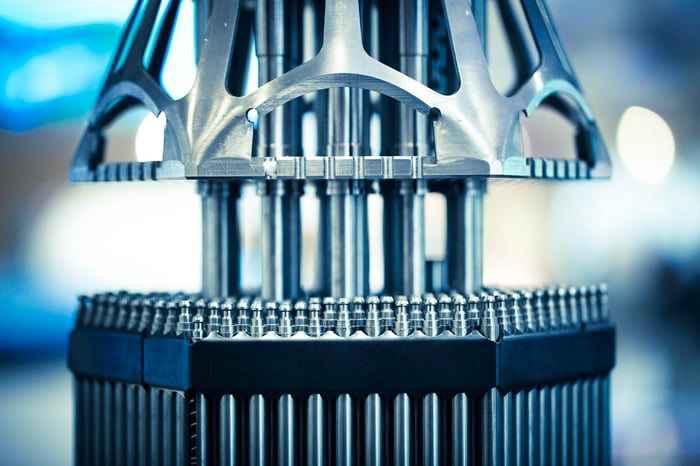
Image source: Getty Images.
How will NuScale and Oklo disrupt the nuclear market?
NuScale produces small modular reactors (SMRs), which can fit in vessels that are only 65 feet high and nine feet wide. They're prefabricated, modular, and assembled on site, reducing the time and costs required to build a working nuclear power plant. It's the only SMR maker that holds Standard Design Approvals (SDAs) from the U.S. Nuclear Regulatory Commission (NRC).
The NRC approved NuScale's 77 MWe SMR design, which is being used to construct a 462 MWe plant for Romania's RoPower, last year. It also recently agreed to deploy up to six gigawatts of SMR capacity across seven states for the Tennessee Valley Authority (TVA).
Oklo produces microreactors, which are even smaller than NuScale's SMRs. Its Aurora microreactor generates only 1.5 MWe on its own, but it can be chained into larger reactors to deliver 15 to 100 MWe per deployment. That flexibility makes them ideal for remote and off-grid deployments that can't occupy as much space as a conventional nuclear power plant.
Oklo's microreactors also use metallic uranium fuel pellets -- which are denser, more thermal resistant, and cheaper to fabricate than the uranium dioxide fuel pellets used in NuScale's SMRs and conventional reactors. Oklo's microreactors also reprocess and recycle their fuel in a closed loop, so they last about a decade without refueling. Reactors that use uranium dioxide generally need to be refueled every two years. However, NuScale's modular design enables its reactors to be fueled in separate stages, keeping the entire plant online.
Last September, Oklo broke ground on its first Powerhouse reactor in Idaho, with a maximum capacity of 75 MWe. It's also secured a government contract to build a small reactor for Eielson Air Force Base in Alaska, and it's working with Siemens Energy to produce the steam turbine and generator systems for its modular reactors.
But when will these next-gen reactors come online?
NuScale and Oklo could eventually disrupt the nuclear energy market, but neither company will deploy their next-gen reactors anytime soon.
NuScale's project in Romania, where it serves as a subcontractor to Fluor (NYSE: FLR), recently received its final investment decision (FID) -- but it doesn't expect its first reactors to come online until the early 2030s. The first reactors for its TVA project also probably won't be installed until 2032. Until then, NuScale will generate most of its revenue from front-end engineering and design (FEED) studies, converting some of its memorandums of understanding (MOUs) into binding contracts, and additional licensing deals with other companies.
From 2025 to 2028, analysts expect NuScale's revenue from those sources to rise more than ninefold from $31 million to $287 million as it gradually narrows its losses. However, its real growth spurt probably won't start until the early 2030s when it finally activates its first reactors.
Oklo won't generate any revenue until it deploys its first reactors in Idaho in late 2027. If that happens, analysts expect it to generate $16 million in revenue in 2027, followed by much stronger growth and narrower losses as it expands its fledgling business.
But does Oklo deserve its premium valuation?
Oklo seems to be ahead of NuScale in the next-gen reactor race. But with a market cap of $9.7 billion, it trades at more than 600 times its projected 2027 sales. NuScale, with a market cap of $3.9 billion, looks more reasonably valued (but still expensive) at 19 times its 2027 sales.
Oklo is difficult to value without greater visibility beyond its initial 2027 deployments. NuScale's near-term catalysts are easier to see, even if its first plants won't come online until the early 2030s. Investors should note that Oklo's earlier deployments won't necessarily spell doom for NuScale, since the former is used to build smaller plants than the latter.
Both stocks could soar much higher over the next few decades. Yet as of this writing, I think the market's focus on near-term catalysts will help Oklo stay ahead of NuScale. With its biggest long-term catalysts still years away, NuScale could remain out of favor in this choppy market.
Should you buy stock in NuScale Power right now?
Before you buy stock in NuScale Power, consider this:
The Motley Fool Stock Advisor analyst team just identified what they believe are the 10 best stocks for investors to buy now… and NuScale Power wasn’t one of them. The 10 stocks that made the cut could produce monster returns in the coming years.
Consider when Netflix made this list on December 17, 2004... if you invested $1,000 at the time of our recommendation, you’d have $534,817!* Or when Nvidia made this list on April 15, 2005... if you invested $1,000 at the time of our recommendation, you’d have $1,123,912!*
Now, it’s worth noting Stock Advisor’s total average return is 964% — a market-crushing outperformance compared to 192% for the S&P 500. Don't miss the latest top 10 list, available with Stock Advisor, and join an investing community built by individual investors for individual investors.
See the 10 stocks »
*Stock Advisor returns as of March 6, 2026.
Leo Sun has no position in any of the stocks mentioned. The Motley Fool recommends NuScale Power. The Motley Fool has a disclosure policy.
Recommended Articles


