


Got $1,000? This Cryptocurrency Is a No-Brainer Buy for Long-Term Holding
Key Points
Ethereum has become a lot more capable in recent years.
That's helped its chain to attract vast sums of capital, and many users.
It will keep building out its capacity and upgrading its technology from here on out.
- 10 stocks we like better than Ethereum ›
The crypto market is still reeling from a couple of years of back-to-back flare-ups of macroeconomic disruption and geopolitical tension, and its hard times probably aren't over yet. Ethereum (CRYPTO: ETH), for its part, is up just 16% during the past three years, and in the last three months, it fell by 38%.
But at the same time, the network underpinning the value of the coin has never been healthier or more deeply woven into the fabric of digital finance. And if you have $1,000 on hand and are looking for a crypto investment, it's a no-brainer buy, so long as you're willing to hold it for the long term. Here's why.
Will AI create the world's first trillionaire? Our team just released a report on the one little-known company, called an "Indispensable Monopoly" providing the critical technology Nvidia and Intel both need. Continue »
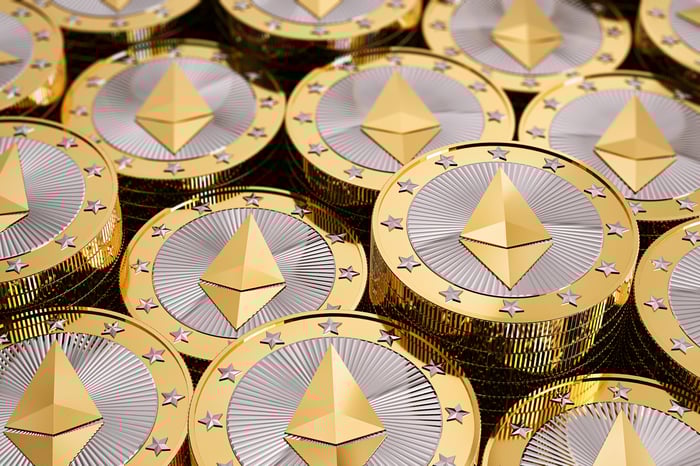
Image source: Getty Images.
This is infrastructure all of crypto depends on
Today, Ethereum is effectively the operating system on which the majority of decentralized finance (DeFi) runs, meaning that it's the native asset for an ecosystem of applications for lending, borrowing, and exchanging assets without intermediaries in the traditional financial sector. Given its positioning in DeFi today, its future dominance is very likely, implying that there will continue to be persistent demand for the blockchain's native coin, Ether.
Ethereum hosts a huge share of the DeFi market's $96 billion in total value locked (TVL), with about $55 billion in TVL, or the amount of digital assets held on a chain. Solana, Ethereum's next-closest competitor in DeFi, has less than $7 billion in TVL.
So Ethereum's lead is commanding even in the face of at least one capable competitor that offers both lower transaction costs and faster transaction times. The picture is similar when looking at stablecoins; Ethereum hosts $159 billion in stablecoins, more than half of the $309 billion market.
The chain also has a huge amount of developer activity; in Q4 2025, a record 8.7 million smart contracts were deployed on Ethereum. Its daily active wallet addresses nearly doubled during 2025, and there are now more than 651,000 active daily wallets.
Thus, people are using this network's financial technology, creating a network effect, wherein liquidity attracts developers, developers attract users, and then users bring more liquidity, boosting the price of the coin over time.
Two planned upgrades will likely be big catalysts
Two major protocol upgrades are slated for Ethereum in 2026, both of which are aimed at making the network faster, cheaper, and more resilient.
Glamsterdam, expected in the first half of the year, will create the software prerequisites for the chain to later add parallel transaction processing, which would increase the chain's speed and likely drive down its costs too. Among many other features slated for launch, developers plan changes that could lower gas (user) fees substantially.
The second upgrade, Hegota, which is targeting a launch in late 2026, will try to address the hardware costs of securing the network. That could make it cheaper to run validator nodes, which could in turn make the chain more resilient against disruption by way of attracting more independent validators -- the participants who verify transactions and add them to the blockchain. Hegota's scope is still in flux at the moment, though, and it will likely bundle in a few additional features by the time it's implemented.
These two packages will not be the last, and they will make Ethereum an even more appealing place to develop apps and to do on-chain business using DeFi or other applications. Still, investors should stay realistic about what's likely to happen this year. Major Ethereum upgrades in the past have often triggered hype followed by a letdown, and neither upgrade will negate the macro headwinds weighing on crypto, nor calm the widening gyre of armed conflict abroad.
Nonetheless, both Glamsterdam and Hegota will strengthen the technical foundations that have so far been quite effective at attracting and retaining institutions, developers, and long-term holders. And if you're just starting to build a crypto portfolio, it's a no-brainer for allocating $1,000 to Ethereum. Its advantages in DeFi and stablecoins aren't about to go anywhere, and if the chain's leadership is developing its feature set to match what users are looking for -- which it certainly has been so far -- it will be a great crypto to hold for years.
Should you buy stock in Ethereum right now?
Before you buy stock in Ethereum, consider this:
The Motley Fool Stock Advisor analyst team just identified what they believe are the 10 best stocks for investors to buy now… and Ethereum wasn’t one of them. The 10 stocks that made the cut could produce monster returns in the coming years.
Consider when Netflix made this list on December 17, 2004... if you invested $1,000 at the time of our recommendation, you’d have $526,889!* Or when Nvidia made this list on April 15, 2005... if you invested $1,000 at the time of our recommendation, you’d have $1,103,743!*
Now, it’s worth noting Stock Advisor’s total average return is 947% — a market-crushing outperformance compared to 192% for the S&P 500. Don't miss the latest top 10 list, available with Stock Advisor, and join an investing community built by individual investors for individual investors.
See the 10 stocks »
*Stock Advisor returns as of March 5, 2026.
Alex Carchidi has positions in Ethereum and Solana. The Motley Fool has positions in and recommends Ethereum and Solana. The Motley Fool has a disclosure policy.
Recommended Articles


