


Will Spiking Oil Prices Hurt the Stock Market?
Key Points
Crude prices are up about 7% since the strikes on Iran.
Stock prices fell initially and are now recovering.
But a prolonged or wider war would send stocks lower.
- These 10 stocks could mint the next wave of millionaires ›
Oil prices have spiked since the joint U.S.-Israel strikes on Iran that began on Feb. 28, over fears that a protracted or wider regional war will severely disrupt global oil supplies.
Brent crude is about 7% higher than its closing price on Friday, Feb. 26. In fact, the price of crude had been climbing in the weeks preceding the strikes due to rising investor nervousness that war could break out in the Middle East. The price per barrel now stands at around $71, $9 higher than just a month ago. And prices briefly spiked to around $80 over the weekend.
Will AI create the world's first trillionaire? Our team just released a report on the one little-known company, called an "Indispensable Monopoly" providing the critical technology Nvidia and Intel both need. Continue »
It's no wonder that crude prices are so sensitive to this particular crisis. About one-fifth of the global supply of crude oil flows through the Strait of Hormuz, the narrow passage from the Persian Gulf to the Indian Ocean and the wider world. And at one time, Iran had the ability to slow or even stop traffic through the strait.
To be sure, some of the oil that would have moved on ships through the strait can be moved in pipelines instead. And some of it can be stored onshore.
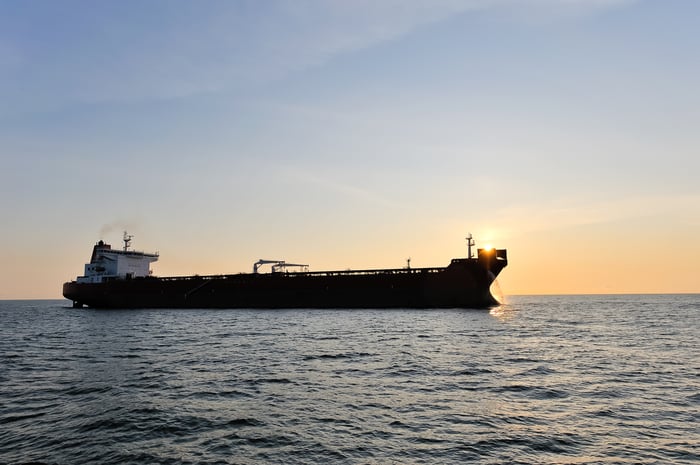
Image source: Getty Images.
A prolonged conflict could send the price of oil above $100
But JPMorgan Chase says those shipping and storage alternatives can only absorb so much of the Gulf's production, and it estimated in a recent report that if the conflict lasts more than three weeks, Brent crude could spike to between $110 and $120 a barrel. That would have a severe negative output on the U.S. and other economies, as it causes inflation while decreasing consumers' spending (because they continue to spend on higher-priced gasoline). It would almost certainly send the stock market into a drawdown or correction.
Fortunately, Iran has said it does not plan to close the critical strait to traffic, though that may be because the nation's navy has been largely destroyed in recent strikes. Still, traffic through the strait is now at a voluntary standstill as shippers wait for a lull in the fighting to traverse the dangerous strait. For the moment, at least, the global economy seems able to withstand a small increase in energy prices.
Still, if the conflict is prolonged, it will take a toll on stocks. On Monday morning, the S&P 500 index opened about 1% below Friday's close, though it recovered by the end of the trading session to end the day flat.
Most analysts are betting the current conflict will be decisive and short-lived, with contained regional spillovers. A second, worse, scenario entails a short-lived conflict that has greater spillover to other nations in the region and a partial close of the Hormuz Strait. The worst case is a prolonged campaign with lots of spillover and a partial-to-full Hormuz closure. Fitch Ratings service says scenario two is most likely right now.
We should all be hoping for a short, contained conflict that does the least damage to the stock market and, more importantly, the people of the region.
Where to invest $1,000 right now
When our analyst team has a stock tip, it can pay to listen. After all, Stock Advisor’s total average return is 947%* — a market-crushing outperformance compared to 192% for the S&P 500.
They just revealed what they believe are the 10 best stocks for investors to buy right now, available when you join Stock Advisor.
See the stocks »
*Stock Advisor returns as of March 4, 2026.
The Motley Fool has a disclosure policy.
Recommended Articles


