


Will the Federal Reserve Cut Interest Rates in 2026?
Key Points
Since 2022, the Federal Reserve has instituted a number of changes to monetary policy.
Meanwhile, inflation has dropped from 9.1% to 2.4% over the last few years.
While inflation continues to cool off, the labor market remains in a tough spot.
- These 10 stocks could mint the next wave of millionaires ›
During President Donald Trump's first stint in the Oval Office, the S&P 500 rocketed by 70%. While the market continued roaring during the early part of President Joe Biden's tenure, stocks experienced a drawdown in 2022 as inflation levels started rising due to overhangs from ongoing supply chain disruptions and stimulus checks from the pandemic.
During the summer of 2022, inflation peaked at 9.1% -- its highest level in nearly 40 years. As a result, the Federal Reserve implemented an aggressive tightening policy, which featured 11 interest rate hikes.
Will AI create the world's first trillionaire? Our team just released a report on the one little-known company, called an "Indispensable Monopoly" providing the critical technology Nvidia and Intel both need. Continue »
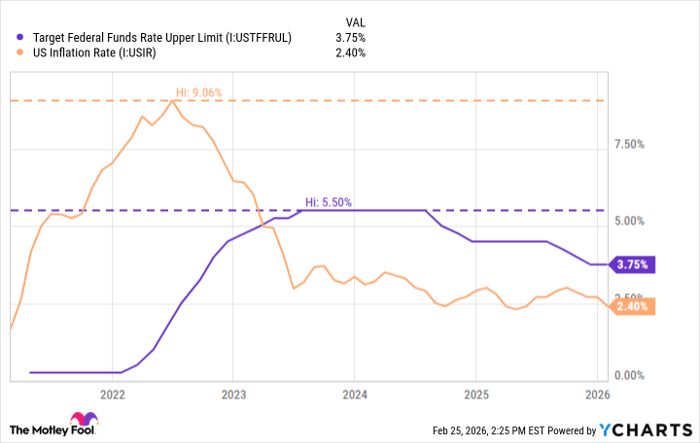
Target Federal Funds Rate Upper Limit data by YCharts
However, over the last couple of years, the Fed has gradually tapered interest rates as inflation levels cooled off. Now, with inflation inching closer to the Fed's target level of 2%, could further reductions to interest rates be on the horizon this year? Let's dig into the dynamics at play to help assess which direction monetary policy could move in 2026.
Are lower interest rates good for the economy?
In 2025, the Fed instituted three separate 25-basis-point reductions. When interest rates are lower, consumer purchasing power becomes stronger. In theory, this means people may be willing to spend more discretionary income on goods and services or be more open-minded to the idea of taking on a loan to finance a project.
While these dynamics increase economic activity, there is an opportunity cost at play. An ongoing debate among members of the Federal Open Market Committee (FOMC), the branch of the Fed that determines monetary policy, is how safely interest rates can be further reduced without reigniting inflation.
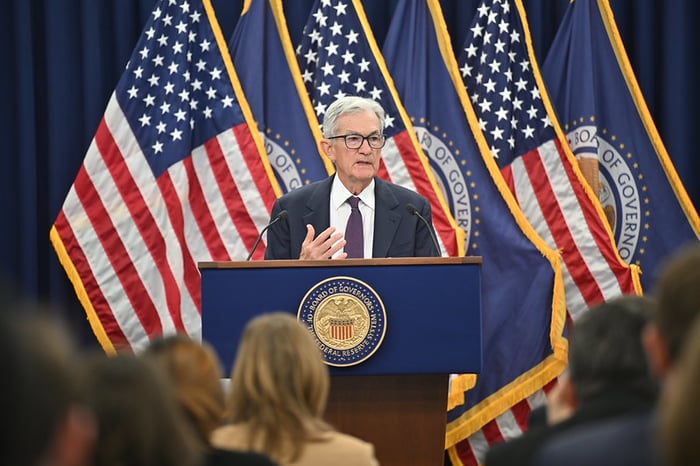
Chair Jerome Powell answers reporters' questions at the FOMC press conference on Jan. 28, 2026. Image source: Federal Reserve.
Inflation vs. interest rates
A prominent period when the U.S. witnessed similar levels between inflation and interest rates was in the 1970s. Back then, the Fed prematurely cut interest rates after it saw inflation levels dip. By reducing rates too soon, inflation swiftly shot back up -- putting the economy in a tough spot.
One learning from this misstep was for the Fed to establish a target inflation rate, which sits at 2%. Moreover, the Fed also maintains positive real interest rates -- meaning interest rates are kept elevated above inflation. If this were not the case, then real interest rates would be negative.
Will the Fed cut interest rates in 2026?
There are a few factors that will likely play a strong role in the Fed's monetary policy decisions throughout 2026.
First, the historical dynamics explored above, combined with the fact that the current level of inflation hovers nominally higher than the Fed's target, make it incredibly difficult to say one way or another whether more rate reductions are appropriate.
Second, looking at inflation levels in isolation doesn't help the Fed that much. While inflation is indeed cooling off, the current U.S. unemployment rate of 4.3% is notably higher compared to other periods in recent years. Under these conditions, the Fed might choose to reduce rates as a way to stimulate demand amid a challenging labor market.
The last, and possibly biggest, factor at play in determining the direction of monetary policy is who will succeed Chairman Jerome Powell after his tenure comes to an end in May.
In my eyes, whoever replaces Chairman Powell won't be privy to any more or different economic data than the FOMC is already digesting. The biggest difference will likely be how new leadership interprets inflation, labor statistics, and GDP growth and how changes to interest rates will impact these variables.
Against this backdrop, my honest take is that a rate cut in 2026 is a coin toss. If it happens, I wouldn't be shocked. What I will say is that I'd be more surprised to see rates go up before the end of the year. Ultimately, my gut tells me that the Fed's agenda could remain unchanged this year, and investors won't see any reductions or raises to interest rates in 2026.
Where to invest $1,000 right now
When our analyst team has a stock tip, it can pay to listen. After all, Stock Advisor’s total average return is 947%* — a market-crushing outperformance compared to 192% for the S&P 500.
They just revealed what they believe are the 10 best stocks for investors to buy right now, available when you join Stock Advisor.
See the stocks »
*Stock Advisor returns as of March 4, 2026.
Adam Spatacco has no position in any of the stocks mentioned. The Motley Fool has no position in any of the stocks mentioned. The Motley Fool has a disclosure policy.
Recommended Articles


