


This Ratio Just Hit a 12-Year Low. History Says a Correction Usually Follows.
Key Points
The S&P 500-to-gold ratio just hit its lowest point since early 2014.
Significant downturns in this ratio have preceded the last several recessions and bear markets.
Monetary system dynamics make this a unique situation, but evidence suggests that stocks could be in trouble here.
- 10 stocks we like better than S&P 500 Index ›
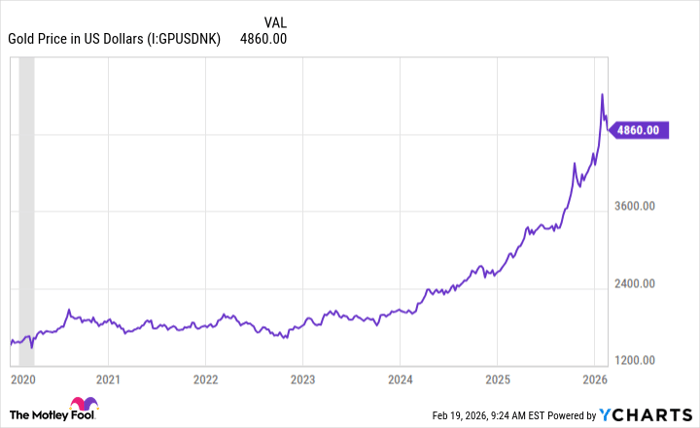
Most of you already know about the gold rally over the past couple of years. After hitting a ceiling around the $2,000 mark earlier this decade, gold finally broke through in March 2024 and has gone parabolic ever since.
Where to invest $1,000 right now? Our analyst team just revealed what they believe are the 10 best stocks to buy right now, when you join Stock Advisor. See the stocks »
Gold Price in US Dollars data by YCharts
Today, it's come down from its high of around $5,600 per ounce in January, but gold is still hanging on to most of its gains from this incredible bull run.
Normally, that should serve as a warning for equity investors. Gold is traditionally a safe-haven asset that investors accumulate when they're worried about the markets and want to take risk off the table.
It's an especially unusual situation here because the S&P 500 (SNPINDEX: ^GSPC) is still trading near all-time highs, and long-term Treasury bond yields have moved mostly sideways for much of the past year.
My first inclination is that this is a sign investors are using precious metals instead of Treasuries as their safe haven of choice. If money were moving from stocks to bonds, we'd like to see stock prices drift lower while Treasury yields moved lower too. We're seeing neither. Stocks are rising, and Treasury yields are going sideways.
Image source: Getty Images.
Why are gold and the S&P 500 both hitting all-time highs?
Gold and stocks hitting new highs at the same time is historically unusual. Why is it happening? My belief is that this is looking less like a flight-to-safety trade and more like a structural monetary system change trade.
We know that the U.S. federal debt continues to climb rapidly. As of Jan. 31, total government debt is approximately $38.5 trillion. The government is currently running annual budget deficits of nearly $2 trillion, which means the debt will only keep growing.
Global central banks, especially China, have been increasing their gold stockpiles for years. Add in the potential tailwind of a de-dollarization trade, and you have the catalyst for a big gold rally outside of just a pure defensive play.
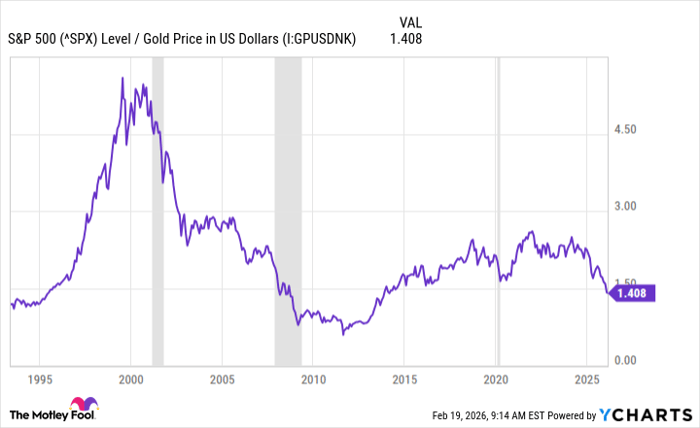
But now, the S&P 500-to-gold ratio has fallen to a level not seen since early 2014.
Fundamental Chart data by YCharts
The chart shows that sharp dips in the S&P 500-to-gold ratio preceded the tech bubble in the early 2000s, the financial crisis in the late 2000s, and the COVID recession in 2020. Today, we're seeing a similar move.
In isolation, it's easy to make the argument that significant gold outperformance should coincide with a deeper risk-off period. The lack of demand for dollar-denominated Treasuries is a unique wrinkle that could make this another recession predictor or a "this time is different" moment.
Given the trends we're seeing in the size of the federal debt, the labor market, affordability, and valuations, I would guess that a recession is more likely than not at this point. The government has largely spent its way out of recessions since the financial crisis. I believe it's reaching the point where they can't do that much longer.
Should you buy stock in S&P 500 Index right now?
Before you buy stock in S&P 500 Index, consider this:
The Motley Fool Stock Advisor analyst team just identified what they believe are the 10 best stocks for investors to buy now… and S&P 500 Index wasn’t one of them. The 10 stocks that made the cut could produce monster returns in the coming years.
Consider when Netflix made this list on December 17, 2004... if you invested $1,000 at the time of our recommendation, you’d have $409,970!* Or when Nvidia made this list on April 15, 2005... if you invested $1,000 at the time of our recommendation, you’d have $1,174,241!*
Now, it’s worth noting Stock Advisor’s total average return is 889% — a market-crushing outperformance compared to 192% for the S&P 500. Don't miss the latest top 10 list, available with Stock Advisor, and join an investing community built by individual investors for individual investors.
See the 10 stocks »
*Stock Advisor returns as of February 24, 2026.
David Dierking has no position in any of the stocks mentioned. The Motley Fool has no position in any of the stocks mentioned. The Motley Fool has a disclosure policy.
Recommended Articles


