


You Can't Afford Not to Know More About This Unseen AI Stock Giant
Key Points
Plenty of U.S. companies have been wildly successful in the technology sector.
However, one increasingly important player in the semiconductor field has had a key role in driving technological advances worldwide.
Understanding the geopolitical ramifications of tech investing is a must in today's world.
- 10 stocks we like better than Taiwan Semiconductor Manufacturing ›
Artificial intelligence is a global phenomenon, but many U.S. investors focus their attention squarely on companies within the borders of their country. That's understandable, given how many of the largest tech businesses in the world have U.S. headquarters. Even just investing in a simple U.S. stock market index fund gives you broad exposure to many of the leading visionaries in AI.
Yet because AI is moving forward globally, smart investors can't afford to be provincial with their investing. Often, some of the best opportunities to invest show up overseas precisely because so many U.S. investors choose to look the other way. The long history of success that Taiwan Semiconductor Manufacturing (NYSE: TSM) has enjoyed is a testament to how the global economy has accelerated technological innovation, and Taiwan Semi is already an essential piece of the puzzle for AI growth. In this month-long look at some of the world's largest companies for the Voyager Portfolio, it's fitting to include Taiwan Semi, especially because so few people know how the company got its start and how it rose to prominence.
Where to invest $1,000 right now? Our analyst team just revealed what they believe are the 10 best stocks to buy right now, when you join Stock Advisor. See the stocks »
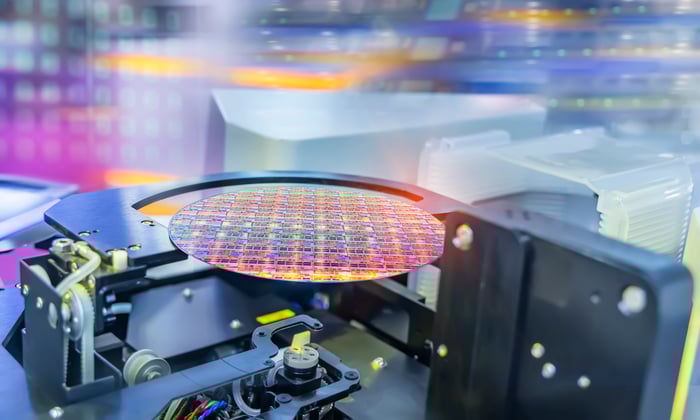
Image source: Getty Images.
Morris Chang and the founding of Taiwan Semiconductor
Taiwan Semi's formal history goes back to the 1980s, but to really understand how the company came to be, you'll have to turn back the clock a lot further than that. Morris Chang was a Taiwanese electrical engineer who played an instrumental role in semiconductor development in the 1950s and 1960s. He started working for Texas Instruments (NASDAQ: TXN) in 1958 and had a 25-year career there, eventually rising to become the top executive for TI's global semiconductor operations. When TI started to pivot toward consumer electronics, Chang decided to leave.
That set the stage for Chang to answer a call from his home country. Under pressure from mainland China, Taiwan faced macroeconomic and geopolitical challenges in the 1970s and 1980s. In order to find a sustainable path toward economic development, the Taiwanese government identified semiconductor manufacturing as a potentially lucrative industry. Taiwan sought out Chang's help in leading a nonprofit institute whose purpose was to turn semiconductors into a viable business opportunity on the island.
In 1987, Taiwan Semi formally came into existence. Taiwan's sovereign wealth fund provided a substantial amount of capital in exchange for a 48% stake, while the Netherlands-based electronics company Philips (NYSE: PHG) provided production technology and licenses for proprietary intellectual property and received about 28% of the company. Private investors within Taiwan provided much of the remainder of the start-up capital.
How Taiwan Semi reinvented chipmaking
Before Taiwan Semi, most companies in the technology industry were vertically integrated , containing their semiconductor chip design teams under the same corporate umbrella as their chip production facilities. However, Chang believed that it would be more efficient to build a foundry-based business that was able to produce chips designed by many different clients. Because a pure-play foundry would be able to afford the most advanced equipment necessary to meet the needs of the entire universe of semiconductor design customers, Taiwan Semi would have a competitive advantage over smaller in-house operations.
The impact of Taiwan Semi's success across the chip industry was huge. Freed from the need to manufacture their own chips, companies started specializing solely in chip design. As those design companies thrived, the foundries that served them shared in their success, and Taiwan Semi was among the largest.
Taiwan Semi's climb to fortune
Today, Taiwan Semi is an important partner to some of the largest tech companies in the world. It has also become immensely profitable, making Taiwan Semi stock an attractive investment. In the second article of this three-part series on Taiwan Semi, you'll see more details on how favorable long-term trends like digital transformation, cloud computing, and artificial intelligence have promoted the Taiwanese foundry company's financial success.
Should you buy stock in Taiwan Semiconductor Manufacturing right now?
Before you buy stock in Taiwan Semiconductor Manufacturing, consider this:
The Motley Fool Stock Advisor analyst team just identified what they believe are the 10 best stocks for investors to buy now… and Taiwan Semiconductor Manufacturing wasn’t one of them. The 10 stocks that made the cut could produce monster returns in the coming years.
Consider when Netflix made this list on December 17, 2004... if you invested $1,000 at the time of our recommendation, you’d have $424,262!* Or when Nvidia made this list on April 15, 2005... if you invested $1,000 at the time of our recommendation, you’d have $1,163,635!*
Now, it’s worth noting Stock Advisor’s total average return is 904% — a market-crushing outperformance compared to 194% for the S&P 500. Don't miss the latest top 10 list, available with Stock Advisor, and join an investing community built by individual investors for individual investors.
See the 10 stocks »
*Stock Advisor returns as of February 23, 2026.
Dan Caplinger has no position in any of the stocks mentioned. The Motley Fool has positions in and recommends Taiwan Semiconductor Manufacturing and Texas Instruments. The Motley Fool has a disclosure policy.
Recommended Articles


