


1 Semiconductor ETF to Buy Hand Over Fist and 1 to Avoid
Key Points
Over the past few years, investors have been able to choose any semiconductor ETF and enjoy big returns.
Now that the market is favoring non-tech sectors, investors need to be more precise in choosing semiconductor stocks.
Between the iShares Semiconductor ETF and the VanEck Semiconductor ETF, one has a clear advantage.
- 10 stocks we like better than iShares Trust - iShares Semiconductor ETF ›
Throughout the bull market for tech and artificial intelligence (AI) of the past few years, semiconductor stocks have been the leaders. That narrative has changed in 2026 as investors grow more concerned about how much money is being spent on AI development and whether valuations have become stretched too far.
Semiconductor ETFs still aren't too far off all-time highs, but it looks like momentum has clearly shifted away from tech and growth stocks. That doesn't mean this group can't keep moving higher, but it does mean investors need to be pickier about where they put their money. With valuations historically elevated and growth rates starting to decline, selection may be more important now than it has been in years.
Where to invest $1,000 right now? Our analyst team just revealed what they believe are the 10 best stocks to buy right now, when you join Stock Advisor. See the stocks »
That's why I believe there's a real difference right now in choosing between two exchange-traded funds: the iShares Semiconductor ETF (NASDAQ: SOXX) and the VanEck Semiconductor ETF (NASDAQ: SMH). It's enough of a difference that I think one is worth buying and one is worth staying away from.
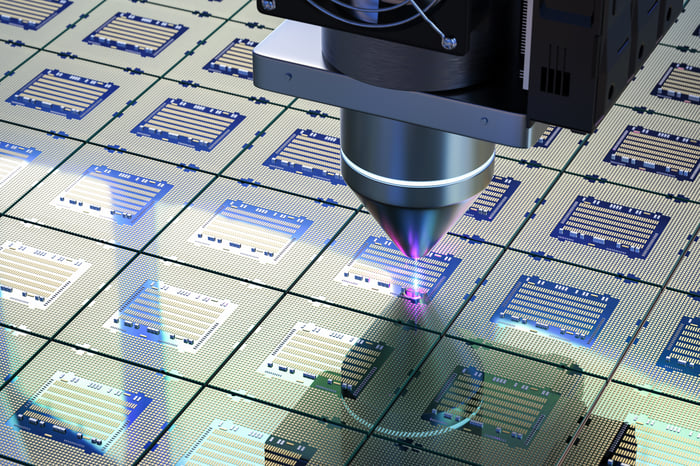
Source: Getty Images.
Buy: iShares Semiconductor ETF
This ETF tracks the NYSE Semiconductor Index. It's weighted by market cap and is designed to capture the performance of the biggest semiconductor stocks in the world. It holds around 30 stocks and charges an annual expense ratio of 0.34%.
The one thing that I believe this fund does well is it tries to eliminate some of the idiosyncratic risk that comes from overweighting the industry leaders. That involves capping the weighting on the fund's individual holdings. Among the criteria:
- The fund's top five holdings are capped at an 8% allocation.
- Remaining holdings are capped at 4%.
There are some added guidelines on what the ETF can hold and in what proportion, but these are the criteria that will affect what the fund looks like the most. This structure helps spread out exposure within the semiconductor sector and avoid some of the vulnerability that comes from excessive weightings in just a few big companies.
In my opinion, this is the preferred way to go. Pure market-cap weighted strategies are fine when just a handful of market leaders are driving returns, as we've seen over the past few years. When the market shifts away from those stocks, as we've seen in 2026, it turns a strength into a weakness.
Avoid: VanEck Semiconductor ETF
This ETF is linked to the MVIS U.S. Listed Semiconductor 25 Index. As the name suggests, it includes roughly 25 stocks. It's also market-cap weighted. Like the iShares fund, it targets all of the global industry leaders. It charges an annual expense ratio of 0.35%.
This ETF is more of a pure play on the industry's biggest companies without the guardrails or caps on individual holdings. As a result, the fund's top two holdings alone -- Nvidia and Taiwan Semiconductor Manufacturing -- account for 30% of the fund. That makes it extremely vulnerable to a sharp pullback in either of these stocks.
As of Feb. 13, Nvidia is down 11% year to date. If investors continue to favor non-tech areas of the market, or decide that companies are going too far with capital expenditures, or momentum has simply slowed down, the VanEck ETF would appear to have more downside risk.
Which semiconductor ETF looks like a better buy?
For me, the iShares Semiconductor ETF is better structured and the better buy. The semiconductor space is concentrated as it is. The VanEck Semiconductor ETF's pure market-cap weighting makes that concentration even worse.
The iShares ETF at least tries to spread out some of that risk. That makes it a better way to approach investing in the sector as a whole.
Should you buy stock in iShares Trust - iShares Semiconductor ETF right now?
Before you buy stock in iShares Trust - iShares Semiconductor ETF, consider this:
The Motley Fool Stock Advisor analyst team just identified what they believe are the 10 best stocks for investors to buy now… and iShares Trust - iShares Semiconductor ETF wasn’t one of them. The 10 stocks that made the cut could produce monster returns in the coming years.
Consider when Netflix made this list on December 17, 2004... if you invested $1,000 at the time of our recommendation, you’d have $415,256!* Or when Nvidia made this list on April 15, 2005... if you invested $1,000 at the time of our recommendation, you’d have $1,151,865!*
Now, it’s worth noting Stock Advisor’s total average return is 892% — a market-crushing outperformance compared to 194% for the S&P 500. Don't miss the latest top 10 list, available with Stock Advisor, and join an investing community built by individual investors for individual investors.
See the 10 stocks »
*Stock Advisor returns as of February 20, 2026.
David Dierking has positions in iShares Trust-iShares Semiconductor ETF. The Motley Fool has positions in and recommends Nvidia, Taiwan Semiconductor Manufacturing, and iShares Trust-iShares Semiconductor ETF. The Motley Fool has a disclosure policy.
Recommended Articles


