


Where Will Lucid (LCID) Stock Be in 1 Year?
Key Points
Lucid’s stock crumbled as it struggled to ramp up its deliveries.
But its stock is undervalued, and any positive news could drive it higher.
- 10 stocks we like better than Lucid Group ›
Lucid's (NASDAQ: LCID) stock has declined more than 70% over the past 12 months. The luxury EV maker, which went public through a 2021 merger with a special purpose acquisition company (SPAC), disappointed investors with sluggish deliveries and steep losses. Let's see if it can break out of its rut over the next year.
Why did Lucid's stock crash?
Lucid initially attracted a lot of attention because it was led by Peter Rawlinson, the former chief vehicle engineer at Tesla (NASDAQ: TSLA), who oversaw the development of the Model S. But like many other SPAC-backed EV makers, Lucid overpromised and underdelivered.
Will AI create the world's first trillionaire? Our team just released a report on the one little-known company, called an "Indispensable Monopoly" providing the critical technology Nvidia and Intel both need. Continue »
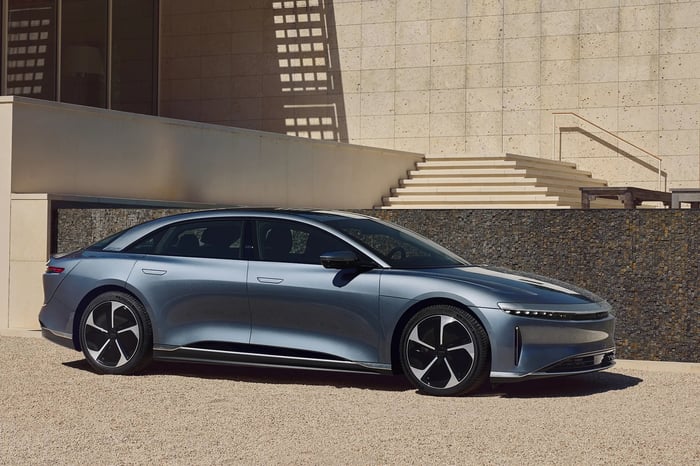
Image source: Lucid.
Before its public debut, Lucid claimed it could deliver 20,000 vehicles in 2022, 49,000 in 2023, and 90,000 in 2024. In reality, it delivered only 4,369 cars in 2022, 6,001 in 2023, and 10,241 in 2024. It struggled with supply chain constraints, competition, and the impacts of inflation, higher interest rates, and reduced EV subsidies on the broader EV market. Rawlinson also resigned in early 2025, and the company still hasn't appointed a permanent CEO.
Can Lucid's stock recover?
The bulls expect Lucid's support from the Saudi Arabian government, which owns over 60% of its shares through its Public Investment Fund (PIF), to help it scale its business. It also finally started shipping its second vehicle, the Gravity SUV, at the end of 2024.
Last July, Lucid partnered with Uber (NYSE: UBER) and Nuro to deploy at least 20,000 autonomous Gravity SUVs across the U.S. over the following six years. It's also still fulfilling a 10-year order for 100,000 vehicles from the Saudi Arabian government, which began in 2022.
Lucid plans to launch its third vehicle, the more affordable "Earth" SUV, in late 2026 or early 2027 to compete more effectively against Tesla and other EV makers. It will also upgrade its original AMP-1 plant in Arizona and AMP-2 plant in Saudi Arabia to support that expansion.
From 2025 to 2027, analysts expect Lucid's revenue to more than triple, from $1.3 billion to $4.6 billion, as it sells more Air sedans, ramps up production of the Gravity SUV, and rolls out its first Earth SUVs. They also expect it to gradually narrow its losses.
With a market cap of $3.3 billion, Lucid looks undervalued at 1.4 times this year's sales. Tesla, which is bigger and more profitable, trades at 15.2 times this year's sales. Moreover, 43% of Lucid's float was still being shorted as of Jan. 30. That bargain-bin valuation and high short interest could set it up for a big short squeeze on any positive news. Lucid is still a highly speculative stock, but I think it could bounce back over the next 12 months if it steadily ramps up its production without any major delays.
Should you buy stock in Lucid Group right now?
Before you buy stock in Lucid Group, consider this:
The Motley Fool Stock Advisor analyst team just identified what they believe are the 10 best stocks for investors to buy now… and Lucid Group wasn’t one of them. The 10 stocks that made the cut could produce monster returns in the coming years.
Consider when Netflix made this list on December 17, 2004... if you invested $1,000 at the time of our recommendation, you’d have $414,554!* Or when Nvidia made this list on April 15, 2005... if you invested $1,000 at the time of our recommendation, you’d have $1,120,663!*
Now, it’s worth noting Stock Advisor’s total average return is 884% — a market-crushing outperformance compared to 193% for the S&P 500. Don't miss the latest top 10 list, available with Stock Advisor, and join an investing community built by individual investors for individual investors.
See the 10 stocks »
*Stock Advisor returns as of February 17, 2026.
Leo Sun has no position in any of the stocks mentioned. The Motley Fool has positions in and recommends Tesla and Uber Technologies. The Motley Fool has a disclosure policy.
Recommended Articles


