


Could Investing $10,000 in USA Rare Earth Make You a Millionaire?
Key Points
USA Rare Earth is building a rare-earth mine and magnet manufacturing facility.
If it succeeds, it could fill a crucial gap in the American supply chain.
A $10,000 investment is a risky move at this point.
- 10 stocks we like better than USA Rare Earth ›
Right now, the U.S. has a gaping hole in its supply chain, a weak link that's gradually becoming a serious security risk. It's a strange kind of fragility, a vulnerability created by something you could easily lose between the cushions of your sofa. That missing link is the production of permanent magnets, and the security risk is that most of them are produced overseas in China.
Permanent magnets are made from rare-earth elements, like neodymium and praseodymium, which are found abundantly in the earth's crust but scarcely in viable quantities. Mining them is one thing, refining them into usable materials is quite another. And USA Rare Earth (NASDAQ: USAR) is aiming to do both.
Where to invest $1,000 right now? Our analyst team just revealed what they believe are the 10 best stocks to buy right now, when you join Stock Advisor. See the stocks »
Strategically, USA Rare Earth is positioning itself as the answer to that missing link in the U.S. supply chain. It wants to mine rare-earth elements and turn them into finished magnets. These homegrown magnets would then serve countless useful ends -- from electric vehicle motors to defense systems to clean energy -- and gradually reduce the United States' dependence on foreign exports.
Surging demand for these magnets has bolstered USA Rare Earth's ambitions, but it's still a long ways away from becoming the go-to American shop for rare-earth magnets. If successful, a huge investment -- say, $10,000 or more -- could possibly set investors up for life. But the risks are just as large as the opportunity, and investors should be aware of both before taking a huge stake in this mining stock.
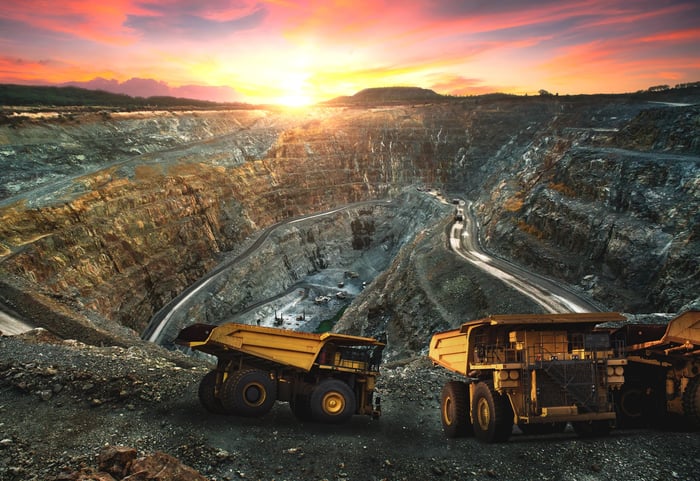
Image source: Getty Images.
Building the missing link in America's supply chain
In a nutshell, USA Rare Earth is trying to build a mine-to-magnet pipeline.
It controls one of the largest critical mineral ore bodies in the U.S -- the Round Top Deposit in Texas. This site contains 15 of 17 rare-earth elements, including several other critical minerals that could serve useful purposes in the American industrial ecosystem. It plans to commission this mine in 2028.
Of course, mining is a capital intensive effort. In anticipation of this, USA Rare Earth also operates a research lab in Colorado in which it's piloting rare-earth separation techniques that could save it millions.
Downstream, the company is also developing a magnet manufacturing facility in Oklahoma. This facility, which is projected to go live in 2026, will be capable of producing 5,000 metric tons of sintered permanent magnets annually.
The mine, research and development lab, and magnet factory could all make USA Rare Earth one of the few fully integrated rare-earth companies outside of China.
But let's not get ahead of ourselves. One of this mining start-up's glaring weaknesses is that it has no history of commercial operations. Right now, it's 100% reliant on external funding for operations, and until it opens its mine and starts producing magnets, it will likely burn cash and report losses.
For $10,000 to grow into $1 million, USA Rare Earth stock would need to grow 100-fold. Its valuation at the end of this growth would be more than $424 billion. Fun fact: The largest industrial and mining stocks carry market caps below $400 billion.
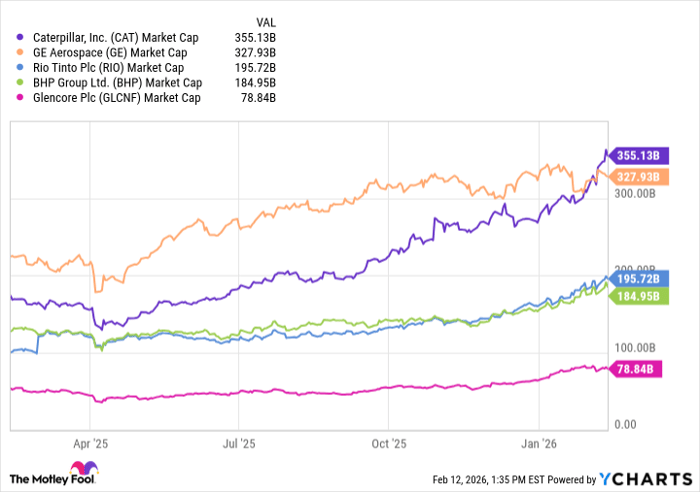
data by YCharts
USA Rare Earth has potential to grow, but I would temper expectations. A small stake in this growth stock could pay off over the long term, but I'd avoid making it a core position.
Should you buy stock in USA Rare Earth right now?
Before you buy stock in USA Rare Earth, consider this:
The Motley Fool Stock Advisor analyst team just identified what they believe are the 10 best stocks for investors to buy now… and USA Rare Earth wasn’t one of them. The 10 stocks that made the cut could produce monster returns in the coming years.
Consider when Netflix made this list on December 17, 2004... if you invested $1,000 at the time of our recommendation, you’d have $414,554!* Or when Nvidia made this list on April 15, 2005... if you invested $1,000 at the time of our recommendation, you’d have $1,120,663!*
Now, it’s worth noting Stock Advisor’s total average return is 884% — a market-crushing outperformance compared to 193% for the S&P 500. Don't miss the latest top 10 list, available with Stock Advisor, and join an investing community built by individual investors for individual investors.
See the 10 stocks »
*Stock Advisor returns as of February 14, 2026.
Steven Porrello has positions in USA Rare Earth. The Motley Fool has positions in and recommends Caterpillar and GE Aerospace. The Motley Fool recommends BHP Group. The Motley Fool has a disclosure policy.
Recommended Articles


