


This Signal Triggered Before the Last 4 Recessions. It Just Happened Again.
Key Points
The 10-year/3-month Treasury yield spread recently went from negative to positive.
That has happened just prior to the last four recessions.
Weakness in the labor market, rising debt levels, and exhausted consumer spending behavior would support the recession argument today.
- These 10 stocks could mint the next wave of millionaires ›
The question of whether the U.S. economy is heading toward recession is a polarizing one.
On one hand, GDP grew at a 4.4% annualized clip in the third quarter. The unemployment rate is still in the 4% to 5% range. Inflation is still well above the Federal Reserve's target but it's also sustainably below the 3% level.
Will AI create the world's first trillionaire? Our team just released a report on the one little-known company, called an "Indispensable Monopoly" providing the critical technology Nvidia and Intel both need. Continue »
Those figures together wouldn't suggest an economy that's facing an imminent threat of recession. But there's more to the story.
The labor market has essentially stagnated with very few jobs being added on a monthly basis. Job openings have dropped to the lowest level since the post-pandemic period. Government and consumer debt levels are continuing to climb and affordability has been a hot topic for years.
One signal, however, indicates a recession might be closer than we realize.

Image source: Getty Images.
The 10-year/3-month Treasury yield spread has turned positive
The shape of the Treasury yield curve often provides clues as to which way the economy might be heading.
The long end of the curve is more influenced by what's going on in the economy. At a high level, rates tend to rise when the economy is in good shape and fall when conditions look questionable. The short end of the curve is highly influenced by the current Fed Funds rate.
History shows that when the difference between the 10-year yield and the 3-month yield turns negative, it triggers a recession watch. In other words, short-term rates are probably set too high for conditions and that could lead to an economic slowdown or even a full-blown recession.
When that spread turns positive again, the recession clock starts. At this point, the Fed has probably started lowering rates, but not quickly enough to avoid a downturn.
It turns out that the pattern of this Treasury yield turning negative and then positive has been a reliable recession predictor.
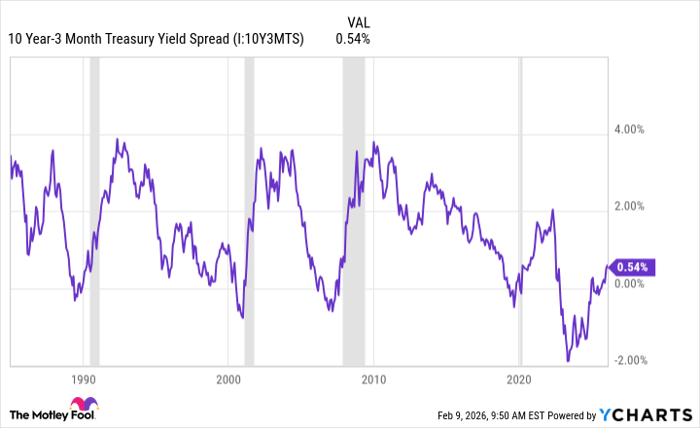
10 Year-3 Month Treasury Yield Spread data by YCharts
For the past four recessions, the 10-year/3-month yield spread turned positive just before a recession officially started.
That spread just recently flipped from negative to positive again.
Does that mean a recession is imminent right now? Not necessarily, but it's not a good sign either. Sometimes, a recession can happen immediately, as it did during the tech bubble. Back in 1991, however, it took more than a year before a recession began. There's no magic formula or timeline, but it often correlates with significant declines in the S&P 500.
I'd be hesitant to argue against history though. In 2026, labor market conditions have meaningfully deteriorated and that tends to be a strong predictor of slowdowns. Consumer spending feels like it's about maxed out. If consumers finally start pulling back, that's another strong indicator of a slowdown ahead. If the government tries to spend its way out of a recession, it's possible that one could be avoided, although that comes with its own set of problems.
Overall, I'm on recession watch. This reliable predictor tells us that we're at risk and it's being backed up by the numbers.
Where to invest $1,000 right now
When our analyst team has a stock tip, it can pay to listen. After all, Stock Advisor’s total average return is 884%* — a market-crushing outperformance compared to 193% for the S&P 500.
They just revealed what they believe are the 10 best stocks for investors to buy right now, available when you join Stock Advisor.
See the stocks »
*Stock Advisor returns as of February 14, 2026.
David Dierking has no position in any of the stocks mentioned. The Motley Fool has no position in any of the stocks mentioned. The Motley Fool has a disclosure policy.
Recommended Articles


