


Should You Buy Vulcan Materials Stock Before Feb. 17?
Key Points
Vulcan Materials is the largest producer of construction aggregates in the U.S.
The stock is up more than 14% this year and more than 21% over the past year.
It trades well above the sector's average valuation.
- 10 stocks we like better than Vulcan Materials ›
Vulcan Materials (NYSE: VMC) may need to crush its fourth-quarter earnings to keep investors happy. The company produces aggregates -- the building blocks of road infrastructure and construction -- such as crushed stone, sand, gravel, and other aggregate-based materials, like ready-mix concrete and asphalt.
The company is scheduled to report fourth-quarter earnings on Feb. 17. Let's see whether it makes sense to buy the stock before then.
Will AI create the world's first trillionaire? Our team just released a report on the one little-known company, called an "Indispensable Monopoly" providing the critical technology Nvidia and Intel both need. Continue »
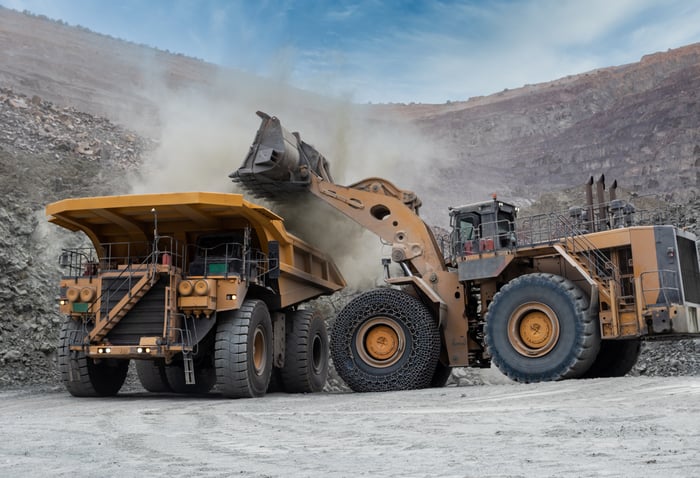
Image source: Getty Images.
What happened the last time Vulcan reported earnings?
Vulcan had very positive numbers in its third-quarter report on Oct. 30. It reported revenue of $2.29 billion, up 14.4% year over year, while earnings per share (EPS) were $2.83, up 80% over the same period a year ago.
The report led to an immediate bump in the stock. It opened on Oct. 30 at $285.50 and closed at $290, about 5% higher. Now, several months later, the company's shares are around $311 as of Feb. 11. The cost of transporting aggregates can cut into profits, but Vulcan cited improved margins for the higher EPS. It said that cash gross profit per ton was $11.51, a 13% year-over-year increase, marking the 11th consecutive quarter of double-digit profitability improvement.
What's the expectation for this quarter?
The company is estimating that aggregate shipments will be up around 3% in 2025 and that 2025 adjusted earnings before interest, taxes, depreciation, and amortization (EBITDA) will be between $2.35 billion and $2.45 billion, an increase of 17% at the midpoint.
Analysts, however, appear less enthusiastic about what the fourth quarter will bring. The average analyst predicts the company's revenue will come in at $1.96 billion, a drop of 2.7% over the same quarter a year ago. Analysts also forecast fourth-quarter EPS of $2.11, down from $2.17 in the fourth quarter of 2024.
One potential gauge of what may happen lies with Vulcan competitor Martin Marietta, which reported fourth-quarter earnings on Feb. 11. Martin Marietta said that its revenue was $1.5 billion, up 9% year over year, despite sluggish numbers for single-family home construction. However, EPS was reported as $4.62, a drop of 4% over the same quarter a year ago, due to increased acquisition, divestiture, and integration expenses.
It might be smart not to buy the stock before Feb. 17
If Vulcan's numbers come in below analysts' expectations, the stock would likely fall. While Vulcan has shown steady growth, it is trading at more than 38 times earnings, well above the building materials sector average of around 27. There's also a concern about a potential slowdown. Investors closely watch the company's tonnage shipped. Vulcan reported 64.7 million tons of aggregate shipped in the third quarter, up 12% year over year. The company is already predicting slower growth than that, and if the number of tons shipped falls, the stock would take a hit.
If Vulcan's stock does fall following earnings, investors may be wise to buy it on the dip. The company, based in Birmingham, Alabama, has been around for more than a century and has a dividend that allows investors to be patient for a rebound. While its yield is only around 0.6% (partially because of the recent strong stock performance), Vulcan has increased its dividend for eight consecutive years, including a 7% rise in 2025.
Should you buy stock in Vulcan Materials right now?
Before you buy stock in Vulcan Materials, consider this:
The Motley Fool Stock Advisor analyst team just identified what they believe are the 10 best stocks for investors to buy now… and Vulcan Materials wasn’t one of them. The 10 stocks that made the cut could produce monster returns in the coming years.
Consider when Netflix made this list on December 17, 2004... if you invested $1,000 at the time of our recommendation, you’d have $429,385!* Or when Nvidia made this list on April 15, 2005... if you invested $1,000 at the time of our recommendation, you’d have $1,165,045!*
Now, it’s worth noting Stock Advisor’s total average return is 913% — a market-crushing outperformance compared to 196% for the S&P 500. Don't miss the latest top 10 list, available with Stock Advisor, and join an investing community built by individual investors for individual investors.
See the 10 stocks »
*Stock Advisor returns as of February 12, 2026.
James Halley has no position in any of the stocks mentioned. The Motley Fool has no position in any of the stocks mentioned. The Motley Fool has a disclosure policy.
Recommended Articles


