


The "Magnificent Seven" Plan to Spend $680 Billion Largely on Artificial Intelligence Capex: Is Now the Time to Pile Into the Group?
Key Points
Despite market concerns, the "Magnificent Seven" are moving full steam ahead with AI-related capital expenditures.
Many of the large tech companies view AI as an arms race.
However, the market is seeking strong returns given the significant investment.
- 10 stocks we like better than Microsoft ›
Despite investor concerns about excessive spending on artificial intelligence (AI)-related infrastructure, large tech companies in the Magnificent Seven group are plowing ahead with big spending plans.
It's clear that these companies still view the AI revolution as an arms race and don't want to miss out on what many are calling the fourth industrial revolution. Is now the time to pile into the group?
Where to invest $1,000 right now? Our analyst team just revealed what they believe are the 10 best stocks to buy right now, when you join Stock Advisor. See the stocks »
Image source: Nvidia.
$680 billion forecast in mostly AI capex
As the Magnificent Seven have reported earnings reports in recent weeks, they have begun to provide guidance on capital expenditure plans, much of which will be used for AI infrastructure, products, and services. Here is where things stand so far:
- Amazon (NASDAQ: AMZN): Guided for $200 billion this year, up from $131 billion last year. CEO Andy Jassy said much of the spend is for infrastructure such as data centers, chips, and networking equipment to keep up with "very high demand" for AI compute.
- Alphabet (NASDAQ: GOOG)(NASDAQ: GOOGL): $180 billion of capex at the midpoint of management's guidance, which is nearly double what the company spent last year. Wall Street analysts, on average, had expected only about $115 billion in capex. Alphabet's CEO Sundar Pichai said spending would be allocated for data centers, the company's custom tensor processing units (TPU), and the company's DeepMind research lab.
- Microsoft (NASDAQ: MSFT): Microsoft's fiscal year 2026 is already halfway over, and the company has spent over $72 billion in capex, putting it on pace for $144 billion in fiscal year 2026. Much of this spending has been on graphics processing units (GPUs) and central processing units (CPUs).
- Meta Platforms (NASDAQ: META) guided for 2026 capex, including principal payments on finance leases, of $125 billion at the midpoint of management's guidance, driven by higher investments in the company's Meta Superintelligence Labs and the core business.
- Tesla (NASDAQ: TSLA) said it plans to more than double capex to about $20 billion in 2026 to fund the expansion of its robotaxi fleet and Optimus humanoid robots.
- Apple (NASDAQ: AAPL) continues to lag on AI capex and is only guiding for $13 billion of capex in 2026.
- Nvidia (NASDAQ: NVDA) will not report earnings until later this month, but it doesn't have high AI capex spending like the other hyperscalers because it is primarily in the business of selling GPUs, and doesn't manufacture its chips, so it's actually a capital-light business.
If I were to annualize Microsoft's fiscal year 2026 capex and add all of these plans together, that's over $680 billion on capex, most of which will go to AI infrastructure. That's up significantly from estimates of $400 billion in AI-related capex in 2025.
Should you pile into the Magnificent Seven?
At this time last year, capex plans like this would have sent many Magnificent Seven stocks soaring. This year, not so much. Meta, which showed how AI is significantly boosting ad revenue, saw its shares surge upon revealing its capex plans. However, Microsoft, which reported 15 million paying Copilot customers for its AI assistant and chatbot, saw its shares crushed because that's only a fraction of its total 450 million Microsoft 365 customer base.
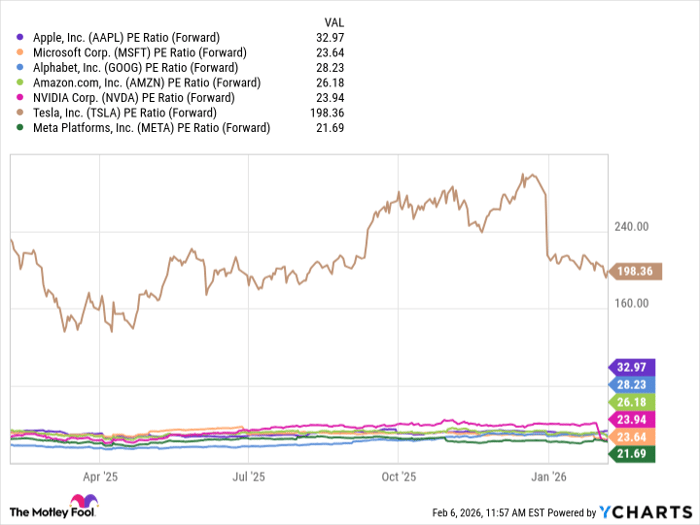
Investors have a tighter leash on the group. Until the returns show up, they aren't likely to reward AI capex spending like they once did. Here is where forward price-to-earnings valuations sit today:
Data by YCharts.
It's not all about selling stocks with high P/E ratios and buying ones with low P/Es. Rather, investors need to justify valuations and determine whether they are paying up for growth that will materialize. Is Microsoft likely to keep growing Copilot's user base? Most likely, but that doesn't necessarily mean Copilot will ever compete with OpenAI's ChatGPT.
Meta is a good name right now because investors can clearly see how capex is translating into revenue growth. Apple is also somewhat well-positioned because it hasn't invested heavily in AI capex, but is expected to develop a more prudent AI strategy.
For Tesla, investors have to understand whether the robotaxi business and humanoid robots can become as big as the market expects.
It certainly could, but how positive are you of that outcome? Also, what happens to the stock if the company disappoints while trading at close to 200 times forward earnings? These are all questions investors need to think about when investing in a Magnificent Seven stock.
Should you buy stock in Microsoft right now?
Before you buy stock in Microsoft, consider this:
The Motley Fool Stock Advisor analyst team just identified what they believe are the 10 best stocks for investors to buy now… and Microsoft wasn’t one of them. The 10 stocks that made the cut could produce monster returns in the coming years.
Consider when Netflix made this list on December 17, 2004... if you invested $1,000 at the time of our recommendation, you’d have $443,353!* Or when Nvidia made this list on April 15, 2005... if you invested $1,000 at the time of our recommendation, you’d have $1,155,789!*
Now, it’s worth noting Stock Advisor’s total average return is 920% — a market-crushing outperformance compared to 196% for the S&P 500. Don't miss the latest top 10 list, available with Stock Advisor, and join an investing community built by individual investors for individual investors.
See the 10 stocks »
*Stock Advisor returns as of February 11, 2026.
Bram Berkowitz has no position in any of the stocks mentioned. The Motley Fool has positions in and recommends Alphabet, Amazon, Apple, Meta Platforms, Microsoft, Nvidia, and Tesla. The Motley Fool has a disclosure policy.
Recommended Articles


