


Prediction: This Monster Growth Stock Will Soar to $10 Trillion by 2030
Key Points
Nvidia has become the dominant force in the artificial intelligence (AI) chip market.
The company is quietly forging partnerships across adjacent pockets of the AI value chain.
Nvidia stock could be on pace to double -- if not rise even more -- by 2030.
- 10 stocks we like better than Nvidia ›
There are few companies in history that have experienced the same trajectory of growth as Nvidia (NASDAQ: NVDA). A little more than three years ago, the general opinion on Nvidia was that the company was a niche specialist in the world of online gaming.
Today, the entire artificial intelligence (AI) narrative essentially hinges on Nvidia's quarterly earnings report. How did this transition happen?
Where to invest $1,000 right now? Our analyst team just revealed what they believe are the 10 best stocks to buy right now. Continue »
In essence, the company's graphics processing units (GPUs) were parlayed far beyond the gaming industry and now represent the backbone of generative AI development. Every time a hyperscaler builds a new data center, you better believe Nvidia's phones are ringing off the hook for more chips.
Image source: Nvidia.
While generative AI represented the first phase of the ongoing technology revolution -- fueling Nvidia's market cap from $345 billion to nearly $4.5 trillion -- the rest of the decade will be defined by infrastructure.
Let's explore the numerous tailwinds that should unfold for Nvidia over the next several years. From there, I'll analyze Nvidia's valuation profile and break down how the company could reach a $10 trillion market cap by 2030.
What tailwinds does Nvidia have through the rest of the decade?
Nvidia is quietly evolving from a GPU designer into an end-to-end platform spanning chips, software, and networking gear. The company has forged relationships with a number of high-profile companies including Anthropic, Intel, Groq, Palantir, Archer Aviation, and Nokia. Each of these opportunities serves the same purpose: turn Nvidia into a vertical solution for systems across the AI value chain.
With Anthropic relying heavily on all three major cloud providers, -- Amazon Web Services (AWS), Microsoft Azure, and Google Cloud Platform (GCP) -- Nvidia is emerging as the biggest winner around AI capacity bottlenecks.
Each of these hyperscalers have outfitted their data centers with clusters of Nvidia's GPUs, giving the company an unparalleled level of lock-in as Anthropic and its peers train next-generation models.
Smartly, Nvidia is making moves beyond the foundation of training models. The next challenge to arise at the compute layer is all about inference. The company's new $20 billion licensing deal with Groq serves a strategic purpose: Move inference internally as a means to more swiftly and efficiently complement its existing infrastructure.
Many companies rely on Intel's x86 CPUs. Through its collaboration with Intel, Nvidia is creatively carving out its own pocket in the CPU realm. The two semiconductor veterans are working on custom CPU designs that leverage Nvidia's NVLink interconnects. This solution allows Nvidia to sell full-stack server racks without forcing companies to switch architectures.
Nvidia's moat is also strengthened by how its technology is being deployed across enterprise workflows. By teaming up with Palantir, Nvidia is becoming integrated in new environments across the private and public sectors. This is important as the company is playing a critical role in how raw data is being fed into AI-powered operating systems.
Lastly, the company's partnerships with Nokia, Archer, and a number of autonomous systems developers underscore how Nvidia is moving beyond data center infrastructure and into the world of physical AI.
Taken together, Nvidia has a number of both near- and long-term opportunities that should position the company for sustained, durable revenue and profits for the remainder of the decade -- and beyond -- as these markets expand.
Nvidia has a legitimate path to $10 trillion
The chart below illustrates consensus estimates among analysts for Nvidia's earnings per share (EPS) over the next couple of years. One point that sticks out to me is that analysts are modeling for a significant slowdown in earnings growth between calendar 2026 and 2027.
I think these figures could wind up being conservative in hindsight as, for now, it is nearly impossible to forecast how the opportunities detailed above will impact revenue and profit margins.
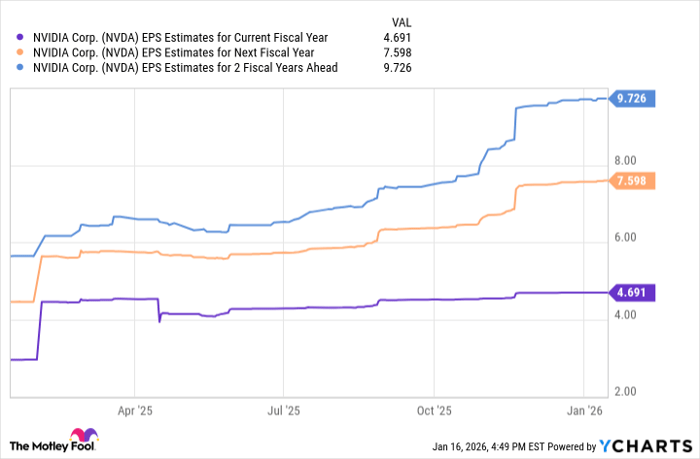
NVDA EPS Estimates for Current Fiscal Year data by YCharts
For the sake of my analysis, I'll assume Nvidia's EPS growth plateaus to around 20% following 2027. This would make the company's implied earnings roughly $17 per share by 2030.
If I apply Nvidia's current forward price-to-earnings (P/E) multiple of 24 to my 2030 projection, then I'd arrive at an implied share price of about $400. This suggests 117% upside from Nvidia's current stock price. Against this backdrop, Nvidia's implied market cap could be $9.7 trillion by 2030.
Here's the big picture: I'm not forecasting egregious, compounding growth from Nvidia's new partnerships and expanding market opportunities. Instead, I'm illustrating how the company could rather easily close in on a $10 trillion valuation even with a slowing, more mature profitability profile and the market no longer assigning a premium multiple.
In reality, I think Nvidia's evolution from chip designer to a diversified platform player will turn out to be massively accretive -- fueling robust acceleration across the top and bottom lines. As such, I think Nvidia is more realistically set up for meaningful valuation expansion and will be worth at least $10 trillion by the beginning of next decade.
For these reasons, I see Nvidia as a no-brainer buy right now for investors with a long time horizon. To me, the company is one of the most compelling opportunities positioned to continue dominating the AI realm for years to come.
Should you buy stock in Nvidia right now?
Before you buy stock in Nvidia, consider this:
The Motley Fool Stock Advisor analyst team just identified what they believe are the 10 best stocks for investors to buy now… and Nvidia wasn’t one of them. The 10 stocks that made the cut could produce monster returns in the coming years.
Consider when Netflix made this list on December 17, 2004... if you invested $1,000 at the time of our recommendation, you’d have $470,587!* Or when Nvidia made this list on April 15, 2005... if you invested $1,000 at the time of our recommendation, you’d have $1,091,605!*
Now, it’s worth noting Stock Advisor’s total average return is 930% — a market-crushing outperformance compared to 192% for the S&P 500. Don't miss the latest top 10 list, available with Stock Advisor, and join an investing community built by individual investors for individual investors.
See the 10 stocks »
*Stock Advisor returns as of January 22, 2026.
Adam Spatacco has positions in Amazon, Microsoft, Nvidia, and Palantir Technologies. The Motley Fool has positions in and recommends Amazon, Intel, Microsoft, Nvidia, and Palantir Technologies. The Motley Fool recommends the following options: long January 2026 $395 calls on Microsoft and short January 2026 $405 calls on Microsoft. The Motley Fool has a disclosure policy.
Recommended Articles


