

Could This Be the Next Stock to Join the Likes of Nvidia, Alphabet, and Amazon in the $1 Trillion Club?
Key Points
Oracle is building hundreds of data centers to meet demand for computing capacity from artificial intelligence developers.
The company's order backlog is over $500 billion, but investors are worried that it won't all convert into revenue.
Oracle was a stone's throw away from joining the $1 trillion club just a few months ago.
- 10 stocks we like better than Oracle ›
The U.S. economy has a history of producing the world's most valuable companies. United States Steel became the first $1 billion enterprise on the planet in 1901, and 117 years later, in 2018, iPhone maker Apple became the first to cross the $1 trillion milestone.
Eight other U.S. companies have since joined Apple in the trillion-dollar club, including Nvidia, Alphabet, Amazon, and Tesla. It looked as though Oracle (NYSE: ORCL) was set to join them back in September as its market capitalization peaked at $940 billion, but following a 41% decline in its stock price since then, the company is now valued at just $550 billion.
Where to invest $1,000 right now? Our analyst team just revealed what they believe are the 10 best stocks to buy right now. Continue »
Recent stock price performance aside, artificial intelligence (AI) developers are lining up to rent access to Oracle's data center infrastructure, which is fueling a surge in the company's revenues. Could it be only a matter of time before this tech titan charts a path back toward $1 trillion?

Image source: Getty Images.
A leader in AI infrastructure
Most AI development happens inside large, centralized data centers fitted with tens of thousands of advanced parallel processors -- many of them graphics processing units (GPUs) supplied by Nvidia and Advanced Micro Devices. It can cost billions of dollars to build a single data center, and since most businesses don't have that kind of money to dedicate to such endeavors, they rent computing capacity from specialized operators like Oracle instead.
Oracle's data center infrastructure is among the best in the industry. It uses proprietary random direct memory access (RDMA) networking technology that moves data between chips and devices more quickly than traditional Ethernet networks. Since most AI developers pay for computing capacity by the minute, even minor increases in processing speed can result in major cost savings over time.
Oracle's data centers also offer significant scale, enabling developers to tap into clusters of over 131,000 GPUs, which is enough to handle even the most advanced AI workloads.
Moreover, it's bringing capacity online at a rapid pace. As of the conclusion of its fiscal 2026 second quarter (which ended Nov. 30), Oracle had 147 data center regions up and running with 64 more in the pipeline. OpenAI, Elon Musk's xAI, and Facebook parent Meta Platforms are just a few of the tech juggernauts using Oracle's infrastructure.
Oracle's cloud infrastructure revenue is soaring
Oracle generated $16.1 billion in total revenue during its fiscal 2026 second quarter, which was a modest 14% increase from the prior-year period. But revenue from its cloud infrastructure segment, specifically, soared by 66% to a record $4.1 billion.
The cloud infrastructure unit could be growing its sales even faster, but Oracle simply can't build data centers fast enough to meet demand. That's why the company's remaining performance obligations (RPO) rocketed by a whopping 438% year over year to $523 billion during the quarter. RPO is like an order backlog, because it reflects the value of signed contracts with customers for services that haven't been delivered yet.
Around $300 billion of Oracle's RPO is reportedly from one customer, OpenAI, which creates concentration risk. OpenAI is still a fairly young company, and it doesn't have anywhere close to $300 billion in cash on hand. Unless it becomes a raging financial success, this enormous commitment might never convert into revenue for Oracle.
Skepticism about this deal is part of the reason Oracle stock has plummeted in the past few months. The company has around $108 billion in debt, and it's taking on even more to fund the construction of more data centers. The possibility that one of its top customers might never have the money to rent all of the capacity it has requested is spooking investors.
Will Oracle join the $1 trillion club?
Oracle generated earnings of $5.32 per share over the last four quarters on a generally accepted accounting principles (GAAP) basis, which gives its stock a price-to-earnings (P/E) ratio of 36.1. That is a premium to the technology-focused Nasdaq-100 index, which trades at a P/E ratio of 32.1, so even though Oracle stock has tumbled, it still isn't cheap.
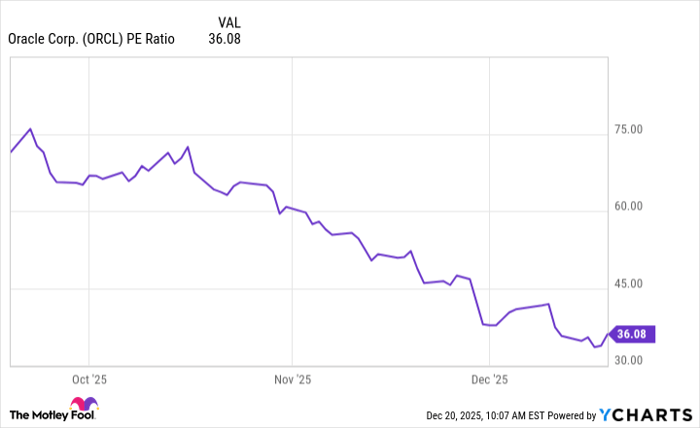
ORCL PE Ratio data by YCharts.
From its market cap of about $550 billion today, Oracle's stock would have to soar by 82% for the company to join the $1 trillion club. If we assume Oracle's P/E ratio remains exactly where it is right now, the company would have to nearly double its earnings per share to justify that type of share price gain. If its P/E ratio declines further, it will have an even steeper mountain to climb.
Oracle's AI business is growing at a lightning-fast pace right now, so there's a good chance the company will join the $1 trillion club at some point, but it probably won't be the next member inducted. Several other U.S. companies are much closer to the mark: Walmart has a market cap of $911 billion, and JPMorgan Chase is also in range at $872 billion.
Should you buy stock in Oracle right now?
Before you buy stock in Oracle, consider this:
The Motley Fool Stock Advisor analyst team just identified what they believe are the 10 best stocks for investors to buy now… and Oracle wasn’t one of them. The 10 stocks that made the cut could produce monster returns in the coming years.
Consider when Netflix made this list on December 17, 2004... if you invested $1,000 at the time of our recommendation, you’d have $509,039!* Or when Nvidia made this list on April 15, 2005... if you invested $1,000 at the time of our recommendation, you’d have $1,109,506!*
Now, it’s worth noting Stock Advisor’s total average return is 972% — a market-crushing outperformance compared to 193% for the S&P 500. Don't miss the latest top 10 list, available with Stock Advisor, and join an investing community built by individual investors for individual investors.
See the 10 stocks »
*Stock Advisor returns as of December 23, 2025.
JPMorgan Chase is an advertising partner of Motley Fool Money. Anthony Di Pizio has no position in any of the stocks mentioned. The Motley Fool has positions in and recommends Advanced Micro Devices, Alphabet, Amazon, Apple, JPMorgan Chase, Meta Platforms, Nvidia, Oracle, Tesla, and Walmart. The Motley Fool has a disclosure policy.
Recommended Articles


