
The Best Stocks to Invest $1,000 in Right Now

Source The Motley Fool

Key Points

  • Two of these tech players make great buys for growth investors, while the third player is well-suited to any stock portfolio.

  • These companies may benefit as the AI boom marches on.

  • 10 stocks we like better than Palantir Technologies ›

Artificial intelligence (AI) stocks have driven gains in the technology industry -- and the overall stock market -- over the past few years. The S&P 500 today is heading for its third straight double-digit annual increase thanks to this momentum. Investors have rushed to get in on these players amid excitement about the potential of AI to make companies more efficient and supercharge earnings performance.

But in recent weeks, some market participants have shied away from AI players with the idea that they may have advanced too far, too fast. Still, many signs point to a very bright long-term AI story: from ongoing demand for AI products and services to soaring revenue that we've seen at many AI companies. This suggests that some price declines may represent buying opportunities.

Where to invest $1,000 right now? Our analyst team just revealed what they believe are the 10 best stocks to buy right now. Continue »

Here, I'll talk about two stocks to buy on the dip and another tech player that hasn't benefited as much as others from the AI boom -- but could do so in the coming year. The first two are best suited to growth investors who can handle a bit of risk, while the third stock makes a fantastic addition to any portfolio. And with $1,000 or even less, you could get in on just one or all three. Let's check out the best stocks to invest $1,000 in right now.

Two smiling investors bump fists in an office.

Image source: Getty Images.

1. Palantir Technologies

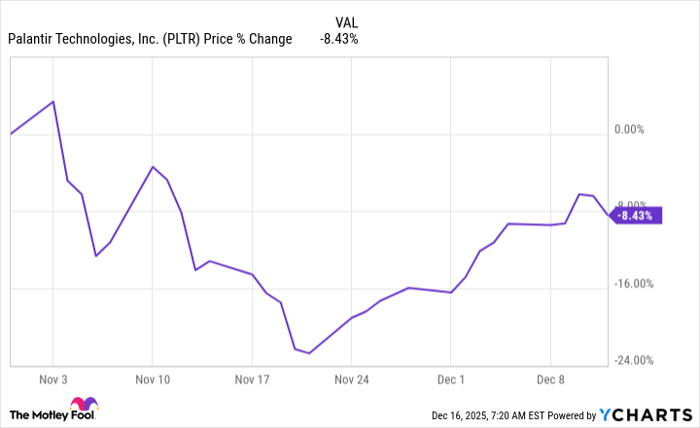
Palantir Technologies (NASDAQ: PLTR) has wowed the market with its earnings and stock price performances. The software company has seen revenue soar in the double digits quarter after quarter, profit also has advanced, and the stock has climbed 2,500% over the past three years.

The reason for all of this is simple: Palantir offers customers a way to apply AI to their needs almost overnight. The company's software aggregates and analyzes a customer's data, so the customer can then make use of that data. Two years ago, Palantir launched its Artificial Intelligence Platform (AIP), an AI-driven system, and since that moment, demand has skyrocketed. All of this has spurred growth in Palantir's government and commercial businesses.

The problem these days is Palantir's lofty valuation, 253x times forward earnings estimates, but it's important to remember that such a measure doesn't take into account earnings potential years down the road. So, even though Palantir looks expensive by that measure, the stock still may have plenty of room to run over the long term -- and this makes it a great buy on the dip for growth investors.
PLTR Chart

PLTR data by YCharts

2. CoreWeave

CoreWeave (NASDAQ: CRWV) offers something that AI customers need right now -- and probably will need well into the future. I'm talking about access to high-powered graphics processing units (GPUs) to power their workloads. CoreWeave is a cloud player that specializes in the compute for AI, renting it out for a few hours or a day or for a long period of time.

The company offers customers options -- and saves them money because, in many cases, renting access to GPUs may be a lot cheaper than investing in a fleet of GPUs.

CoreWeave works closely with top GPU designer Nvidia, which also owns a 7% stake in the company. This vote of confidence from Nvidia is important since the chip leader has its finger on the pulse of the AI industry. Though CoreWeave isn't yet profitable, revenue has exploded higher -- for example, it more than doubled in the recent quarter.

CoreWeave stock has lost 60% from its peak, but it's still heading for a double-digit gain this year. As customers continue to seek compute to advance their AI projects, CoreWeave could be in the early days of its revenue growth story -- so if you're an aggressive investor, the best time to get in on this player may be now.

3. Apple

Apple (NASDAQ: AAPL) has become a household name, with many of us owning at least one of its famous products -- from the iPhone to the Mac. But this tech giant hasn't been a big winner of the AI boom so far, as it's taken a longer time than others to roll out an AI platform. It's progressively launched Apple Intelligence, a family of AI features for its products, over the past year, and the process should continue into next year.

As investors consider shifting out of some of the biggest AI gainers, they now may think of rotating into Apple. The tech powerhouse offers us a long track record of earnings strength, and in the coming months, its presence in AI could add to its growth.

Apple may also benefit from another very important trend that's been unfolding quarter after quarter. And this is growth in services revenue. Now that Apple has a massive base of active devices out there, it can count on them for recurring revenue. This is as Apple users sign up for services such as cloud storage or digital entertainment. In recent quarters, services revenue has reached record levels.

This year, Apple has underperformed the S&P 500, but that may not continue for long, as it soon may be Apple's turn to benefit from the AI boom.

Should you buy stock in Palantir Technologies right now?

Before you buy stock in Palantir Technologies, consider this:

The Motley Fool Stock Advisor analyst team just identified what they believe are the 10 best stocks for investors to buy now… and Palantir Technologies wasn’t one of them. The 10 stocks that made the cut could produce monster returns in the coming years.

Consider when Netflix made this list on December 17, 2004... if you invested $1,000 at the time of our recommendation, you’d have $505,695!* Or when Nvidia made this list on April 15, 2005... if you invested $1,000 at the time of our recommendation, you’d have $1,080,694!*

Now, it’s worth noting Stock Advisor’s total average return is 962% — a market-crushing outperformance compared to 193% for the S&P 500. Don't miss the latest top 10 list, available with Stock Advisor, and join an investing community built by individual investors for individual investors.

See the 10 stocks »

*Stock Advisor returns as of December 16, 2025.

Adria Cimino has no position in any of the stocks mentioned. The Motley Fool has positions in and recommends Apple, Nvidia, and Palantir Technologies. The Motley Fool has a disclosure policy.

Disclaimer: For information purposes only. Past performance is not indicative of future results.
placeholder
Gold Price Forecast: XAU/USD drifts higher above $4,200 as Fed delivers expected cutGold price (XAU/USD) gains momentum to around $4,235 during the early Asian session on Thursday. The precious metal extends its upside after the US Federal Reserve (Fed) delivered an expected third consecutive interest rate cut and maintained its outlook for just one cut in 2026.
Author  FXStreet
Dec 11, Thu
Gold price (XAU/USD) gains momentum to around $4,235 during the early Asian session on Thursday. The precious metal extends its upside after the US Federal Reserve (Fed) delivered an expected third consecutive interest rate cut and maintained its outlook for just one cut in 2026.
placeholder
Ethereum Price Slips Lower — $3,000 Looms as the Key BattlegroundEthereum is attempting to recover from a $3,026 low but remains below $3,200 and the 100-hour SMA, with a bearish trend line near $3,175 capping rebounds as bulls need a clean break above $3,200 to target $3,250–$3,400, while a drop below $3,050 risks a retest of $3,000 and $2,940.
Author  Mitrade
Dec 15, Mon
Ethereum is attempting to recover from a $3,026 low but remains below $3,200 and the 100-hour SMA, with a bearish trend line near $3,175 capping rebounds as bulls need a clean break above $3,200 to target $3,250–$3,400, while a drop below $3,050 risks a retest of $3,000 and $2,940.
placeholder
Macro Analysts: Hawkish Japan Could Push Bitcoin Below $70KAnalysts predict Bitcoin may face further declines towards the $70,000 mark if the Bank of Japan raises interest rates as expected.
Author  Mitrade
Dec 15, Mon
Analysts predict Bitcoin may face further declines towards the $70,000 mark if the Bank of Japan raises interest rates as expected.
placeholder
Bitcoin Slides 5% as Sellers Lean In — Can BTC Reclaim $88,000?Bitcoin has dropped back below $88,000 after rolling over from $90,500, with price still trading under the 100-hour Simple Moving Average. The sell-off found a floor at $85,151, and BTC is now consolidating near that base, but rebounds are facing pressure from a bearish trend line around $89,000. Bulls need to retake $88,000–$89,000 to ease downside risk; failure to do so keeps $85,500–$85,000 and then $83,500 in play, with $80,000 as the deeper “line in the sand.” Bitcoin (BTC) is back in damage-control mode after a sharp pullback wiped out recent gains. The price failed to reclaim the $90,000–$90,500 band, rolled over, and slid through $88,500 before briefly dipping under $87,000. Buyers did show up around $85,000, but the rebound so far looks more like stabilization than a clear trend reversal. Bitcoin dips hard, finds a bid near $85,000(h3) BTC’s latest move lower began when it couldn’t build follow-through above $90,000 and $90,500. Once that upside stalled, sellers took control and pushed price down through $88,500. The slide accelerated enough to spike below $87,000, but the market didn’t free-fall. Bulls defended the $85,000 zone, printing a low at $85,151. Since then, Bitcoin has been consolidating below the 23.6% Fibonacci retracement of the drop from the $93,560 swing high to the $85,151 low — a clue that the bounce is still shallow and that sellers haven’t fully backed off yet. Structurally, BTC is still on the back foot: It’s trading below $88,000, and It remains below the 100-hour Simple Moving Average, keeping short-term trend pressure pointed downward. Resistance is layered, and $89,000 is the problem area(h3) If bulls try to turn this into a recovery, they’ll have to climb through multiple ceilings in quick succession. First, BTC faces resistance around $87,150, followed by a more meaningful barrier near $87,500. From there, the market’s attention snaps back to $88,000 — the level BTC just lost and now needs to reclaim. A close back above $88,000 would improve the tone, but it doesn’t solve the bigger issue: there’s a bearish trend line on the hourly BTC/USD chart (Kraken feed) with resistance near $89,000, which also lines up with the next technical hurdle. If BTC can push through $89,000 and hold, the rebound could extend toward $90,000, with follow-through targets at $91,000 and $91,500. But until price clears that $88,000–$89,000 zone, rallies are at risk of being sold rather than chased. If BTC fails to reclaim resistance, the downside path is clear(h3) The near-term bear case is simple: if Bitcoin can’t climb back above the $87,000 area and keep traction, sellers may attempt another leg lower. Support levels line up like this: Immediate support: $85,500 First major support: $85,000 Next support: $83,500 Then $82,500 in the near term Below that, the major “don’t break this” level is still $80,000. If BTC slips under $80,000, the risk of acceleration to the downside increases significantly — not because it’s magic, but because it’s the kind of psychological and structural level that tends to trigger forced de-risking. Indicators: momentum still leans bearish(h3) The intraday indicators aren’t offering much comfort yet: Hourly MACD is losing pace in the bearish zone. Hourly RSI remains below 50, suggesting sellers still have the upper hand on short timeframes. So while the $85,000 defense held for now, the market hasn’t flipped bullish — it’s just stopped bleeding.
Author  Mitrade
22 hours ago
Bitcoin has dropped back below $88,000 after rolling over from $90,500, with price still trading under the 100-hour Simple Moving Average. The sell-off found a floor at $85,151, and BTC is now consolidating near that base, but rebounds are facing pressure from a bearish trend line around $89,000. Bulls need to retake $88,000–$89,000 to ease downside risk; failure to do so keeps $85,500–$85,000 and then $83,500 in play, with $80,000 as the deeper “line in the sand.” Bitcoin (BTC) is back in damage-control mode after a sharp pullback wiped out recent gains. The price failed to reclaim the $90,000–$90,500 band, rolled over, and slid through $88,500 before briefly dipping under $87,000. Buyers did show up around $85,000, but the rebound so far looks more like stabilization than a clear trend reversal. Bitcoin dips hard, finds a bid near $85,000(h3) BTC’s latest move lower began when it couldn’t build follow-through above $90,000 and $90,500. Once that upside stalled, sellers took control and pushed price down through $88,500. The slide accelerated enough to spike below $87,000, but the market didn’t free-fall. Bulls defended the $85,000 zone, printing a low at $85,151. Since then, Bitcoin has been consolidating below the 23.6% Fibonacci retracement of the drop from the $93,560 swing high to the $85,151 low — a clue that the bounce is still shallow and that sellers haven’t fully backed off yet. Structurally, BTC is still on the back foot: It’s trading below $88,000, and It remains below the 100-hour Simple Moving Average, keeping short-term trend pressure pointed downward. Resistance is layered, and $89,000 is the problem area(h3) If bulls try to turn this into a recovery, they’ll have to climb through multiple ceilings in quick succession. First, BTC faces resistance around $87,150, followed by a more meaningful barrier near $87,500. From there, the market’s attention snaps back to $88,000 — the level BTC just lost and now needs to reclaim. A close back above $88,000 would improve the tone, but it doesn’t solve the bigger issue: there’s a bearish trend line on the hourly BTC/USD chart (Kraken feed) with resistance near $89,000, which also lines up with the next technical hurdle. If BTC can push through $89,000 and hold, the rebound could extend toward $90,000, with follow-through targets at $91,000 and $91,500. But until price clears that $88,000–$89,000 zone, rallies are at risk of being sold rather than chased. If BTC fails to reclaim resistance, the downside path is clear(h3) The near-term bear case is simple: if Bitcoin can’t climb back above the $87,000 area and keep traction, sellers may attempt another leg lower. Support levels line up like this: Immediate support: $85,500 First major support: $85,000 Next support: $83,500 Then $82,500 in the near term Below that, the major “don’t break this” level is still $80,000. If BTC slips under $80,000, the risk of acceleration to the downside increases significantly — not because it’s magic, but because it’s the kind of psychological and structural level that tends to trigger forced de-risking. Indicators: momentum still leans bearish(h3) The intraday indicators aren’t offering much comfort yet: Hourly MACD is losing pace in the bearish zone. Hourly RSI remains below 50, suggesting sellers still have the upper hand on short timeframes. So while the $85,000 defense held for now, the market hasn’t flipped bullish — it’s just stopped bleeding.
placeholder
Senate Delays Crypto Market Structure Hearings to Early 2026The Senate Banking Committee has postponed cryptocurrency market structure hearings until 2026, citing ongoing bipartisan negotiations.
Author  Mitrade
19 hours ago
The Senate Banking Committee has postponed cryptocurrency market structure hearings until 2026, citing ongoing bipartisan negotiations.
goTop
quote