

The Best Stocks to Invest $50,000 in Right Now

Source The Motley Fool

Key Points

  • Artificial intelligence has been a significant driver in the stock market.

  • This trend is expected to continue in the new year.

  • These companies are involved in AI infrastructure, advertising, and autonomous vehicles.

  • 10 stocks we like better than Nvidia ›

December is the ideal time to give your investment portfolio a fresh look. As we're preparing to head into the new year, it's a good idea to take this opportunity to rebalance your positions, consider which ones you need to exit, and how to best set your investments up for the future.

While I'm always a fan of using exchange-traded funds to build a diversified portfolio, I also strongly believe in holding a group of individual stocks that I think will outperform the market.

Where to invest $1,000 right now? Our analyst team just revealed what they believe are the 10 best stocks to buy right now, when you join Stock Advisor. See the stocks »

If you've got $50,000 ready to invest -- you've paid off high-interest debt and won't need the money in the short or medium term -- here are five stock picks to consider. Each of them gets $10,000 in this hypothetical scenario.

Nvidia

Nvidia (NASDAQ: NVDA) is the king of semiconductor stocks -- in fact, it's the king of the stock market right now. Nvidia's graphics processing units (GPUs) are so effective in training and running artificial intelligence programs, machine learning, and generative AI that it has become the largest publicly traded company in the world.

Nvidia is estimated to own as much as 90% of the data center GPU market, and its Blackwell chips sold out in the company's most recent quarter, according to CEO Jensen Huang. It has made numerous partnerships with leading companies that are using its GPUs for AI training and inference. It's also partnering with the U.S. Department of Energy and multiple companies to build out the national AI infrastructure.

And you can bet that infrastructure will be powered by Nvidia's chips. This all makes the stock a strong bet for the future.

Alphabet

It appears that 2026 will be the year that Alphabet (NASDAQ: GOOG) (NASDAQ: GOOGL) starts making meaningful inroads in the chip space. It has been utilizing its in-house Tensor Processing Units (TPUs) as an alternative to other chips and has developed them to the point where they can run large-scale AI workloads. Now Alphabet is reportedly in talks with Meta Platforms to supply TPUs for Meta's data centers in what would be a multibillion-dollar deal.

But even if that doesn't happen, I still love Alphabet stock. It has the leading browser in Chrome and the leading search engine in Google -- both have dominant shares of the market. Its advertising revenue was more than $74 billion in the third quarter, and its Google Cloud revenue was $15.1 billion -- up 33% from a year ago.

Alphabet seems primed for a massive year.

Taiwan Semiconductor Manufacturing Co.

Taiwan Semiconductor Manufacturing Co. (NYSE: TSM) is the go-to foundry for Nvidia, Alphabet, and most other semiconductor manufacturers. TSMC, as it's popularly known, is the world's largest chip fabricator, with 60% of its revenue coming from 3nm and 5nm chips, which are essential for the most powerful semiconductors. TSMC's ability to refine its manufacturing processes and use smaller chip nodes gives it a massive advantage over competitors such as Samsung or Intel.

TSMC also makes chips for smartphones, the automotive industry, and to power Internet of Things products. The company is extremely versatile, using nearly 300 processes in 2024 to make almost 11,900 different products. And talk about consistency -- TSMC has enjoyed a compound annual growth rate of 18.2% since it went public in 1994.

That should continue as well -- the company is projecting revenue CAGR of nearly 20% and its gross margins to top 50%.
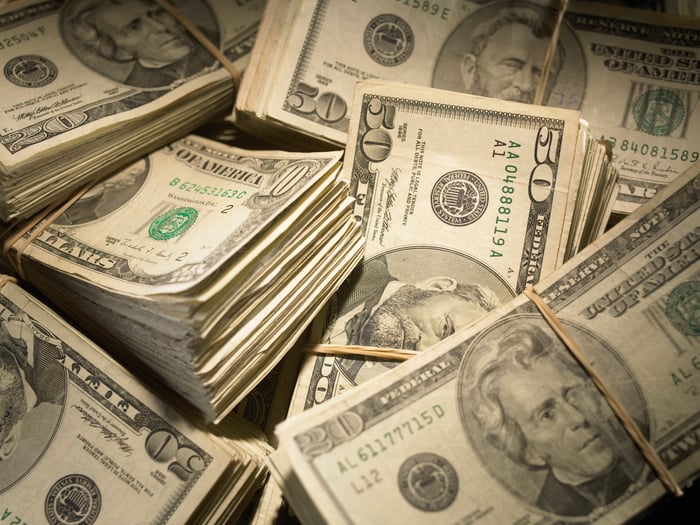
Stacks of paper money.

Image source: Getty Images.

Tesla

Tesla (NASDAQ: TSLA) has been a high-flying stock in the past, but 2025 was a step backward. CEO Elon Musk got involved in politics and President Donald Trump's election, then went to Washington to run the controversial initiative called the Department of Government Efficiency. Musk has since left Washington, and DOGE has closed, but the impact on Tesla stock was clear -- Tesla stock trails the broader market.

Sales of Tesla's electric vehicles are projected to take a hit this winter, and the company's profit margins are down, but Musk's company may be on the verge of a major breakthrough with autonomous driving. It's making rapid improvements in its self-driving software, which, when perfected, the company says, will allow Tesla owners to monetize their vehicles by making them available for robotaxis.

Melius Research analyst Rob Wertheimer has said Tesla's FSD (full self-driving) software will shift "hundreds of billions in value" from other automakers to Tesla. "The world is about to change, dramatically," he wrote in a research note. Many investors believe this to be true.

Credo Technology

This may be the most consequential company that you've never heard of. Credo Technology (NASDAQ: CDRO) provides wiring that data centers need to connect the hundreds of GPUs, TPUs, and other infrastructure components, enabling them to run AI programs.

Instead of copper wiring, Credo uses active electrical cables (AECs) to link chip clusters. The AECs have signal processors in the wiring -- a feature not found in common copper wiring -- that helps move data faster and more efficiently.

Credo's most recent quarter resulted in revenue of $268 million, which was up a whopping 272% from a year ago. For the next quarter, Credo is projecting revenue from $335 million to $345 million, which would be another 151% jump. And margins are expected to be at least 63%.

Credo may not be a sexy pick, but it looks set to bring in massive profits in 2026.

Should you invest $1,000 in Nvidia right now?

Before you buy stock in Nvidia, consider this:

The Motley Fool Stock Advisor analyst team just identified what they believe are the 10 best stocks for investors to buy now… and Nvidia wasn’t one of them. The 10 stocks that made the cut could produce monster returns in the coming years.

Consider when Netflix made this list on December 17, 2004... if you invested $1,000 at the time of our recommendation, you’d have $513,353!* Or when Nvidia made this list on April 15, 2005... if you invested $1,000 at the time of our recommendation, you’d have $1,072,908!*

Now, it’s worth noting Stock Advisor’s total average return is 965% — a market-crushing outperformance compared to 193% for the S&P 500. Don’t miss out on the latest top 10 list, available when you join Stock Advisor.

See the 10 stocks »

*Stock Advisor returns as of December 15, 2025

Patrick Sanders has positions in Nvidia. The Motley Fool has positions in and recommends Alphabet, Intel, Meta Platforms, Nvidia, Taiwan Semiconductor Manufacturing, and Tesla. The Motley Fool has a disclosure policy.

Disclaimer: For information purposes only. Past performance is not indicative of future results.
placeholder
Gold Price Forecast: XAU/USD drifts higher above $4,200 as Fed delivers expected cutGold price (XAU/USD) gains momentum to around $4,235 during the early Asian session on Thursday. The precious metal extends its upside after the US Federal Reserve (Fed) delivered an expected third consecutive interest rate cut and maintained its outlook for just one cut in 2026.
Author  FXStreet
Dec 11, Thu
Gold price (XAU/USD) gains momentum to around $4,235 during the early Asian session on Thursday. The precious metal extends its upside after the US Federal Reserve (Fed) delivered an expected third consecutive interest rate cut and maintained its outlook for just one cut in 2026.
placeholder
Gold remains bid as lack of Fed clarity and geopolitical frictions persistGold (XAU/USD) advances modestly on Friday as traders seem to book profits ahead of the weekend, yet clings to gains of over 0.51% after reaching a seven-week high of $4,353. At the time of writing, XAU/USD trades at $4,302 as traders digest comments from Federal Reserve (Fed) officials.
Author  FXStreet
Yesterday 01: 34
Gold (XAU/USD) advances modestly on Friday as traders seem to book profits ahead of the weekend, yet clings to gains of over 0.51% after reaching a seven-week high of $4,353. At the time of writing, XAU/USD trades at $4,302 as traders digest comments from Federal Reserve (Fed) officials.
placeholder
Ethereum Price Slips Lower — $3,000 Looms as the Key BattlegroundEthereum is attempting to recover from a $3,026 low but remains below $3,200 and the 100-hour SMA, with a bearish trend line near $3,175 capping rebounds as bulls need a clean break above $3,200 to target $3,250–$3,400, while a drop below $3,050 risks a retest of $3,000 and $2,940.
Author  Mitrade
Yesterday 03: 25
Ethereum is attempting to recover from a $3,026 low but remains below $3,200 and the 100-hour SMA, with a bearish trend line near $3,175 capping rebounds as bulls need a clean break above $3,200 to target $3,250–$3,400, while a drop below $3,050 risks a retest of $3,000 and $2,940.
placeholder
Macro Analysts: Hawkish Japan Could Push Bitcoin Below $70KAnalysts predict Bitcoin may face further declines towards the $70,000 mark if the Bank of Japan raises interest rates as expected.
Author  Mitrade
23 hours ago
Analysts predict Bitcoin may face further declines towards the $70,000 mark if the Bank of Japan raises interest rates as expected.
placeholder
Bitcoin Slides 5% as Sellers Lean In — Can BTC Reclaim $88,000?Bitcoin has dropped back below $88,000 after rolling over from $90,500, with price still trading under the 100-hour Simple Moving Average. The sell-off found a floor at $85,151, and BTC is now consolidating near that base, but rebounds are facing pressure from a bearish trend line around $89,000. Bulls need to retake $88,000–$89,000 to ease downside risk; failure to do so keeps $85,500–$85,000 and then $83,500 in play, with $80,000 as the deeper “line in the sand.” Bitcoin (BTC) is back in damage-control mode after a sharp pullback wiped out recent gains. The price failed to reclaim the $90,000–$90,500 band, rolled over, and slid through $88,500 before briefly dipping under $87,000. Buyers did show up around $85,000, but the rebound so far looks more like stabilization than a clear trend reversal. Bitcoin dips hard, finds a bid near $85,000(h3) BTC’s latest move lower began when it couldn’t build follow-through above $90,000 and $90,500. Once that upside stalled, sellers took control and pushed price down through $88,500. The slide accelerated enough to spike below $87,000, but the market didn’t free-fall. Bulls defended the $85,000 zone, printing a low at $85,151. Since then, Bitcoin has been consolidating below the 23.6% Fibonacci retracement of the drop from the $93,560 swing high to the $85,151 low — a clue that the bounce is still shallow and that sellers haven’t fully backed off yet. Structurally, BTC is still on the back foot: It’s trading below $88,000, and It remains below the 100-hour Simple Moving Average, keeping short-term trend pressure pointed downward. Resistance is layered, and $89,000 is the problem area(h3) If bulls try to turn this into a recovery, they’ll have to climb through multiple ceilings in quick succession. First, BTC faces resistance around $87,150, followed by a more meaningful barrier near $87,500. From there, the market’s attention snaps back to $88,000 — the level BTC just lost and now needs to reclaim. A close back above $88,000 would improve the tone, but it doesn’t solve the bigger issue: there’s a bearish trend line on the hourly BTC/USD chart (Kraken feed) with resistance near $89,000, which also lines up with the next technical hurdle. If BTC can push through $89,000 and hold, the rebound could extend toward $90,000, with follow-through targets at $91,000 and $91,500. But until price clears that $88,000–$89,000 zone, rallies are at risk of being sold rather than chased. If BTC fails to reclaim resistance, the downside path is clear(h3) The near-term bear case is simple: if Bitcoin can’t climb back above the $87,000 area and keep traction, sellers may attempt another leg lower. Support levels line up like this: Immediate support: $85,500 First major support: $85,000 Next support: $83,500 Then $82,500 in the near term Below that, the major “don’t break this” level is still $80,000. If BTC slips under $80,000, the risk of acceleration to the downside increases significantly — not because it’s magic, but because it’s the kind of psychological and structural level that tends to trigger forced de-risking. Indicators: momentum still leans bearish(h3) The intraday indicators aren’t offering much comfort yet: Hourly MACD is losing pace in the bearish zone. Hourly RSI remains below 50, suggesting sellers still have the upper hand on short timeframes. So while the $85,000 defense held for now, the market hasn’t flipped bullish — it’s just stopped bleeding.
Author  Mitrade
2 hours ago
Bitcoin has dropped back below $88,000 after rolling over from $90,500, with price still trading under the 100-hour Simple Moving Average. The sell-off found a floor at $85,151, and BTC is now consolidating near that base, but rebounds are facing pressure from a bearish trend line around $89,000. Bulls need to retake $88,000–$89,000 to ease downside risk; failure to do so keeps $85,500–$85,000 and then $83,500 in play, with $80,000 as the deeper “line in the sand.” Bitcoin (BTC) is back in damage-control mode after a sharp pullback wiped out recent gains. The price failed to reclaim the $90,000–$90,500 band, rolled over, and slid through $88,500 before briefly dipping under $87,000. Buyers did show up around $85,000, but the rebound so far looks more like stabilization than a clear trend reversal. Bitcoin dips hard, finds a bid near $85,000(h3) BTC’s latest move lower began when it couldn’t build follow-through above $90,000 and $90,500. Once that upside stalled, sellers took control and pushed price down through $88,500. The slide accelerated enough to spike below $87,000, but the market didn’t free-fall. Bulls defended the $85,000 zone, printing a low at $85,151. Since then, Bitcoin has been consolidating below the 23.6% Fibonacci retracement of the drop from the $93,560 swing high to the $85,151 low — a clue that the bounce is still shallow and that sellers haven’t fully backed off yet. Structurally, BTC is still on the back foot: It’s trading below $88,000, and It remains below the 100-hour Simple Moving Average, keeping short-term trend pressure pointed downward. Resistance is layered, and $89,000 is the problem area(h3) If bulls try to turn this into a recovery, they’ll have to climb through multiple ceilings in quick succession. First, BTC faces resistance around $87,150, followed by a more meaningful barrier near $87,500. From there, the market’s attention snaps back to $88,000 — the level BTC just lost and now needs to reclaim. A close back above $88,000 would improve the tone, but it doesn’t solve the bigger issue: there’s a bearish trend line on the hourly BTC/USD chart (Kraken feed) with resistance near $89,000, which also lines up with the next technical hurdle. If BTC can push through $89,000 and hold, the rebound could extend toward $90,000, with follow-through targets at $91,000 and $91,500. But until price clears that $88,000–$89,000 zone, rallies are at risk of being sold rather than chased. If BTC fails to reclaim resistance, the downside path is clear(h3) The near-term bear case is simple: if Bitcoin can’t climb back above the $87,000 area and keep traction, sellers may attempt another leg lower. Support levels line up like this: Immediate support: $85,500 First major support: $85,000 Next support: $83,500 Then $82,500 in the near term Below that, the major “don’t break this” level is still $80,000. If BTC slips under $80,000, the risk of acceleration to the downside increases significantly — not because it’s magic, but because it’s the kind of psychological and structural level that tends to trigger forced de-risking. Indicators: momentum still leans bearish(h3) The intraday indicators aren’t offering much comfort yet: Hourly MACD is losing pace in the bearish zone. Hourly RSI remains below 50, suggesting sellers still have the upper hand on short timeframes. So while the $85,000 defense held for now, the market hasn’t flipped bullish — it’s just stopped bleeding.
goTop
quote