


These Artificial Intelligence (AI) Stocks Are Up 257% and 316% So Far in 2025. Here's Why They Could Be a Bust in 2026.
Key Points
This duopoly saw strong demand for their products push revenue and margins higher in 2025.
Customers have started seeking substitutes, which could eat into pricing power in 2026.
Both stocks look richly valued for highly cyclical stocks.
- 10 stocks we like better than Seagate Technology Plc ›
Three years after the release of ChatGPT, generative AI remains the biggest trend in the stock market. It has created many big winners, as big tech companies are spending as much as possible building new data centers and outfitting them with equipment. Just about every industry has felt the impact of the trend, and it's even had a meaningful impact on U.S. GDP.
But the biggest winners are still firmly in the technology industry. While many investors think of software giants and chipmakers when considering the leading AI stocks, 2025 has been a year of increased demand for memory and storage. As developers expand the input for their large language models, demand for data storage and throughput has led to stellar financial results for many memory chip and hard drive makers.
Where to invest $1,000 right now? Our analyst team just revealed what they believe are the 10 best stocks to buy right now, when you join Stock Advisor. See the stocks »
Seagate Technology (NASDAQ: STX), for example, has climbed 257% (at the time of this writing) on the back of strong demand for its high-capacity hard drives and promises of its next-generation technology. Likewise, Western Digital (NASDAQ: WDC) has climbed even faster, up 316% so far this year. But after a stellar run in 2025, 2026 could result in a bust in the stocks.
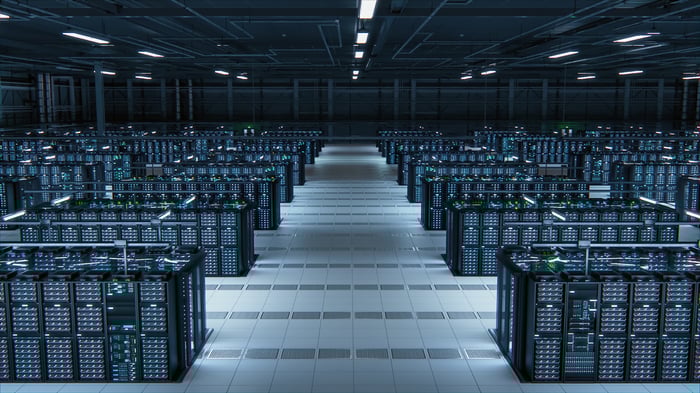
Image source: Getty Images.
Booming demand has sent shares soaring
As companies like OpenAI and Anthropic build new large language models trained on billions of pieces of information, they require a storage solution to house all that data near their high-powered GPUs. Importantly, most of that data doesn't need to be instantly accessible for processing, and servers can use what's called "nearline" storage to access it. Nearline storage might take a few seconds to read, and that trade-off is usually worth it because it's relatively cheap.
The most common form of nearline storage are hard disk drives (HDDs). Seagate and Western Digital account for the vast majority of HDD sales, and both saw their revenue and earnings soar in 2025 amid growing demand for nearline storage. In fact, demand has climbed faster than supply, resulting in strong margin expansion for both, as they're able to raise prices on the big tech companies buying their products.
Western Digital CEO Irving Tan expects the market to remain supply constrained through mid-2027. Seagate CEO Dave Mosley said its capacity is already largely committed to contracts through 2026. Indeed, both companies should be able to continue growing revenue and earnings at a rapid pace next year.
But balancing the strong demand with building out more capacity is a tricky challenge for HDD makers. Building out lots of capacity amid booming demand will lower their pricing power and leave them with huge costs if and when demand dissipates. As a result, both companies are cautiously adding more capacity in order to maintain high prices and keep their financial risk low.
The competitive threat of substitute technologies
As supply of HDDs increases slowly, big tech companies have sought alternative resources for storage. In recent months, they've been buying up capacity of NAND storage, commonly sold as solid-state drives (or SSDs). That's sent the price of NAND chips higher, benefiting companies like Western Digital's spinoff Sandisk and Micron Technology.
That's a threat that Seagate and Western Digital can't afford to ignore. While HDDs still offer a significant price advantage over SSDs in terms of raw storage costs, SSDs have other advantages to consider that can significantly offset the higher up-front cost.
They're smaller, so AI data centers can hold more storage with less real estate. They're more power efficient, which can reduce one of the biggest costs of ongoing data center operations. You can access data from them much faster, which can improve the overall efficiency of a GPU cluster, further reducing operating costs. On top of that, SSDs are expected to have longer lifespans than HDDs.
While Seagate and Western Digital have a stranglehold on the HDD market, there are a handful of NAND chipmakers they'll also have to compete with. That could increase total storage capacity over the next year, potentially bringing prices back down as supply catches up to demand. And that's a much tougher challenge to navigate than if either company were operating in a pure duopoly with no other substitutes.
As a result, Seagate and Western Digital could see their current demand cycle cut short as data centers shift a larger portion of their nearline storage to SSDs, especially if companies build NAND capacity faster than the duopoly builds HDD capacity.
The stock valuations are deceptively high
Investors may look at the forward P/E ratios of Seagate and Western Digital and think they look like bargains. With multiples of 27 and 24, respectively, they're not much more expensive than the S&P 500 in aggregate. And compared to other big AI stocks, their multiples are far more attractive.
But the market for HDDs is cyclical. Earnings growth doesn't go up year after year; it fluctuates wildly as supply and demand search for equilibrium. Since Western Digital and Seagate's products are practically interchangeable with one another and easily substituted with SSDs, they don't have real competitive advantages that can protect their pricing power or ensure demand. It's worth noting that NAND chips and other memory chips face the same challenge.
As a result, the market should assign those stocks much lower earnings multiples than a company that can expect steady improvements in earnings power over time, with occasional setbacks. It appears that both stocks are currently trading at high valuations, based on optimism that the 2025 trend will continue into the future. Meanwhile, Sandisk and Micron are trading at forward P/Es in the mid-to-high teens, despite the trends currently favoring both companies.
Given the uncertainty facing both Seagate and Western Digital, their P/E multiples could start to contract in 2026. And if there are growing signs that long-term orders for 2027 are being cannibalized by SSDs, analysts could lower their earnings forecasts, leading to big corrections in both companies' stock prices. Following the stellar returns of 2025, it may be prudent to avoid Seagate and Western Digital in 2026 until their valuations return to more reasonable levels relative to the risks they face.
Should you invest $1,000 in Seagate Technology Plc right now?
Before you buy stock in Seagate Technology Plc, consider this:
The Motley Fool Stock Advisor analyst team just identified what they believe are the 10 best stocks for investors to buy now… and Seagate Technology Plc wasn’t one of them. The 10 stocks that made the cut could produce monster returns in the coming years.
Consider when Netflix made this list on December 17, 2004... if you invested $1,000 at the time of our recommendation, you’d have $513,353!* Or when Nvidia made this list on April 15, 2005... if you invested $1,000 at the time of our recommendation, you’d have $1,072,908!*
Now, it’s worth noting Stock Advisor’s total average return is 965% — a market-crushing outperformance compared to 193% for the S&P 500. Don’t miss out on the latest top 10 list, available when you join Stock Advisor.
See the 10 stocks »
*Stock Advisor returns as of December 8, 2025
Adam Levy has no position in any of the stocks mentioned. The Motley Fool has no position in any of the stocks mentioned. The Motley Fool has a disclosure policy.
Recommended Articles


