

Why Is Germany Buying $3.5 Billion Worth of RTX Missiles?
Key Points
Germany has asked permission to buy 750 air defense missiles from RTX.
The $3.5 billion purchase price appears unusually large for the missiles in question.
RTX profit margins may improve if this massive missile sale goes through.
- 10 stocks we like better than RTX ›
A new Cold War has begun in Europe, which has implications not just for historians, soldiers, and geopoliticians, but also for investors in the defense industry. The Russian bear is growling, and Germany is rearming -- buying $3.5 billion worth of missiles for missile defense from defense contractor RTX (NYSE: RTX).
Last month, the Defense Security Cooperation Agency -- or DSCA, the U.S. Department of Defense division responsible for coordinating foreign arms sales -- notified Congress of a German request to purchase:
Where to invest $1,000 right now? Our analyst team just revealed what they believe are the 10 best stocks to buy right now, when you join Stock Advisor. See the stocks »
- 173 Standard Missile 6 (SM-6) Block I missiles.
- Up to 577 Standard Missile 2 Block IIIC missiles.
- Multiple MK 21 and MK 13 Vertical Launch Systems for same.
RTX has been named principal contractor on the sale, meaning that -- assuming Congress approves the sale (and Congress has never not approved a sale notified to it by DSCA) -- the entirety of the $3.5 billion price tag on these missiles will go to RTX.
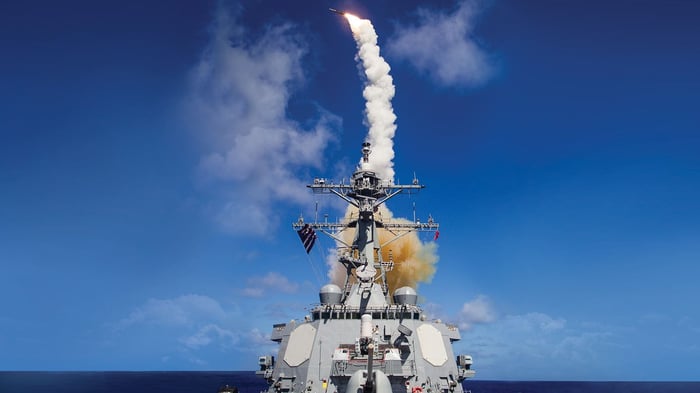
Image source: RTX.
Why does Germany want missiles from RTX?
Despite the "Standard" name, the missiles in question are anything but ordinary. Raytheon, which is now the name of RTX's defense division, calls the SM-6 "three missiles in one ... the only weapon that can perform anti-air warfare, anti-surface warfare, and ballistic missile defense or sea-based terminal missions." It's designed primarily for use aboard U.S. Navy warships, and that's how Germany plans to utilize it as well, defending German Navy F127-class frigates in the North Sea.
The SM-2 is similar. Raytheon calls it "the world's premier surface-to-air defense weapon," with over 12,000 SM-2 units sold worldwide. SM-2 is used for defense against both anti-ship missiles and aircraft, and "a primary weapon for the U.S. Navy." It saw heavy use in the Red Sea area in early 2024, defending commercial shipping from Houthi drones and anti-ship missiles.
In both cases, DSCA assures Congress that "Germany will have no difficulty absorbing these missiles into its armed forces."
(Germany does not appear to have ordered any of Raytheon's SM-3 missiles, which are specifically designed for exoatmospheric ballistic missile defense).
How profitable is this for RTX?
You may think this is just another arms sale for RTX, but the numbers tell a different story: RTX has sold 12,000 SM-2 missiles globally. Germany wants to buy nearly 600 of them at one go. Meaning that, in just one sale, RTX is about to grow the number of SM-2 missiles sold -- ever -- to just one single customer.
And how profitable will these sales be?
According to data from S&P Global Market Intelligence, RTX's Raytheon division, which makes all variants of the Standard missile, generated $26.7 billion in revenue last year and earned an operating profit of $2.6 billion on those sales. That's very close to a 10% operating profit margin.
Therefore, $3.5 billion in missile sales to Germany should yield operating profit of about $350 million for RTX, or about $0.26 per share. It should generate that much profit, except for one thing: Publicly available data indicate that the average cost of an SM-2 missile is slightly over $2 million, while each SM-6 costs between $4 million and $5 million. Tallying up the total number of missiles being sold suggests the cost to a U.S. buyer of the 750 missiles involved in this sale would be roughly $2 billion -- but Germany will pay nearly twice that.
Conclusion: This sale will probably be more than ordinarily profitable for RTX, and RTX's profit margins will move higher.
Is RTX stock a buy?
Will this be enough to move the needle for RTX stock? Possibly, but not necessarily. Even if operating profit margin on this international sale does in fact turn out to be substantially (say, 75%) higher than what RTX would earn for a sale to the U.S. military, we're still probably talking no more than $0.45 per share in extra pre-tax profit -- and it's unlikely all this profit will land within a single fiscal year, much less a single quarter. Most likely, it will be spread out over several years of missile deliveries -- perhaps as much as a decade.
For a defense contractor as big as RTX, earning $6.6 billion in annual net profit ($4.87 per share), this would still be a noticeable boost to earnings. But it's probably not going to be -- in and of itself -- enough to turn RTX stock from a "hold" into a "buy."
Priced at 35 times earnings, but paying only a miserly 1.6% dividend yield and expected by most analysts to grow earnings no faster than 10% annually over the next five years, I cannot yet recommend buying RTX stock.
Should you invest $1,000 in RTX right now?
Before you buy stock in RTX, consider this:
The Motley Fool Stock Advisor analyst team just identified what they believe are the 10 best stocks for investors to buy now… and RTX wasn’t one of them. The 10 stocks that made the cut could produce monster returns in the coming years.
Consider when Netflix made this list on December 17, 2004... if you invested $1,000 at the time of our recommendation, you’d have $513,353!* Or when Nvidia made this list on April 15, 2005... if you invested $1,000 at the time of our recommendation, you’d have $1,072,908!*
Now, it’s worth noting Stock Advisor’s total average return is 965% — a market-crushing outperformance compared to 195% for the S&P 500. Don’t miss out on the latest top 10 list, available when you join Stock Advisor.
See the 10 stocks »
*Stock Advisor returns as of December 8, 2025
Rich Smith has no position in any of the stocks mentioned. The Motley Fool has positions in and recommends S&P Global. The Motley Fool recommends RTX. The Motley Fool has a disclosure policy.
Recommended Articles


