


The Best Oil Stock to Invest $150 in Right Now
Key Points
Chevron expects to reach an inflection point in producing free cash flow next year.
Drivers include recently completed expansion projects and cost-saving initiatives.
The oil giant anticipates it can continue growing its free cash flow at a healthy rate through at least 2030.
- 10 stocks we like better than Chevron ›
Oil prices are having a down year. Brent, the global benchmark price, has fallen 15% to around $63 a barrel. That slump has weighed on the cash flows and stock prices of most oil companies.
There's no telling where oil prices will go from here. However, Chevron (NYSE: CVX) doesn't need crude prices to rally to drive its cash flow higher. That's because the oil giant is about to hit a major inflection point that will fuel a meaningful uptick in its free cash flow in 2026 and beyond. That makes it stand out as the best oil stock to buy for those with around $150 to invest right now (about the price of one Chevron share).
Where to invest $1,000 right now? Our analyst team just revealed what they believe are the 10 best stocks to buy right now, when you join Stock Advisor. See the stocks »
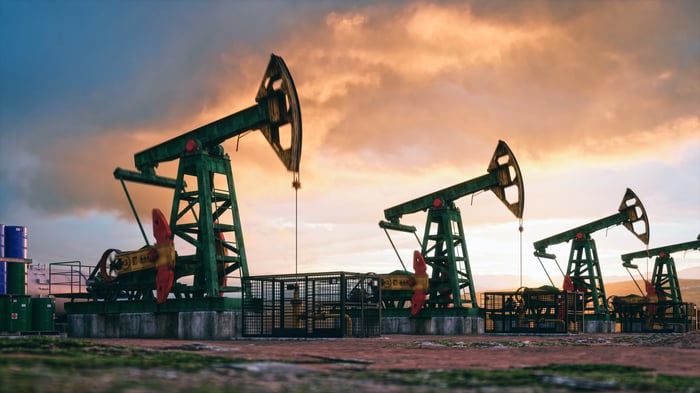
Image source: Getty Images.
The coming free cash flow gusher
Chevron has invested heavily in expanding its operations over the past several years. The oil company and its partners have been working on many major capital projects around the world, most notably in Kazakhstan and the Gulf of Mexico (also known as the Gulf of America in the U.S.). Several of these projects have started producing oil over the past year. As a result, they've gone from cash consumers to cash producers.
The oil giant has also significantly expanded its U.S. onshore production in recent years through acquisitions (Noble Energy in 2020 and PDC Energy in 2023) and organic development. As a result, it recently achieved a key milestone in the Permian Basin by hitting 1 million barrels of oil equivalent (BOE) per day of production, while also significantly expanding its output in the DJ Basin. Chevron also recently completed its $55 billion acquisition of Hess. That deal added to its U.S. onshore resource position (Bakken) and gave it a stake in a world-class oil resource in Guyana.
Additionally, Chevron is working to leverage its growing scale to deliver structural cost savings. The oil giant aims to achieve $3 billion to $4 billion of cost reductions by the end of next year. That's a $1 billion increase from its prior target.
This combination of production growth and cost reductions, driven by lower capital expenses and operating cost savings, has Chevron on track to produce significantly more free cash flow in 2026. The company anticipates generating an additional $12.5 billion in free cash flow next year, assuming oil prices average $70 per barrel, compared to this year's level. It can still produce a lot more free cash flow next year if crude remains at its current level in the low-to-mid $60s.
More to come
While 2026 will mark a step-change in Chevron's free cash flow, that won't be the end. The company believes it can grow its free cash flow at a more than 10% compound annual rate from this year's level through 2030. Several catalysts fuel that view.
A big one is continued production growth in Guyana. ExxonMobil is leading the joint development of that massive resource. In September, Exxon approved the $6.8 billion Hammerhead project, which it expects to complete in 2029. That's the seventh project in the region, four of which it has already completed, with two more on track to start producing over the next two years (Uaru in 2026 and Whiptail in 2027). Exxon expects to approve at least one more project, which would bring the field's output up to 1.7 million BOE per day by 2030.
Chevron also expects to approve new growth projects in the Eastern Mediterranean, Gulf of America, and other offshore and international areas in the future. Additionally, the company is working to capitalize on the U.S. data center boom. It aims to approve its first natural gas power project in Texas, with plans to start up by 2027. These and other projects help support the company's view that it can grow its production at a healthy rate over the coming years, driving more than 10% annual free cash flow growth.
In a strong position to grow shareholder value
Chevron expects to deliver a meaningful increase in its free cash flow next year, while growing it at a more than 10% compound annual rate through 2030. That ever-increasing free cash flow should enable Chevron to grow value for shareholders through continued dividend increases and share repurchases. This combination of growth and cash returns could give the company the fuel to produce a high-octane total return in the coming years, making it look like a great oil stock to buy right now.
Should you invest $1,000 in Chevron right now?
Before you buy stock in Chevron, consider this:
The Motley Fool Stock Advisor analyst team just identified what they believe are the 10 best stocks for investors to buy now… and Chevron wasn’t one of them. The 10 stocks that made the cut could produce monster returns in the coming years.
Consider when Netflix made this list on December 17, 2004... if you invested $1,000 at the time of our recommendation, you’d have $513,353!* Or when Nvidia made this list on April 15, 2005... if you invested $1,000 at the time of our recommendation, you’d have $1,072,908!*
Now, it’s worth noting Stock Advisor’s total average return is 965% — a market-crushing outperformance compared to 195% for the S&P 500. Don’t miss out on the latest top 10 list, available when you join Stock Advisor.
See the 10 stocks »
*Stock Advisor returns as of December 8, 2025
Matt DiLallo has positions in Chevron. The Motley Fool has positions in and recommends Chevron. The Motley Fool has a disclosure policy.
Recommended Articles


