

ASML Is the Silent Monopoly Behind the Entire Tech Industry, but Is It a Buy Right Now?
Key Points
ASML is the only provider of EUV lithography machines to the semiconductor industry worldwide.
It's positioned at the root of the global tech supply chain, with no real competitors.
- 10 stocks we like better than ASML ›
Mark Twain once said, "When everyone is looking for gold, it's a good time to be in the pick-and-shovel business." Most of the prospectors who went west looking for gold went bust, but the person who sold those prospectors mining gear in St. Louis or Denver was rolling in dough.
If I asked you which company was the "pick-and-shovel" player in the tech industry, you'd probably guess Taiwan Semiconductor Manufacturing (NYSE: TSM). It makes sense; it's the largest chip manufacturer on the planet. But it's not; there's a company that even Taiwan Semiconductor needs for its own proverbial picks and shovels.
Where to invest $1,000 right now? Our analyst team just revealed what they believe are the 10 best stocks to buy right now, when you join Stock Advisor. See the stocks »
It's called ASML (NASDAQ: ASML), and it has built a silent monopoly over the very root of the tech supply chain.
Going Dutch
Based in the Netherlands, ASML produces extreme ultraviolet (EUV) and deep ultraviolet (DUV) lithography machines. These machines, which run as much as $400 million new and are roughly the size of a bus, etch the patterns on semiconductor wafers that allow them to function in chips.
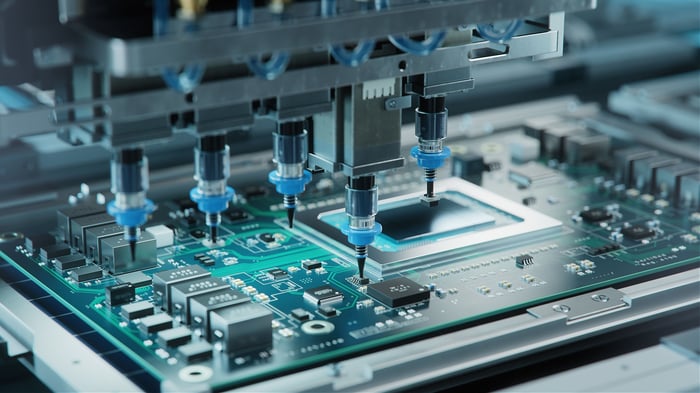
Image source: Getty Images.
Lithography machines are used by every semiconductor manufacturer, and ASML has a near-monopoly on the industry, with 90% market share, per industry estimates. ASML does have a total monopoly on EUV systems, as its lithography industry peers Nikon and Canon only provide older KrF or krypton fluoride and I-line lithography.
If you want to make the most advanced chips in the world, you need ASML lithography machines. It took the company 30 years to develop its technology, and producing those machines is complicated, to say the least. So it's likely to be some time before anyone else comes out with a competitor.
Genuine monopolies like this are exceedingly rare. Let's take a look at ASML's financials to see the benefits of being the only game in town for ourselves.
Too expensive? Debatable.
As big as it is, ASML is not a fast-growth stock, but it is a steady growth stock capable of providing security for your portfolio. For Q3 2025, ASML's revenue totaled over 7 billion euros, flat from Q3 2024. Similarly, gross margin for the quarter remained relatively flat from the year-ago quarter. While net income and earnings per share got a bit of a bump over the prior year. However, more importantly, the company appears to have a substantial backlog, which should sustain revenue for the foreseeable future, as indicated by the table below.
| ASML Key Financial Metrics | |||
|---|---|---|---|
| (in billions of euros) | Q3 2025 | Q3 2024 | Change |
| Net Sales | 7,516 | 7,467 | 0.6% |
| Gross Margin | 51.6% | 50.8% | 1.5% |
| Net Income | 2,125 | 2,077 | 2.3% |
| EPS | 5.49 | 5.28 | 3.9% |
| Net Bookings | 5,399 | 2,633 | 105% |
Table by author. Data Source: ASML Q3 2025 Earnings.
Now, on to valuation, which is a little confusing at first glance. ASML trades at a P/E of 40, which sounds high, especially compared to Canon at 24. But remember, ASML is one of one in the world of advanced lithography.
Canon and Nikon only compete with it in the lower-grade, older types of lithography. So, considering that, and that Nikon is trading at just shy of 65, ASML's valuation looks much better to me.
Couple that with the fact that ASML counts among its customers Intel, Samsung, and Taiwan Semiconductor Manufacturing. Taiwan Semiconductor alone controls a 71% share of the global semiconductor manufacturing market, while Samsung occupies the No. 2 position with 8% market share.
And that means all the companies that outsource some or all of their semiconductor production to Taiwan Semiconductor are also reliant on ASML's lithography machines. Those include Apple, Sony, and Nvidia.
ASML is the beginning of the tech hardware supply chain. The materials to manufacture semiconductors can come from various places, but the machines needed to turn those materials into the finished product come from just one: ASML. And the entire tech ecosystem, from chip manufacturers to designers to the software developers who use the hardware, relies on ASML.
So is it overvalued? In a way, I suppose it is. It's in a class all its own, so ASML is both the most overvalued and undervalued company of its type. Make of that what you will, but by my math, ASML is essentially a silent monopoly behind the entire tech industry.
Picks and shovels for the silicon gold rush
As mentioned, ASML makes the picks and shovels for the new gold rush in the shape of its EUV lithography machines. Everybody across the whole technology industry is reliant on them in some way. And I only see ASML's business growing.
There are 17 new semiconductor factories planned or under construction in the United States, with expansions planned at seven other factories. All of them will need lithography machines, and ASML is the only game in town for the EUV machines you need to make the most advanced chips.
And the semiconductor industry is a growth market if ever there were one. PwC projects the industry will be worth $1 trillion by 2030. Every company involved in that industry needs ASML's machines.
I'd say that makes this one a buy or, at the very least, worth a look.
Should you invest $1,000 in ASML right now?
Before you buy stock in ASML, consider this:
The Motley Fool Stock Advisor analyst team just identified what they believe are the 10 best stocks for investors to buy now… and ASML wasn’t one of them. The 10 stocks that made the cut could produce monster returns in the coming years.
Consider when Netflix made this list on December 17, 2004... if you invested $1,000 at the time of our recommendation, you’d have $507,421!* Or when Nvidia made this list on April 15, 2005... if you invested $1,000 at the time of our recommendation, you’d have $1,109,138!*
Now, it’s worth noting Stock Advisor’s total average return is 972% — a market-crushing outperformance compared to 195% for the S&P 500. Don’t miss out on the latest top 10 list, available when you join Stock Advisor.
See the 10 stocks »
*Stock Advisor returns as of December 8, 2025
James Hires has no positions in any of the companies mentioned. The Motley Fool has positions in and recommends ASML, Apple, Intel, Nvidia, and Taiwan Semiconductor Manufacturing. The Motley Fool has a disclosure policy.
Recommended Articles


