

Down 50%, Should You Buy the Dip on Pfizer?
Key Points
Pfizer is one of the world's largest drugmakers.
It has long managed to produce new blockbuster drugs to replace drugs losing patent protection.
In time, the company's current patent cliff is likely to be resolved.
- 10 stocks we like better than Pfizer ›
Pfizer (NYSE: PFE) is deeply unloved today. There are a couple of reasons for this that are important, but the big story revolves around the company's drug portfolio. With three drugs facing patent expirations in 2027 and 2028, and no replacements for that revenue, investors are adopting a wait-and-see attitude. Here's why you might not want to follow the crowd on this one and, instead, consider buying the dip.
What does Pfizer do?
Pfizer is one of the world's largest pharmaceutical companies. This is a very competitive industry. It's highly technical and driven by research and development. Companies face significant regulatory burdens. And the products they produce are only afforded a relatively short period of time before other companies can, essentially, copy them.
Where to invest $1,000 right now? Our analyst team just revealed what they believe are the 10 best stocks to buy right now, when you join Stock Advisor. See the stocks »

Image source: Getty Images.
Small drug companies come and go with great regularity. However, a handful have grown to the point where they have enough scale to manage the industry's ups and downs. Pfizer is one of those companies, sporting a market cap of $145 billion -- even after the stock fell 55% since it hit a high-water mark in 2021.
One of the biggest problems for large drug companies like Pfizer is what's known as a patent cliff. This is when a highly profitable drug (often a blockbuster drug -- one that brings in more than $1 billion a year) loses its patent protection. New drugs are so expensive and time-consuming to create that companies are granted a period of exclusivity to recoup their investment. During that period, those products can bring in a lot of revenue. However, when a drug's patent protections run out, profitability tends to fall dramatically.
Pfizer is facing three patent expirations: Its oncology drug Ibrance loses protection in 2027, and its cardiovascular drugs Eliquis and Vyndaqel lose theirs a year later, in 2028.
This is normal for a large drug company
The important thing to remember is that patent expirations are a completely normal and frequent occurrence, and Pfizer has a proven track record of addressing such challenges. There are two broad ways to achieve this: developing new drugs in-house, or acquiring a company with a promising candidate. Pfizer's recent acquisition of Metsera is basically a move to deal with its upcoming patent cliffs.
This purchase was driven by Metsera's drug pipeline in the obesity space, and came after Pfizer's own obesity drug flamed out. It's clear evidence that management and the board of directors will take the necessary steps to keep the company moving forward. This is the main reason why long-term investors should consider taking a contrarian stance with Pfizer. It's highly likely that this giant drug company will eventually get back on track.
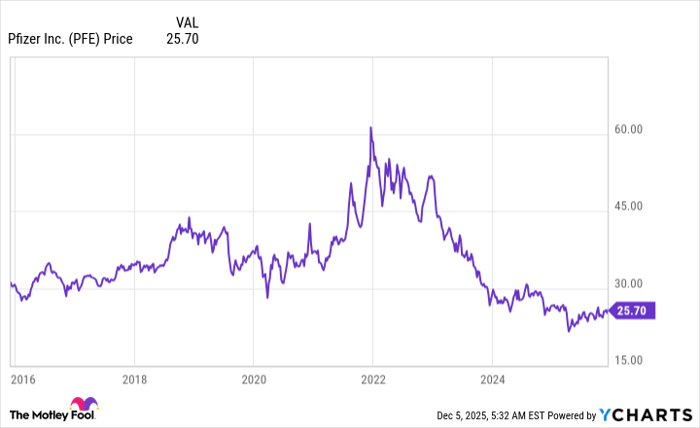
PFE data by YCharts.
There's a wrinkle here, however. The massive drop is partly a result of investors' overexuberance early in the coronavirus pandemic. At that point, Pfizer's COVID-19 vaccine had investors believing that the future was unusually bright. As the world learned to live with COVID, the stock began to decline. The upcoming patent cliffs pushed sentiment even lower -- to the point where the stock is now below its level prior to the start of the pandemic.
The negativity is likely overdone, as investors are hyperfocused on GLP-1 drugmakers right now. That helps explain why Pfizer is working to enter the obesity drug market. However, the real story is that it's likely to survive this difficult period relatively unscathed. As it proves it can do the same thing it has done before (find new drugs), investors are likely to reward its stock with a higher valuation.
A word of caution with Pfizer
Many investors will likely view Pfizer's 6.6% dividend yield as a sign that it's an attractive dividend stock. But dividend lovers should tread with a little caution. The dividend payout ratio is hovering around 100%, and the board of directors has cut the dividend before, notably after making a large acquisition.
It's probably better to view Pfizer as a turnaround story. If the dividend holds up, that's just icing on the cake.
Should you invest $1,000 in Pfizer right now?
Before you buy stock in Pfizer, consider this:
The Motley Fool Stock Advisor analyst team just identified what they believe are the 10 best stocks for investors to buy now… and Pfizer wasn’t one of them. The 10 stocks that made the cut could produce monster returns in the coming years.
Consider when Netflix made this list on December 17, 2004... if you invested $1,000 at the time of our recommendation, you’d have $521,982!* Or when Nvidia made this list on April 15, 2005... if you invested $1,000 at the time of our recommendation, you’d have $1,137,459!*
Now, it’s worth noting Stock Advisor’s total average return is 981% — a market-crushing outperformance compared to 194% for the S&P 500. Don’t miss out on the latest top 10 list, available when you join Stock Advisor.
See the 10 stocks »
*Stock Advisor returns as of December 8, 2025
Reuben Gregg Brewer has no position in any of the stocks mentioned. The Motley Fool has positions in and recommends Pfizer. The Motley Fool has a disclosure policy.
Recommended Articles


