

If I Could Only Buy and Hold a Single Stock, This Would Be It
Key Points
Alphabet has delivered a 2,017% return since 2010 despite numerous product failures and legal challenges.
The company's willingness to fail fast and fail often is actually its greatest strength, not a weakness.
The stable search advertising business gives Alphabet a financial platform to experiment with moonshots like Waymo and quantum computing.
- 10 stocks we like better than Alphabet ›
Some of the stocks I own can make me nervous from time to time.
That includes many of my favorite names. I still expect big things from remote medicine specialist Teladoc (NYSE: TDOC), for example, but my original holding is down 96% from August 2020. The Trade Desk (NASDAQ: TTD) position I started two years later is down 13% on Nov. 26, 2025. I think it's an unreasonable price drop, involving a 72% plummet from last December's record highs.
Where to invest $1,000 right now? Our analyst team just revealed what they believe are the 10 best stocks to buy right now. Continue »
But not all of them give me the shivers. I never lost any sleep worrying about my Alphabet (NASDAQ: GOOG) (NASDAQ: GOOGL) investment.
Why I bought Google when smartphones were young and dumb
I started my Alphabet position in December 2010 at a split-adjusted price of $15.03 per share. The company was known as Google back then. I've added more capital to that position over the years, but the original shares are up by 2,017% as of Thanksgiving Day, 2025.
Things were different in 2010. Cloud computing and software as a service (SaaS) were still fairly new concepts, at least on a large scale. The Google Docs office suite was only four years old, people generally didn't have smartphones, and Google was intensely focused on its online search and advertising business.
Buying Google at that point was already a pretty common and respectable idea, of course. With a $192.6 billion market cap when I opened my Google position, it was the 8th largest stock on the American market.
The ad-based search business was thriving, but the success wasn't properly reflected in Google's stock price. Because of the financial crisis in 2008 and Google's exit from the promising Chinese market, the stock traded at modest valuation ratios such as 24.5 times trailing earnings and 22.6 times free cash flow.
And I had been using Google services every day for about a decade at that point. Moreover, I loved co-founders Larry Page and Sergey Brin's business philosophy -- build something great and focus on the user. The financial results will follow eventually.
My only regret about the first Google stock buy is that I didn't do it earlier.
Let's talk about Google's worst flops
No company is perfect, and no business is risk-free. Alphabet (and Google before it) certainly had its fair share of unforced errors. For example:
- Alphabet could have dominated global smartphone profits with its Android platform, but the Apple (NASDAQ: AAPL) iPhone ran away with the smartphone revenue and profit trophies right away. There are more Android units out there, but people gladly pay more for their iPhones.
- You've seen several Google-branded messaging services come and go, like Allo, Hangouts, Meet, and Duo. Most of them never gained much usage despite Google accounts being nearly ubiquitous.
- The Google Pixel line of smartphones isn't even the leading version of Google's own Android system; that would be Samsung (OTC: SSNL.F) and its popular Galaxy line.
- The company keeps running into legal and ethical challenges. Most recently, a federal judge ordered Google to share search index data with competitors and stop entering exclusive search contracts with web browser and smartphone makers. The ruling is now under appeal.
That's just a small sampling of a very long list. Many of these items have resulted in lower Alphabet share prices, at least temporarily. But I'm holding on to my shares, because these issues don't scare me.
Why the failures don't matter (and most likely never will)
You see, Alphabet is built to change with the times. You can see it in the financial results. Five years ago, for example, 83% of Alphabet's 2019 revenue came from various forms of Google advertising. In last month's third-quarter 2025 report, that ratio had dwindled to 72%. Google Cloud accounts for a growing portion of Alphabet's business, chiefly driven by demand for its artificial intelligence (AI) services.
The company's business model will probably change faster in the next few years as the AI boom plays out. Not only will Google Cloud continue to grow its financial importance, but a plethora of AI-driven products and services should pop up. Most will be forgettable footnotes in Alphabet's history, but some should stick. Ten or 20 years from now, self-driving taxi service Waymo might account for more than 10% of Alphabet's total sales. Or maybe Verily's medical research steps up in that role instead, or the Google Quantum AI research lab.
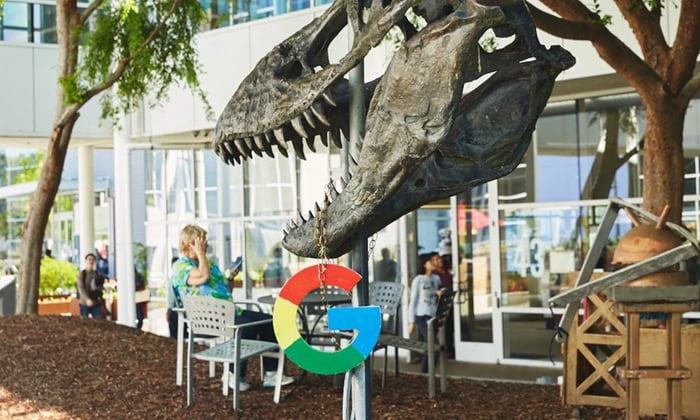
Image source: Getty Images.
The search-based advertising business provides a stable financial platform from which Alphabet can try a ton of experimental ideas. The large number of mistakes along the way is a testament to the company's inventive operating approach. This is why I don't panic when one of Alphabet's many ideas goes off the rails. The company will throw some more spaghetti on the wall to find something that sticks.
The success stories are frequent enough that the failures don't really matter. If you want proof, look back at the stock returns I showed you earlier. Alphabet's trailing revenues have soared 1,220% in that 15-year period. Free cash flows are up from $7.0 billion to $73.6 billion. And the hits keep coming.
So if you forced me to pick just one stock to buy and hold forever, Alphabet is that no-brainer pick.
Should you invest $1,000 in Alphabet right now?
Before you buy stock in Alphabet, consider this:
The Motley Fool Stock Advisor analyst team just identified what they believe are the 10 best stocks for investors to buy now… and Alphabet wasn’t one of them. The 10 stocks that made the cut could produce monster returns in the coming years.
Consider when Netflix made this list on December 17, 2004... if you invested $1,000 at the time of our recommendation, you’d have $580,171!* Or when Nvidia made this list on April 15, 2005... if you invested $1,000 at the time of our recommendation, you’d have $1,084,986!*
Now, it’s worth noting Stock Advisor’s total average return is 1,004% — a market-crushing outperformance compared to 194% for the S&P 500. Don’t miss out on the latest top 10 list, available when you join Stock Advisor.
See the 10 stocks »
*Stock Advisor returns as of November 24, 2025
Anders Bylund has positions in Alphabet, Teladoc Health, and The Trade Desk. The Motley Fool has positions in and recommends Alphabet, Apple, Teladoc Health, and The Trade Desk. The Motley Fool has a disclosure policy.
Recommended Articles


