




1 Fantastic Dividend Stock Down 13% That's a Screaming Buy for Passive Income Investors in 2025
Key Points
Energy Transfer hasn't had a dividend yield below 5.2% in the past five years.
Energy Transfer says it has its strongest financial position in company history.
Energy Transfer plans to spend $5 billion this year on growth projects.
- 10 stocks we like better than Energy Transfer ›
Although all three of the U.S. stock market's major indexes (S&P 500, Nasdaq Composite, and Dow Jones) are up this year, it hasn't been peachy keen for many stocks. One notable company that has had a lackluster year so far is Energy Transfer (NYSE: ET). This stock is down 13% through Sept. 9.
Although Energy Transfer's stock is down for the year, its ultra-high dividend yield makes it a prime candidate for investors looking for passive income. We can't predict how its stock (or any stock) will perform, but we can be certain that its dividend payout will be one of the highest you'll find on the stock market.
Where to invest $1,000 right now? Our analyst team just revealed what they believe are the 10 best stocks to buy right now. Learn More »

Image source: Getty Images.
Operating in the sweet spot of the energy industry
Energy Transfer operates in the midstream segment of the energy industry. Midstream companies are responsible for transporting, storing, and processing energy commodities. That's what Energy Transfer does, dealing with natural gas, crude oil, natural gas liquids (NGLs), and, soon, liquefied natural gas (LNG).
Upstream companies explore for and produce raw energy commodities, while downstream companies refine, market, and sell the end products, like gasoline, diesel, and jet fuel.
The midstream segment is often viewed as the most stable of the three because these companies typically charge fees for companies using their assets (pipelines, storage tanks, etc.), so the prices of the commodities going through don't have much of a direct impact on their finances.
Energy Transfer's main business model is signing long-term contracts with producers and refiners, which helps bring in reliable and consistent cash flow.
A dividend that's music to income-seekers' ears
Reliable cash flow is important for any company, but it's particularly important for limited partnerships (LP) because of how their businesses are structured. Unlike typical corporations, LPs don't pay corporate income taxes. Instead, they pass on most of their earnings to investors, paying them in cash distributions. The investors then pay their portion of the partnership's tax bill. This is why many of them tend to have high dividend payouts.
At the time of this writing, Energy Transfer's dividend is over 7.5%, six times the S&P 500's average. That's impressive, but arguably more impressive is the fact that its dividend hasn't dipped below 5.2% at any point over the past five years.
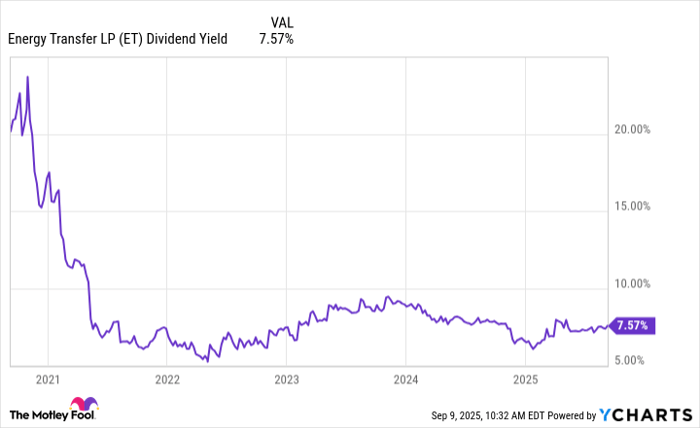
ET Dividend Yield data by YCharts
Whereas typical corporations set their annual dividends on earnings, Energy Transfer's dividend is directly tied to its distributable cash flow (DCF).
Energy Transfer has sustained consistently strong DCF (the COVID-19 pandemic being an exception). You can't say this for all LP companies.
Energy Transfer is tightening up its balance sheet and putting money toward growth
In the second quarter, Energy Transfer's DCF attributable to partners was $1.96 billion, which was down from the $2.04 billion in the second quarter of last year. Despite the drop, Energy Transfer says it's at its "strongest financial position in partnership history," with much of this having to do with a more manageable balance sheet.
From an operational standpoint, Energy Transfer showed record-breaking volume across multiple segments in the quarter:
- Gathered gas: Up 10%
- Crude oil transport: Up 9%
- NGL transport: Up 4%
- NGL exports: Up 5%
Much of Energy Transfer's growth will come from investments in its core infrastructure, and it has been diligently making them. It expects to spend around $5 billion on growth projects in 2025, with a lot going toward its Permian Basin expansions (a few processing plants), pipelines, and NGL infrastructure.
It's not flashy, but it's the type of investment that should contribute to Energy Transfer's long-term cash flow, which, in turn, works out in investors' favor because of the dividend payouts. The company is well positioned to be a lucrative income investment for the long haul.
Should you invest $1,000 in Energy Transfer right now?
Before you buy stock in Energy Transfer, consider this:
The Motley Fool Stock Advisor analyst team just identified what they believe are the 10 best stocks for investors to buy now… and Energy Transfer wasn’t one of them. The 10 stocks that made the cut could produce monster returns in the coming years.
Consider when Netflix made this list on December 17, 2004... if you invested $1,000 at the time of our recommendation, you’d have $640,916!* Or when Nvidia made this list on April 15, 2005... if you invested $1,000 at the time of our recommendation, you’d have $1,090,012!*
Now, it’s worth noting Stock Advisor’s total average return is 1,052% — a market-crushing outperformance compared to 188% for the S&P 500. Don’t miss out on the latest top 10 list, available when you join Stock Advisor.
See the 10 stocks »
*Stock Advisor returns as of September 8, 2025
Stefon Walters has no position in any of the stocks mentioned. The Motley Fool has no position in any of the stocks mentioned. The Motley Fool has a disclosure policy.
Recommended Articles


