

USD/THB sees red on quiet Monday, eyes on May's FOMC minutes

Source Fxstreet
  • USD/THB trades at around 36.11, marking a 0.15% decrease in Monday's session.
  • Fed officials ask for caution on premature easing, despite some recent data weakness.
  • May’s FOMC minutes, April’s S&P PMIs, and Durable Goods figures from May will be the highlights this week.

The USD/THB pair is trading mildly down on Monday after falling to a low of 36.05 earlier in the session and managed to clear most of the daily losses. The USD is holding its ground, driven by cautious comments from the Federal Reserve (Fed) officials who are reluctant to loosen monetary policy prematurely.

Fed policymakers reiterated their reluctance towards premature easing on Monday, referencing that it is too soon to consider as evidence of disinflation the recent soft inflation data. The odds of a cut by the Fed until September is bookmarked at around 35% but officials and mid-tier data this week may change those odds.

Investors seem to be waiting for additional delivery of Fed speeches this week and for May's Federal Open Market Committee (FOMC) minutes slated for release this Wednesday, hoping for greater clarity on the direction of the Fed’s outlook. On Thursday, May’s S&P readings and weekly Jobless Claims will be looked upon as well as Friday’s Durable Goods figures from April.

USD/THB technical analysis

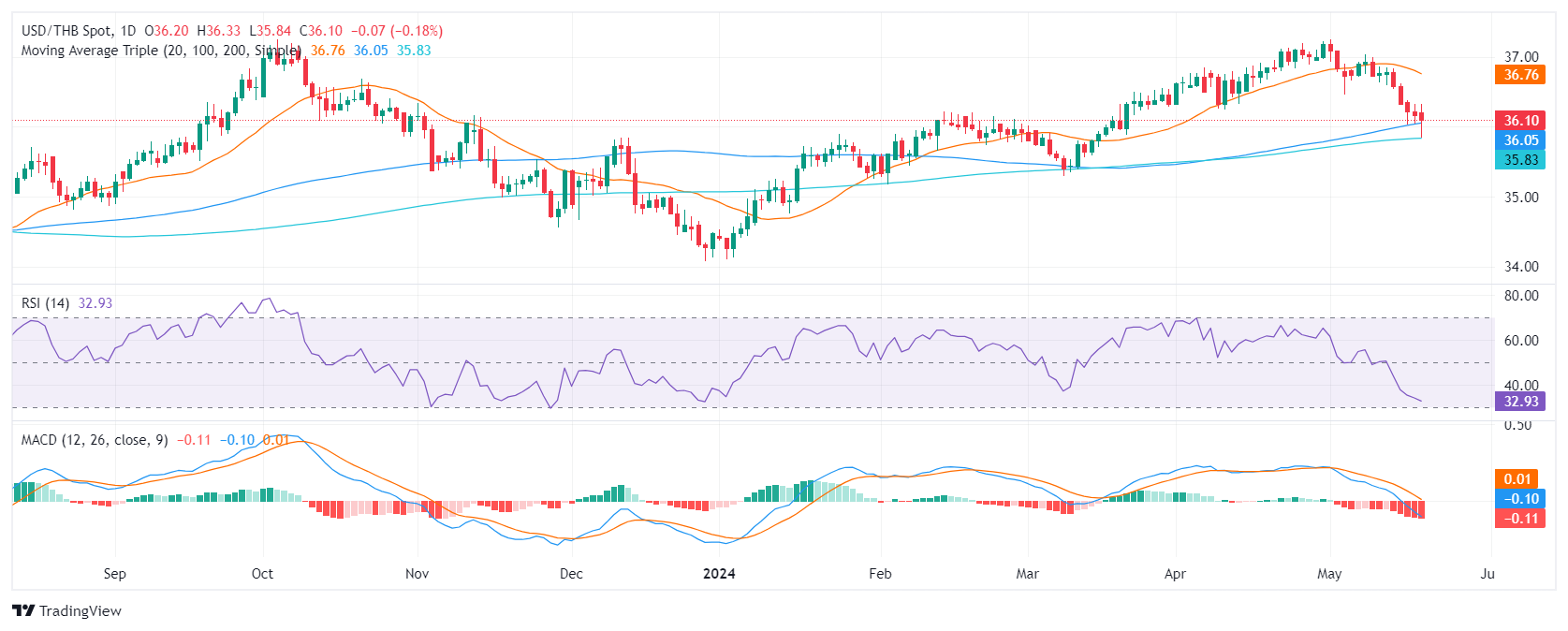
Examining the daily graph, the Relative Strength Index (RSI) of the USD/THB is hovering in the negative territory, suggesting a hint of bearish momentum. Simultaneously, the Moving Average Convergence Divergence (MACD) histogram is displaying red bars, indicating a negative momentum. Yet, as the histogram bars are flat, these suggest a decreasing selling pressure and the potential for a lessening in the current bearish bias.

USD/THB daily chart

Regarding the Simple Moving Average (SMA), the pair is below the 20, 100-day SMAs. However, it is noteworthy that in Monday's session, buyers defended the 200-day SMA at the 35.83 mark. This reveals resilience, potentially impeding the bearish narrative and may trigger a bullish sentiment if sustained. This combination reveals that the pair is in a bearish trend but if the bulls remain resilient, the losses might be limited.
 

Disclaimer: For information purposes only. Past performance is not indicative of future results.
placeholder
Gold ends three-week slide at the $4,400 line — eight straight days of ETF inflows vs a 5% 10-year and a 100 dollarSpot gold closed Friday at $4,378.39, up 0.84% on the day and about 0.8% for the week — its first weekly gain in four weeks — with the intraday high of $4,399.67 leaving it 33 cents shy of the $4,400 line. Gold ETFs have now logged eight straight sessions of inflows, but with the 10-year back above 5% and the dollar index near 100, here is what decides whether this is a reversal or a bounce.
Author  Suzie
Sep 20, Sun
Spot gold closed Friday at $4,378.39, up 0.84% on the day and about 0.8% for the week — its first weekly gain in four weeks — with the intraday high of $4,399.67 leaving it 33 cents shy of the $4,400 line. Gold ETFs have now logged eight straight sessions of inflows, but with the 10-year back above 5% and the dollar index near 100, here is what decides whether this is a reversal or a bounce.
placeholder
October hike odds climb toward 60% as Goldman and BofA both flip — what Warsh's "dose of accommodation" really changedRate futures now price roughly 55% to 62% for a 25bp hike at the October 27-28 FOMC, up from about 30% before Chair Warsh's post-meeting framing that the Fed is merely "removing some accommodation." Goldman Sachs has added an October hike to its forecast and Bank of America now sees moves in both October and December. Here is the repricing, the language behind it, and the two data points that decide it.
Author  Irene Q.
Yesterday 06: 22
Rate futures now price roughly 55% to 62% for a 25bp hike at the October 27-28 FOMC, up from about 30% before Chair Warsh's post-meeting framing that the Fed is merely "removing some accommodation." Goldman Sachs has added an October hike to its forecast and Bank of America now sees moves in both October and December. Here is the repricing, the language behind it, and the two data points that decide it.
placeholder
Memory chips surge, Nasdaq notches a second straight record close — why the Dow fell 185 points anywayMicron gained 5%, SanDisk 6.8%, Seagate 4% and Western Digital 3% as the memory complex led the Nasdaq Composite to a second consecutive record close of 27,244.28. But the Dow fell 185 points as JPMorgan, Wells Fargo and Schwab slid more than 3% each — a split tape that says more about positioning than about the economy.
Author  Irene Q.
Yesterday 06: 51
Micron gained 5%, SanDisk 6.8%, Seagate 4% and Western Digital 3% as the memory complex led the Nasdaq Composite to a second consecutive record close of 27,244.28. But the Dow fell 185 points as JPMorgan, Wells Fargo and Schwab slid more than 3% each — a split tape that says more about positioning than about the economy.
placeholder
Gold Price Forecast: XAU/USD drifts toward $4.300 with bears gaining tractionGold (XAU/USD) retraces Tuesday’s gains on Wednesday and drifts lower, approaching the $4,300 area as the US Dollar Index (DXY) rallies further amid high US Treasury yields.
Author  FXStreet
Yesterday 10: 02
Gold (XAU/USD) retraces Tuesday’s gains on Wednesday and drifts lower, approaching the $4,300 area as the US Dollar Index (DXY) rallies further amid high US Treasury yields.
placeholder
US input costs rose at the fastest pace in four years — the September flash PMI beat is an inflation story, not a growth storyUS September flash PMIs came in far above expectations, with the composite at 58.4, a five-year high. But the detail that moved markets was input cost inflation at its fastest since October 2022, driven by fuel, transport and supply shortages. Brent is back above $100 and the 10-year Treasury yield has hit its highest since 2007.
Author  Suzie
5 hours ago
US September flash PMIs came in far above expectations, with the composite at 58.4, a five-year high. But the detail that moved markets was input cost inflation at its fastest since October 2022, driven by fuel, transport and supply shortages. Brent is back above $100 and the 10-year Treasury yield has hit its highest since 2007.
goTop
quote