


Japanese Bond Yields Break 4%. Sanae Takaichi’s Political Gamble Is Stirring a Global Capital Tidal Wave
TradingKey - Tuesday (February 16), A "depth charge" was dropped into global financial markets as the yield on Japan's 40-year government bonds returned to the 4% threshold for the first time in 30 years, marking a record high since the instrument's inception in 2007. Furthermore, this bond market storm coincided with Prime Minister Sanae Takaichi's election declaration. On Monday, Takaichi officially confirmed at a press conference that the House of Representatives would be dissolved this Friday (the 23rd), with a snap election set for February 8, while also making a major promise to "reduce the food consumption tax from 8% to 0%."
A global financial storm is brewing in Japanese markets, where a political gamble on Japan's debt credit is sending shockwaves through the capillaries of capital flows to the global financial system. The arbitrage logic built over three decades of low interest rates is collapsing, and the "shifting tide" of global capital is quietly opening Pandora's box.
The "Tight Money + Loose Fiscal" policy is shattering market trust.
As Japanese government bond (JGB) yields broke 4% and bond prices plummeted, investors are voting with their feet, puncturing the illusion of balance in the Japanese economy. Japan's debt-to-GDP ratio has soared to 240%, the highest among major global economies, surviving for years only through the Bank of Japan's "unlimited backstop" and a low-interest-rate environment. However, Takaichi has added further strain to this fragile debt chain in pursuit of votes.
Takaichi's primary goal for the snap election is to consolidate her governing mandate, but the expansionary fiscal promises in her campaign platform have become the direct catalyst for bond market volatility. To win voter support, Takaichi promised to cut the food consumption tax from 8% to 0% if re-elected; the opposition coalition has proposed similar tax cuts. While this policy may stimulate consumption in the short term, the market is broadly concerned it will widen the fiscal deficit.
Driven by persistent inflation, the Bank of Japan is being forced to raise interest rates. With Japan's core CPI exceeding the 2% target for 44 consecutive months and approaching the 3% threshold, the central bank had to raise the policy rate to 0.75%, the highest since 1995.
Since Takaichi's cabinet took office, it has introduced a stimulus package worth 21.3 trillion yen. The fiscal 2026 budget has climbed to 122.3 trillion yen, with new government bond issuance reaching 29.6 trillion yen, a significant expansion from the previous year.
Government bonds are essentially financing tools; fiscal expansion inevitably leads to a surge in issuance. However, the JGB market is facing a contraction in demand—the Bank of Japan has continued to reduce its bond purchases after starting quantitative tightening, while domestic life insurers and banks are paring holdings due to unrealized losses on long-term bonds. Overseas investors remain risk-sensitive and on the sidelines. This supply-demand gap is putting downward pressure on bond prices, forcing yields higher.
This contradictory operation—the central bank raising rates to control inflation while the government spends money to win votes—has completely shattered market confidence in Japan's debt sustainability.
Barclays strategists noted that the competition between political parties over fiscal expansion has pushed concerns about JGB supply-demand imbalances to a peak, with the shadow of bond sell-offs seen before previous Upper House elections once again looming over the market.
The reversal of the US-Japan interest rate differential is changing the direction of global capital flows.
The core logic of global capital flow has always been "the pursuit of profit." As the Federal Reserve continues to cut rates and the Bank of Japan implements rate hikes, the US-Japan interest rate differential is changing rapidly. JGB yields breaking 4% are becoming a driver of global capital movement.
For the past thirty years, the yen carry trade has supported half of the world's risky assets—investors borrowed yen at near-zero cost to invest in high-yield assets like US Treasuries and stocks, profiting from both yield spreads and asset appreciation. Today, however, this arbitrage logic has completely failed.
The following table shows changes in the US-Japan interest rate differential since 2025, clearly illustrating the narrowing and eventual reversal trend that has triggered a chain reaction in capital flows:
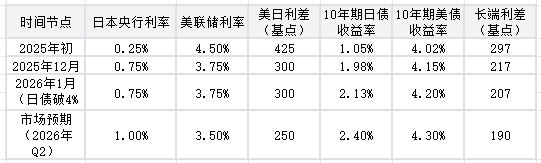
Changes in the US-Japan Interest Rate Differential
Data shows that the US-Japan differential has shrunk from 525 basis points at the start of 2025 to 300 basis points, with the narrowing trend continuing. Crucially, long-term spreads have also tightened; the 30-year JGB yield has surpassed German Bunds, significantly boosting the yield attractiveness of Japanese debt. This has directly triggered two major capital flow phenomena: the unwinding of the carry trade and the repatriation of Japanese overseas assets, both of which will stir global capital turmoil.
How will the JGB storm leverage global capital?
The global yen carry trade is valued at $1 trillion and was once the "liquidity engine" for global risky assets. Now, with yen borrowing costs surging alongside JGB yields, the strategy of "borrowing yen to buy high-yield assets" is no longer viable. The August 2024 plunge in global tech stocks caused by carry trade unwinding was merely a rehearsal; the wave of unwinding triggered by JGB yields breaking 4% could be far more violent.
Arbitrageurs are forced to sell assets such as US stocks, cryptocurrencies, and emerging market stocks and bonds to buy back yen and repay debts, directly causing volatility in global risky assets. Goldman Sachs estimates that the unwinding of the carry trade alone could exert downward pressure of over 5% on US stocks, while leveraged assets like cryptocurrencies could face even steeper declines.
The unwinding of the yen carry trade will be a "nightmare" for emerging markets. Economies with high external debt, such as Turkey and Argentina, are on the front lines. International investors, forced to repay yen debts, are selling assets in these countries, triggering capital flight and currency depreciation.
Li Qingru, a researcher at the Chinese Academy of Social Sciences, warned that the reduction of overseas asset holdings by Japanese financial institutions will further tighten global liquidity. This contraction, transmitted through international investor portfolios, will drive up global risk premiums, worsening the financing environment for developing countries and potentially triggering localized debt crises.
The most peculiar phenomenon in the JGB storm is the "inverse reaction" of the Japanese stock market—the Nikkei 225 has strengthened against the trend to reach record highs, creating a spectacle of "equity-bond divergence." This is driven not by improved economic fundamentals, but by the "cross-market migration" of domestic capital.
On one hand, investors are withdrawing funds from the plunging bond market and pouring them into stocks in search of safety and returns. On the other hand, a weaker yen benefits the earnings of export enterprises, combined with a rally in the food retail sector due to expected consumption tax cuts (7&i Holdings up 5%, Ajinomoto up 6.07%), which has propped up the stock market. However, this prosperity is extremely fragile; if JGB yields climb further, capital flight will follow, leaving Japanese stocks vulnerable to a double blow to valuations and liquidity.
Sanae Takaichi's election could exacerbate global financial market volatility.
The outcome of Takaichi's election will serve as a "watershed" for global capital flows. If the LDP wins, further fiscal expansion will push JGB yields above 4.5%, accelerating capital repatriation and the unwinding of the carry trade, thereby intensifying global market volatility; if there is an election upset, policy uncertainty will trigger brief safe-haven sentiment, though the yen's long-term weakness remains difficult to reverse.
For global investors, the asset valuation framework reliant on low-interest yen leverage has completely collapsed, making high-dividend, low-volatility assets the new safe havens. For central banks worldwide, managing the capital shocks triggered by JGB volatility and balancing growth with risk mitigation will be an unprecedented challenge.
Recommended Articles


