


Bitcoin Price Forecast: Trends and Investment Outlook from 2025 to 2030
Introduction
TradingKey – In July 2025, Bitcoin (BTC) surged past $120,000, setting a new all-time high and pushing the total crypto market cap above $3.9 trillion. This explosive rally has reignited global interest and bullish sentiment, prompting investors to ask:
- What’s driving Bitcoin’s price higher?
- How far can it go?
- What are the projections for year-end 2025 and 2030?
This report explores Bitcoin’s trajectory through historical cycles, macro factors, institutional forecasts, and risk analysis, offering strategic insights for long-term investors.
Bitcoin Price History: Three Cycles of Growth
Bitcoin’s price has consistently trended upward across bull and bear cycles, with each peak and trough surpassing the previous. Excluding its early development phase, Bitcoin has completed two full market cycles and is now entering its third bull run.
Early Phase (2009–2013)
Launched by the pseudonymous Satoshi Nakamoto, Bitcoin began as a niche experiment. In 2011, BTC crossed $1, drawing global attention.
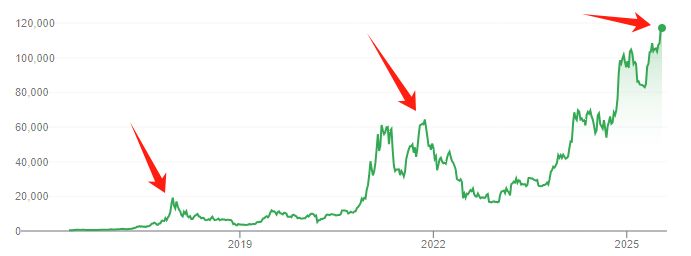
Bitcoin price trend chart (2009-2025), source: Google.
First Bull Run (2017)
After peaking at $1,200 in 2013, Bitcoin faced setbacks due to exchange hacks and regulatory uncertainty. In 2017, fueled by global investor enthusiasm, BTC surged to nearly $20,000.
Second Bull Run (2021)
Amid pandemic-driven economic uncertainty, Bitcoin rallied past $60,000 in 2021, attracting institutional capital and mainstream media coverage.
Key Drivers of Bitcoin Price Movement
Category | Factor | Impact | Example |
Macroeconomics | Inflation & Fiat Debasement | BTC as digital gold | 2020 USD devaluation |
Interest Rates | Low rates boost risk assets | 2020–2021 U.S. easing | |
Regulation | Crackdowns | Market panic | 2017 China exchange ban |
Policy Support | Market confidence | 2025 U.S. strategic reserve | |
Supply & Demand | Halving Events | Reduced issuance | 2020 halving → $69K |
Institutional Demand | Price surge | 2024 BTC ETF approval | |
Sentiment | Panic Selling | Sharp declines | 2022 FTX collapse |
Celebrity Influence | Volatility | Elon Musk’s Tesla tweet |
Institutional Forecasts for 2025
After bottoming at $16,000 in 2023, Bitcoin rebounded on the back of:
- The 2024 halving
- Trump’s re-election
- U.S. approval of spot BTC ETFs
- Strategic reserve designation
On July 14, 2025, BTC hit $123,000, up 668% from its 2023 low. Will the price of Bitcoin continue to rise, or will it plummet into a bear market? Financial institutions are generally bullish, believing that Bitcoin may rise to $130,000 to $200,000 by the end of 2025.
Institution | Target Price (2025) | Rationale |
21Shares | $138,555 | On-chain momentum, macro trends |
JPMorgan | $145,000 | Lightning Network growth |
Galaxy Digital | $185,000 | Institutional & sovereign adoption |
Standard Chartered | $200,000 | ETF inflows, stablecoin legislation |
In the longer term, institutions are more bullish on Bitcoin. Among them, Standard Chartered believes that the price of Bitcoin will change in the next three years: $300,000 (2026), $400,000 (2027), and $500,000 (2028). ARK Invest, owned by Wood, is more radical, believing that Bitcoin will exceed $1 million in 2030.
Risks and Investment Considerations
Although institutions are generally bullish on the future prospects of Bitcoin, it does not mean that Bitcoin investment is easy and risk-free. On the contrary, Bitcoin faces problems such as sharp price retracements and technical security, so it is necessary to invest in Bitcoin with caution.
Key Risks
Risk Type | Description |
Price Volatility | No circuit breakers; leveraged trading amplifies swings |
Security | Wallet key loss, exchange hacks, smart contract bugs |
Fraud | Fake exchanges, Ponzi schemes, phishing scams |
Investment Tips
Strategy | Advice |
Portfolio Allocation | Limit BTC exposure to ≤5% of total assets |
Long-Term Holding | Focus on fundamentals; avoid short-term noise |
Platform Safety | Use regulated exchanges like Coinbase or Binance |
Avoid Scams | Ignore “guaranteed returns” and never share private keys |
Conclusion
From $0.01 in 2009 to $120,000+ in 2025, Bitcoin has evolved from obscurity to a globally recognized financial asset. While institutions and governments increasingly embrace it, investors must remain vigilant against volatility, security risks, and scams.
Recommended Articles


