

Bitcoin Bottom In Sight As Trump Expected To Soften Stance On Reciprocal Tariffs: Report

Source Newsbtc

According to a recent report by 10X Research, Bitcoin (BTC) may be attempting to form a local bottom, as US President Donald Trump is expected to soften his stance on reciprocal tariffs, which are set to go into effect on April 2.

Up Only For Bitcoin?

Bitcoin’s plunge to $77,000 on March 10 may have marked the bottom for the top cryptocurrency in the current market cycle. Since then, the digital asset has appreciated by more than 10%, trading in the mid $80,000 range at the time of writing.

The 10X Research report suggests that Trump’s recent pivot toward “flexibility” on the upcoming April 2 reciprocal trade tariffs may have alleviated some concerns about further deterioration in the global macroeconomic outlook.

Additionally, the report emphasizes the US Federal Reserve’s (Fed) comments following this month’s Federal Open Market Committee (FOMC) meeting, where the central bank indicated that it would slow the pace of balance sheet drawdown and end the current cycle of quantitative tightening.

The Fed’s remarks followed the release of the February 2025 Consumer Price Index (CPI) inflation data, which came in line with expectations, easing concerns about inflation. The report’s claim that BTC has formed a bottom aligns with crypto entrepreneur Arthur Hayes’ recent statement, where he noted that BTC may have “probably” bottomed at $77,000.

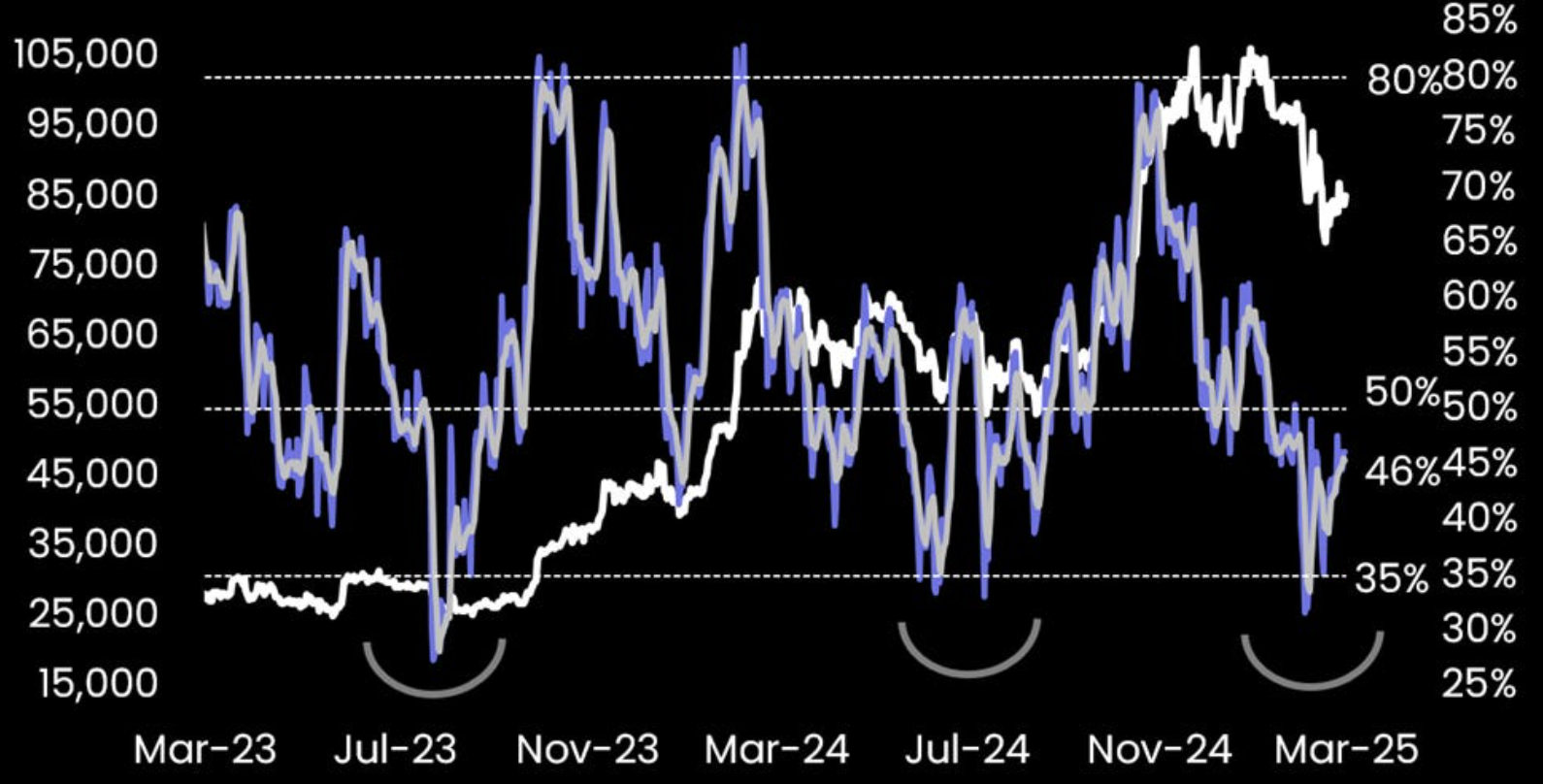
The following chart illustrates a bullish reversal in BTC’s 21-day moving average, which currently sits at $85,200. The report points out that these weekly reversal signs are back at levels typically seen when past bull markets have resumed.
10x

For example, in September 2023, BTC benefited from bullish momentum as the Bitcoin exchange-traded funds (ETF) narrative gained traction. Similarly, BTC embarked on a historic rally in August 2024 as the US presidential election drew closer.

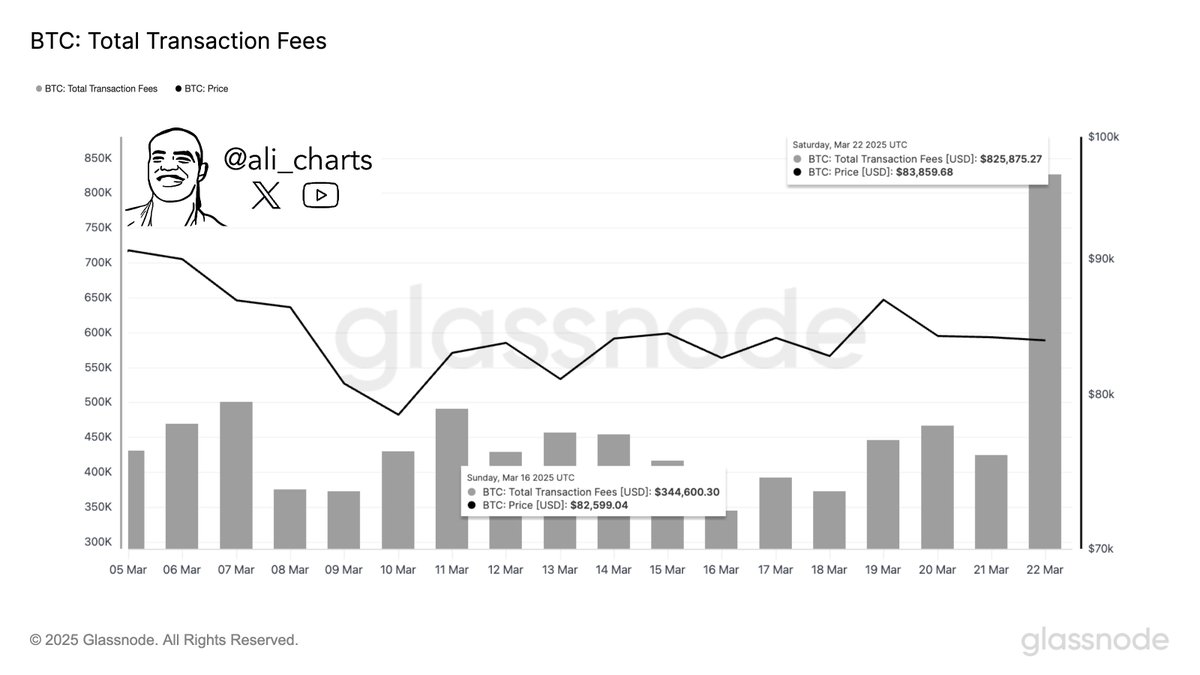
Additionally, a recent post on X by seasoned crypto analyst Ali Martinez highlights that Bitcoin transaction fees have nearly tripled over the past week, indicating an uptick in network activity as market sentiment improves.
ali

BTC Still Not Completely Bullish

While Trump’s softening stance on tariffs is good news for risk-on assets like cryptocurrencies, BTC still needs to break through and sustain certain price levels to regain strong bullish momentum.

Recent analysis by Martinez identified $94,000 as a critical price level for BTC to overcome. If the digital asset decisively breaks through and sustains this level, it could be poised to climb as high as $112,000.

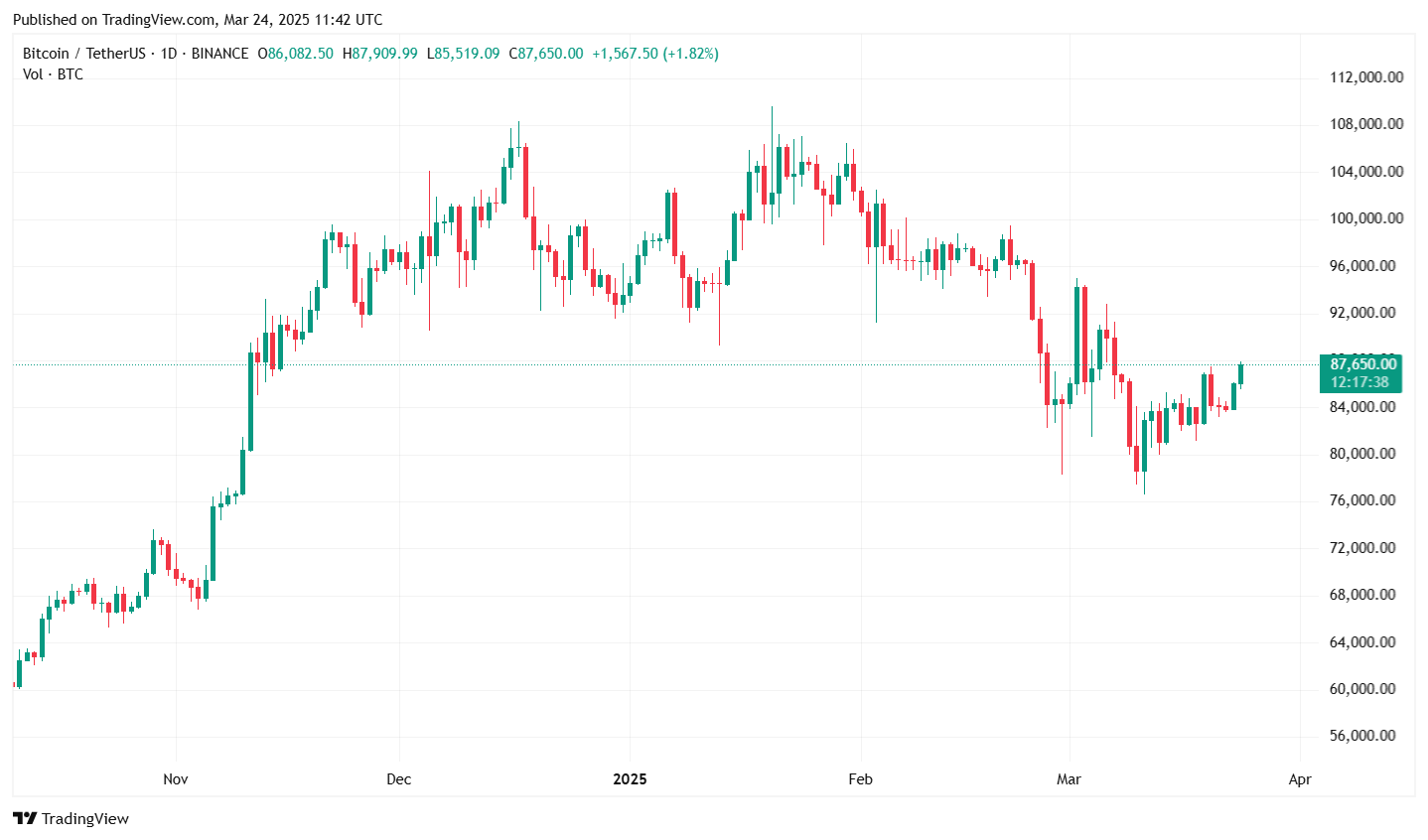
That said, concerns remain about BTC’s relatively weak price performance compared to other safe-haven assets like gold. At press time, BTC is trading at $87,650, up 3.6% in the past 24 hours.
bitcoin
Disclaimer: For information purposes only. Past performance is not indicative of future results.
placeholder
Gold Price Analysis Today | Forex Gold Analysis | XAU/USD Analysis - November 11, 2026Get the latest gold price analysis, forex gold insights, and XAU/USD analysis for November 11, 2026. Read on for the details.
Author  Mitrade
Nov 11, Wed
Get the latest gold price analysis, forex gold insights, and XAU/USD analysis for November 11, 2026. Read on for the details.
placeholder
Bitcoin lost its 200-day average — but the exit started three sessions before the CPIBitcoin fell 2.5% to about $73,400 on 11 November, an 11-week low, breaking its 200-day moving average near $73,100. The 24-hour liquidation tally reached $632 to $705 million, roughly 82% of it longs. But spot ETF outflows began three sessions earlier and USDT's market cap has shrunk $6.6 billion in 60 days — the leveraged length left before the inflation print did. A double top at 81,890 and 81,080 leaves a measured target of 69,366.
Author  Suzie
Nov 11, Wed
Bitcoin fell 2.5% to about $73,400 on 11 November, an 11-week low, breaking its 200-day moving average near $73,100. The 24-hour liquidation tally reached $632 to $705 million, roughly 82% of it longs. But spot ETF outflows began three sessions earlier and USDT's market cap has shrunk $6.6 billion in 60 days — the leveraged length left before the inflation print did. A double top at 81,890 and 81,080 leaves a measured target of 69,366.
placeholder
Nvidia slid 7.7% after hours while AMD and Broadcom rose — the AI trade changed hands, it didn't breakNvidia closed Wednesday at 173.73, up 2.87%, then fell as much as 8.1% to 159.44 after reports that its board was preparing for a possible leadership change. The same session, the Philadelphia Semiconductor Index rose 5.7% with all 30 components higher, CoreWeave jumped 24.7% on 168% revenue growth, and Micron added 11.9%. If AI demand were being repriced, AMD and Broadcom would not be bid. This is a governance discount on one name, and 204.54 — the 200-day average — is the level that settles it.
Author  Irene Q.
Nov 12, Thu
Nvidia closed Wednesday at 173.73, up 2.87%, then fell as much as 8.1% to 159.44 after reports that its board was preparing for a possible leadership change. The same session, the Philadelphia Semiconductor Index rose 5.7% with all 30 components higher, CoreWeave jumped 24.7% on 168% revenue growth, and Micron added 11.9%. If AI demand were being repriced, AMD and Broadcom would not be bid. This is a governance discount on one name, and 204.54 — the 200-day average — is the level that settles it.
placeholder
Gold hit a one-year low while central banks bought 321 tonnes — the sellers were never the ones you thinkSpot gold closed at 3,876 on Thursday, down 2.8% and its lowest close in more than a year, with an intraday low near 3,852. The dollar is at a 19-month high of 103.21 and the 10-year yield is at 5.10%, so the price move is easy to explain. What is harder to explain is who sold: central banks bought 321 tonnes in Q3, the PBoC added for a 24th straight month, ETF holdings are near a record 4,256 tonnes, and roughly 95% of the futures selling came from non-reportable and sovereign-type accounts rather than hedge funds. This piece separates the two books that have to balance.
Author  Irene Q.
Yesterday 02: 40
Spot gold closed at 3,876 on Thursday, down 2.8% and its lowest close in more than a year, with an intraday low near 3,852. The dollar is at a 19-month high of 103.21 and the 10-year yield is at 5.10%, so the price move is easy to explain. What is harder to explain is who sold: central banks bought 321 tonnes in Q3, the PBoC added for a 24th straight month, ETF holdings are near a record 4,256 tonnes, and roughly 95% of the futures selling came from non-reportable and sovereign-type accounts rather than hedge funds. This piece separates the two books that have to balance.
placeholder
Brent rose 3.3% and US crude stocks built 4.66 million barrels in the same weekBrent January settled at 95.82, up 3.3%, and WTI at 88.74, up 2.55%, after the US signalled it would not pursue a deal with Iran and attacks on Gulf shipping continued. In the same week, EIA data showed US crude inventories rising 4.657 million barrels against expectations of a 1.1 million draw, with gasoline up another 1.799 million. OPEC output also rebounded 1.96 million barrels a day to 27.16 million in October, led by Saudi Arabia at 10.56 million. This piece separates the geopolitical premium from the physical balance and lays out where each side of the trade is anchored.
Author  Irene Q.
Yesterday 03: 06
Brent January settled at 95.82, up 3.3%, and WTI at 88.74, up 2.55%, after the US signalled it would not pursue a deal with Iran and attacks on Gulf shipping continued. In the same week, EIA data showed US crude inventories rising 4.657 million barrels against expectations of a 1.1 million draw, with gasoline up another 1.799 million. OPEC output also rebounded 1.96 million barrels a day to 27.16 million in October, led by Saudi Arabia at 10.56 million. This piece separates the geopolitical premium from the physical balance and lays out where each side of the trade is anchored.
goTop
quote