

Bitcoin Falls from the Shadows: Privacy Coins Now Dominate Dark Web Transactions

Source Beincrypto

Bitcoin was once considered the dominant currency in illicit transactions. However, it is now being replaced by privacy-focused cryptocurrencies like Monero (XMR), Zcash (ZEC), Dash, and stablecoins.

The primary reason for Bitcoin’s decline in illegal activities is its transparency.

Reasons for the Shift from Bitcoin to Privacy Coins

Bitcoin (BTC) once dominated illicit activities on the Dark Web, such as Nucleus Marketplace or Brian’s Club. The report from TRM Labs indicated that Bitcoin accounted for 97% of the total cryptocurrency volume associated with illegal activities in 2016.

However, by 2022, this figure had dropped sharply to just 19%, indicating a significant shift toward other cryptocurrencies. 

According to the TRM Labs’ report, illegal cryptocurrency activities involving Bitcoin will drop to just 12% by 2024. Tron (TRX) holds the top position with 58%. In another report from Chainalysis, stablecoins now account for the majority of total illicit transaction volume at 63%. The use of Bitcoin in illegal activities also recorded a significant decline.
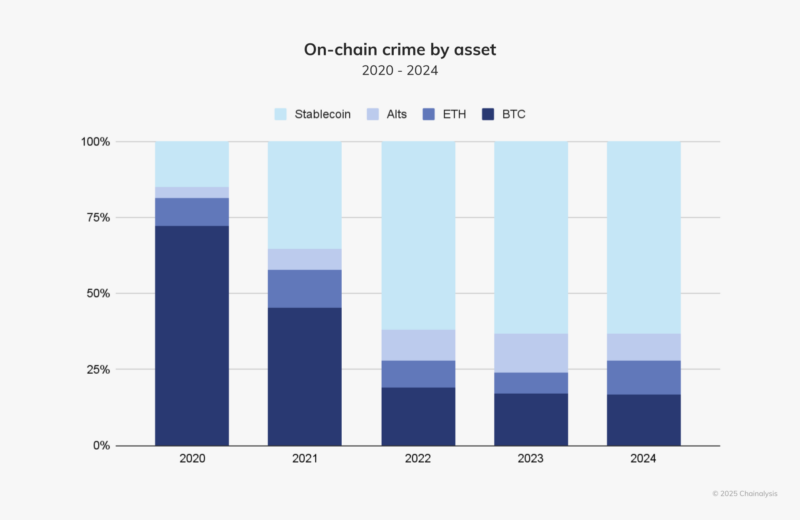
Stablecoins gained 63% of illicit trading activity by 2024. Source: ChainalysisStablecoins gained 63% of illicit trading activity by 2024. Source: Chainalysis

White House Market, one of the largest Dark Web marketplaces, stopped accepting Bitcoin and exclusively used Monero (XMR) for transactions in 2020. 

“The Bitcoin workaround was supposed to be there just to help with transition to XMR and as we are concerned, it’s done, therefore we are now Monero only, just as planned,” stated White House Market.

Elliptic researchers uncovered $11 billion in illicit trades using USDT on Cambodia’s Huione Guarantee marketplace in July 2024. Japanese law enforcement tracked Monero, marking the country’s first arrest linked to Monero transaction analysis.

The decision was driven by Bitcoin’s limitations, particularly its blockchain transparency. This move reflected a strategic shift in Dark Web markets and highlighted the rise of privacy coins like Monero, which are designed to provide enhanced anonymity.

The Popularity of Privacy Coins on the Dark Web

The decline of Bitcoin in illegal activities is not coincidental but rather stems from its inherent limitations. First and foremost, Bitcoin’s blockchain is a public ledger. When combined with additional data such as IP addresses or exchange records, every transaction can be tracked.

This transparency has enabled law enforcement agencies like the FBI to use blockchain analytics tools from Chainalysis and Elliptic to dismantle major Dark Web markets. Examples include the Silk Road shutdown in 2013, AlphaBay in 2017, Hydra in 2022, and Incognito Market in 2024.

Additionally, Bitcoin faces technical challenges, including high transaction fees and slow confirmation times. In contrast, privacy coins like Monero, Zcash, and Dash leverage advanced technologies to ensure high levels of anonymity, making transaction tracking extremely difficult. The Research from ScienceDirect suggests that privacy coins are closely linked to Dark Web traffic, further increasing their popularity in illicit markets.

The Two Sides of the Shift to Privacy Coins

On the positive side, Bitcoin’s declining role in illegal activities may improve its reputation as a legitimate financial tool. This could lead to wider acceptance and attract more users and investors.

However, the shift from Bitcoin to privacy coins and stablecoins has made it more challenging for law enforcement agencies to track and prevent illegal transactions. Despite advanced blockchain analytics tools that can detect transaction trails through mixers and tumblers, dealing with Monero and other privacy coins remains a significant challenge.

Global regulators are increasingly scrutinizing privacy coins and stablecoins. Some countries have outright banned privacy coins, while stablecoins are subjected to stricter oversight.

The transition from Bitcoin to privacy coins and stablecoins on the Dark Web is a clear trend, driven by the growing demand for anonymity and efficiency in illicit transactions. While Bitcoin still plays a role in certain crypto-related crimes, its transparency makes it less attractive to the Dark Web.

Meanwhile, Monero, Zcash, Dash, and stablecoins have become the preferred choices due to their enhanced security and privacy. This trend poses significant challenges for law enforcement agencies while driving advancements in blockchain analytics tools. 

However, it also raises concerns about using cryptocurrencies in illegal activities, necessitating a balance between technological innovation and regulatory oversight to ensure transparency and security in the digital financial ecosystem.

Disclaimer: For information purposes only. Past performance is not indicative of future results.
placeholder
Bitcoin CME gaps at $35,000, $27,000 and $21,000, which one gets filled first?Prioritize filling the $27,000 gap and even try higher.
Author  FXStreet
Aug 22, 2023
Prioritize filling the $27,000 gap and even try higher.
placeholder
Pinduoduo Earnings Incoming: Morgan Stanley Sees Long-Term Profit Potential​Insights – On November 21, Chinese e-commerce giant Pinduoduo (PDD) will release its Q3 2024 earnings.
Author  Mitrade
Nov 20, 2024
​Insights – On November 21, Chinese e-commerce giant Pinduoduo (PDD) will release its Q3 2024 earnings.
placeholder
Elon Musk’s xAI and Neuralink Launch New Funding Rounds​Billionaire Elon Musk recently raised funds for his two high-profile tech companies, xAI and Neuralink.
Author  Insights
Jun 03, 2025
​Billionaire Elon Musk recently raised funds for his two high-profile tech companies, xAI and Neuralink.
placeholder
Bitcoin briefly loses 2025 gains as crypto plunges over the weekend.Bitcoin experienced a sharp decline this weekend, briefly erasing its 2025 gains and dipping below its year-opening value of $93,507. The cryptocurrency fell to a low of $93,029 on Sunday, representing a 25% drop from its all-time high in October. Although it has rebounded slightly to around $94,209, the pressures on the market remain significant. The downturn occurred despite the reopening of the U.S. government on Thursday, which many had hoped would provide essential support for crypto markets. This year initially appeared promising for cryptocurrencies, particularly after the inauguration of President Donald Trump, who has established the most pro-crypto administration thus far. However, ongoing political tensions—including Trump's tariff strategies and the recent government shutdown, lasting a historic 43 days—have contributed to several rapid price pullbacks for Bitcoin throughout the year. Market dynamics are also being influenced by Bitcoin whales—investors holding large amounts of Bitcoin—who have been offloading portions of their assets, consequently stalling price rallies even as positive regulatory developments emerge. Despite these sell-offs, analysts from Glassnode argue that this behavior aligns with typical patterns seen among long-term investors during the concluding stages of bull markets, suggesting it is not indicative of a mass exodus. Notably, Bitcoin is not alone in its struggles, as Ethereum and Solana have also recorded declines of 7.95% and 28.3%, respectively, since the start of the year, while numerous altcoins have faced even steeper losses. Looking ahead, questions linger regarding the viability of the four-year cycle thesis, particularly given the increasing institutional support and regulatory frameworks now in place in the crypto landscape. Matt Hougan, chief investment officer at Bitwise, remains optimistic, suggesting a potential Bitcoin resurgence in 2026 driven by the “debasement trade” thesis and a broader trend toward increased adoption of stablecoins, tokenization, and decentralized finance. Hougan emphasized the soundness of the underlying fundamentals, pointing to a positive outlook for the sector in the longer term.
Author  Mitrade
Nov 17, 2025
Bitcoin experienced a sharp decline this weekend, briefly erasing its 2025 gains and dipping below its year-opening value of $93,507. The cryptocurrency fell to a low of $93,029 on Sunday, representing a 25% drop from its all-time high in October. Although it has rebounded slightly to around $94,209, the pressures on the market remain significant. The downturn occurred despite the reopening of the U.S. government on Thursday, which many had hoped would provide essential support for crypto markets. This year initially appeared promising for cryptocurrencies, particularly after the inauguration of President Donald Trump, who has established the most pro-crypto administration thus far. However, ongoing political tensions—including Trump's tariff strategies and the recent government shutdown, lasting a historic 43 days—have contributed to several rapid price pullbacks for Bitcoin throughout the year. Market dynamics are also being influenced by Bitcoin whales—investors holding large amounts of Bitcoin—who have been offloading portions of their assets, consequently stalling price rallies even as positive regulatory developments emerge. Despite these sell-offs, analysts from Glassnode argue that this behavior aligns with typical patterns seen among long-term investors during the concluding stages of bull markets, suggesting it is not indicative of a mass exodus. Notably, Bitcoin is not alone in its struggles, as Ethereum and Solana have also recorded declines of 7.95% and 28.3%, respectively, since the start of the year, while numerous altcoins have faced even steeper losses. Looking ahead, questions linger regarding the viability of the four-year cycle thesis, particularly given the increasing institutional support and regulatory frameworks now in place in the crypto landscape. Matt Hougan, chief investment officer at Bitwise, remains optimistic, suggesting a potential Bitcoin resurgence in 2026 driven by the “debasement trade” thesis and a broader trend toward increased adoption of stablecoins, tokenization, and decentralized finance. Hougan emphasized the soundness of the underlying fundamentals, pointing to a positive outlook for the sector in the longer term.
placeholder
Gold declines as Trump scraps Iran memorandum, markets await Fed minutesGold (XAU/USD) trades around $4,050 on Wednesday, down 1.40% on the day at the time of writing, as investors favor the US Dollar (USD) following a fresh deterioration in tensions between the United States (US) and Iran.
Author  FXStreet
Jul 08, Wed
Gold (XAU/USD) trades around $4,050 on Wednesday, down 1.40% on the day at the time of writing, as investors favor the US Dollar (USD) following a fresh deterioration in tensions between the United States (US) and Iran.
goTop
quote