

Did A Massive Bitcoin And Ethereum Sell-Off By Binance Trigger The Market Crash? Crypto Exchange Responds

Source Newsbtc

There have been recent concerns within the crypto community regarding Binance’s recent activities after a claim surfaced that the exchange had been offloading large amounts of Bitcoin and Ethereum. The Binance selloff trend was first noted on social media platform X by a market participant known as AB Kuai.Dong (@_FORAB), who noted that the crypto exchange had allegedly been selling off its Bitcoin and Ethereum holdings. 

Did Binance Trigger The Market Crash?

The crypto market has endured a turbulent two weeks, with Bitcoin at the center of a series of price crashes. The downturn began as Bitcoin plunged to $92,000 on February 3. Although a brief recovery saw BTC climb toward $98,000 on February 11, the momentum proved short-lived. Bitcoin has since struggled to regain momentum and is hovering around $95,000.

Unsurprisingly, Bitcoin’s price crash rippled across the market, dragging down other cryptocurrencies. On the same day Bitcoin hit its local low, Ethereum fell below $2,470.

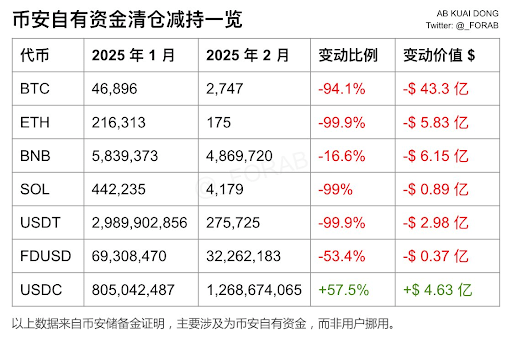
As noted by AB Kuai.Dong, Binance may have contributed to the downturn. Data shows that crypto addresses owned by Binance have seen a drastic decline in their holdings in recent few days. Particularly, AB Kuai.Dong noted that Binance had allegedly been selling off a huge part of its crypto holdings, which cuts across Bitcoin, Ethereum, Solana, BNB, and some stablecoins. 
Binance

On-chain data revealed that Binance has experienced a drastic 94.1% reduction in its Bitcoin holdings between January and February. The outflow was even more extreme for Ethereum, where balances dropped by 99.9% over the same period. BNB, Solana, and Tether USDT have also been reduced by 16.6%, 99%, and 99.9%. 

Interestingly, AB Kuai.Dong noted these assets were primarily past revenue generated by the platform rather than user funds. He also pointed out that a significant portion of the sold cryptocurrencies had been converted into USDC, which has increased by 57.5% in Binance’s wallets.

Binance Responds To Market Crash Allegations

AB Kuai.Dong quickly gained traction among crypto traders and investors on X, particularly those searching for explanations for the recent drop in Bitcoin and Ethereum prices. As the biggest crypto exchange in the world, a major selloff by Binance would be one of the worst things to happen to the cryptocurrencies involved.

However, Binance was quick to address the concerns, firmly denying that it had sold any assets. In an official statement on X, the exchange clarified that what had been observed was merely an internal accounting adjustment within the Binance treasury. As such, Binance reassured users that their funds remained safe and secure as always.

At the time of writing, Bitcoin is trading at $95,740, having declined by 2.6% in the past 24 hours. Ethereum is trading at $2,600 and is on a 4.2% decline in the past 24 hours.

Bitcoin
Disclaimer: For information purposes only. Past performance is not indicative of future results.
placeholder
WTI (USOIL) Is down 2.03% on Sep 25: Here Is WhyWTI (USOIL) is down 2.03% at Sep 24 22:20(UTC+0), now at $92.517, with a 7-day down of 3.63%.What is driving WTI (USOIL)’s stock price down today?The drop in WTI crude oil prices was primarily driven by
Author  TradingKey
Yesterday 04: 57
WTI (USOIL) is down 2.03% at Sep 24 22:20(UTC+0), now at $92.517, with a 7-day down of 3.63%.What is driving WTI (USOIL)’s stock price down today?The drop in WTI crude oil prices was primarily driven by
placeholder
Silver Price Forecast: XAG/USD remains steady near $64.00 as oil prices easeSilver price (XAG/USD) inches higher after two days of losses, trading around $63.90 per troy ounce during Asian hours on Friday. Non-yielding Silver is finding underlying support as inflation concerns ease following a pullback in crude oil prices.
Author  FXStreet
Yesterday 03: 30
Silver price (XAG/USD) inches higher after two days of losses, trading around $63.90 per troy ounce during Asian hours on Friday. Non-yielding Silver is finding underlying support as inflation concerns ease following a pullback in crude oil prices.
placeholder
Gold Price Forecast: Gold Drops Below $4,300, Will It Continue to Fall? As of the European session on September 24, gold prices (XAUUSD) extended their correction, dipping below $4,300 intraday to hit a low of $4,262.45. After previously rebounding close to $
Author  TradingKey
Sep 24, Thu
As of the European session on September 24, gold prices (XAUUSD) extended their correction, dipping below $4,300 intraday to hit a low of $4,262.45. After previously rebounding close to $
placeholder
Yen touches 158.37 as Tokyo reopens, then slips back — ¥15.4 trillion of intervention and the 200-day line stand between here and 160USD/JPY reached 158.37 overnight, its highest since early September, then eased to 157.88 as Japanese markets reopened after a three-day holiday. The Ministry of Finance has spent ¥15.4 trillion defending the yen since late July and the BOJ ran a rate check on September 18. The 200-day average sits at 158.43.
Author  Irene Q.
Sep 24, Thu
USD/JPY reached 158.37 overnight, its highest since early September, then eased to 157.88 as Japanese markets reopened after a three-day holiday. The Ministry of Finance has spent ¥15.4 trillion defending the yen since late July and the BOJ ran a rate check on September 18. The 200-day average sits at 158.43.
placeholder
US input costs rose at the fastest pace in four years — the September flash PMI beat is an inflation story, not a growth storyUS September flash PMIs came in far above expectations, with the composite at 58.4, a five-year high. But the detail that moved markets was input cost inflation at its fastest since October 2022, driven by fuel, transport and supply shortages. Brent is back above $100 and the 10-year Treasury yield has hit its highest since 2007.
Author  Suzie
Sep 24, Thu
US September flash PMIs came in far above expectations, with the composite at 58.4, a five-year high. But the detail that moved markets was input cost inflation at its fastest since October 2022, driven by fuel, transport and supply shortages. Brent is back above $100 and the 10-year Treasury yield has hit its highest since 2007.
goTop
quote