

The key trends reshaping the 2025 crypto landscape

Source Cryptopolitan

CryptoQuant has released its 2024 survey on crypto market trends, focusing on investor demographics, exchange behavior, and asset preferences. The research outlines several factors that could shape the market this year.

2024 was a year of two extremes for the crypto market that literally told a tale of two halves: unbearable sobering setbacks and the biggest triumphs seen for however long Bitcoin has been around.

Bitcoin and Ethereum ETFs were approved at the beginning of the year, but even institutional adoption wasn’t enough to carry the market to the “promised land.” 

It took the victory of a certain Donald J Trump in the November US elections to push the BTC train over the “dream target” of $100,000. And with that, investors managed to nurse their pocket’s wounds as the crypto market traded in the green for weeks.

So, what really took place in 2024? And will the trends that influenced the market last year carry over to 2025?

Here’s a breakdown of CryptoQuant’s 2024 survey. 

The crypto demographic: A younger, experienced investor base

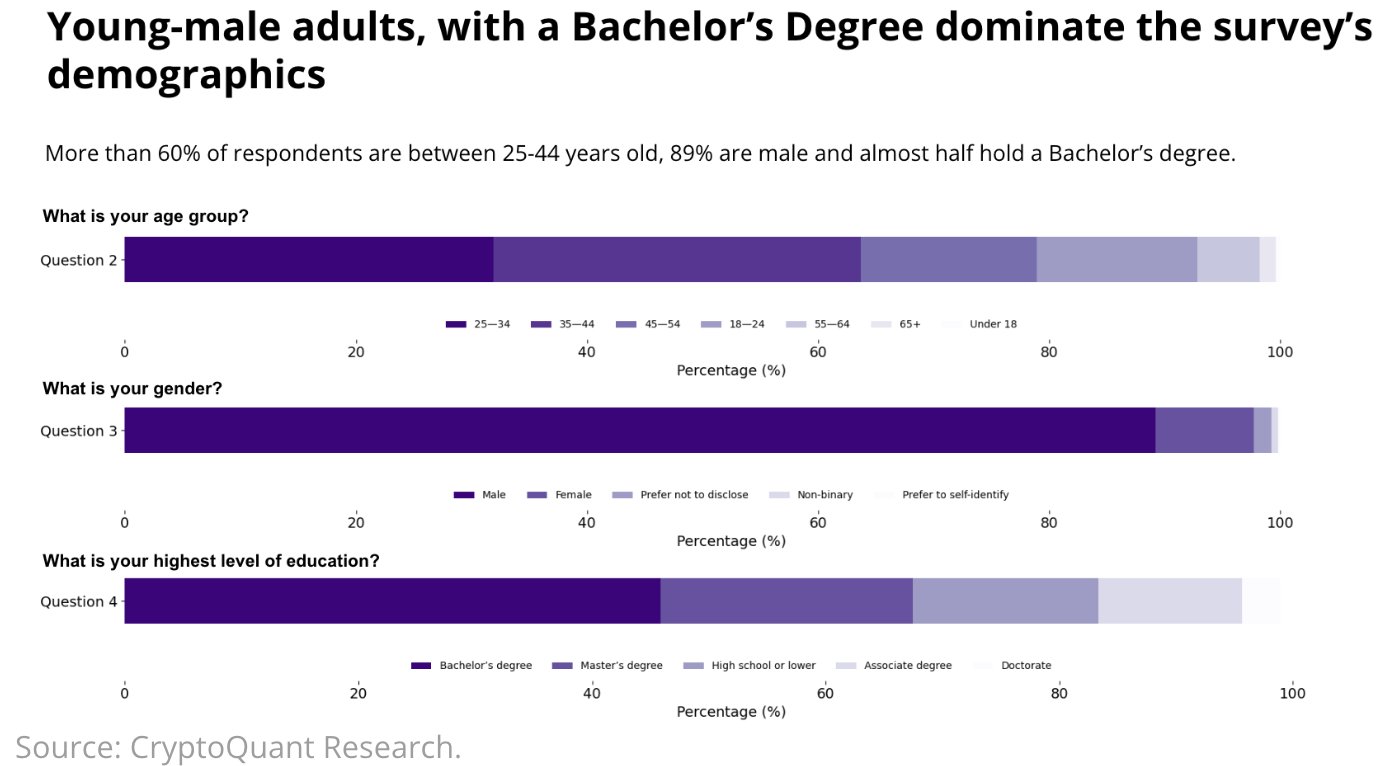
In the crypto market data platform’s survey, 60% of respondents fell within the 25-44 age range; Gen-Zs and millennials undoubtedly have a better understanding of crypto. But what’s particularly striking is that over 62% of participants have been in the industry for more than three years. 
Crypto demographic | CryptoQuant Research

So, young people are not just riding the “next big thing” wave; they know what they’re getting themselves into.

On the gender front, 89% of respondents identified as male and only 11% as female; the space remains predominantly male-dominated.

Retail investors dominate the market

Even though there’s presumably a high level of experience, the majority of these investors are still classified as retail. Most of them reported annual investments under $10,000. 

CryptoQuant analyst Emma Lee notes, “This indicates that while crypto has attracted retail investors, it remains a highly fragmented market. The majority of users are not large-scale institutional players, but rather individual investors who continue to fuel the market’s growth.

Regionally, Asia led the crypto investment bandwagon, with 40% of users coming from this region, followed by Europe at 29% and North America at 10%.

Analyst David W. Kim explained that retail investors have driven many exchanges to cater to smaller trades. “Traders are prioritizing exchanges with simplified user interfaces, which is one reason platforms like Binance remain so popular,” Kim noted.

Meanwhile, spot crypto trading continues to dominate the crypto landscape, with 76% of users prioritizing it over activities like derivatives trading or staking. Only 28% of participants used trading platforms for their earn products, and this is where exchanges can tap in if the market grows.

Binance: Everywhere but the US

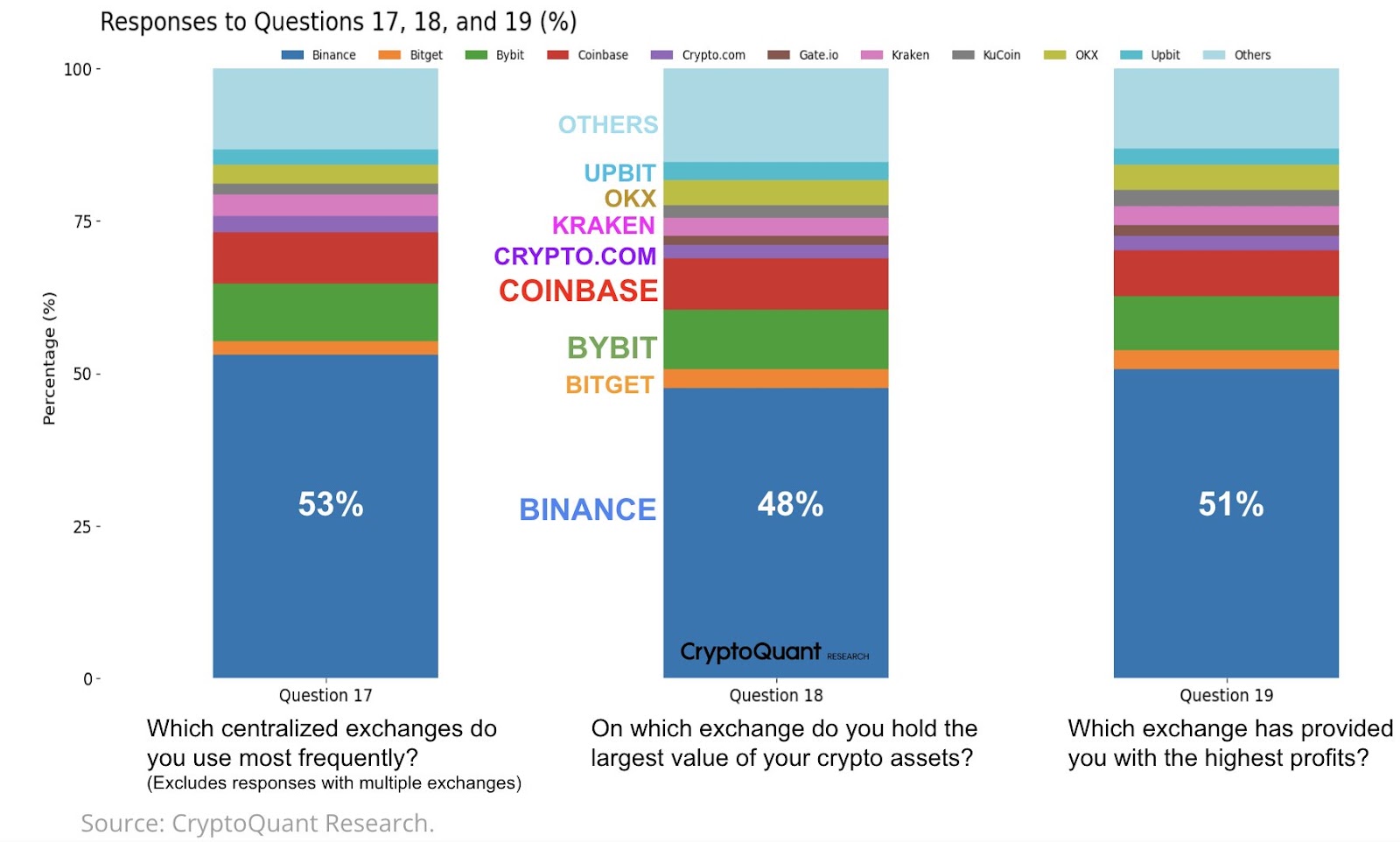
The CryptoQuant survey revealed that Binance is the top choice for crypto enthusiasts. More than half (53%) of respondents were in favor of Binance, and nearly half held the majority of their assets on the exchange. 
Crypto holders survey | CryptoQuant Research

The numbers don’t lie: Binance commands a staggering 46.59% of the total market share, based on a cumulative spot volume of $7.23 trillion. However, according to CryptoQuant founder Ki Young-Ju, Coinbase leads the way in North America, with a market share of 45%.

The survey also revealed that 83% of participants were mindful of exchanges’ security and compliance status. Most traders avoided exchanges that faced regulatory challenges. In terms of compliance, 32% of respondents considered Binance the most regulatory-compliant exchange. 14% of respondents felt Coinbase played by regulatory rules.

Industry expert Maria Alvarez explained, “The heavy concentration around top exchanges like Binance means traders are betting on liquidity. In such a competitive market, smaller exchanges face a difficult challenge in attracting and retaining users.

The report also highlighted the concentration of market activity around a small number of exchanges. The top five exchanges—Binance, Bybit, Crypto.com, OKEx, and Coinbase—control a staggering 81.24% of the cumulative spot volume. This means that smaller exchanges like Upbit, Huobi Pro, and Bithumb Korea, while still relevant, contribute a fraction of the overall volume.

Interestingly, the survey notes a steep drop-off in trading volume as you move down the list of exchanges. Smaller platforms like Coinone, Korbit, and Binance USA barely register new players and hold barely 0.4% of the total market share. 

Bitcoin and Ethereum market leaders, AI will grow too

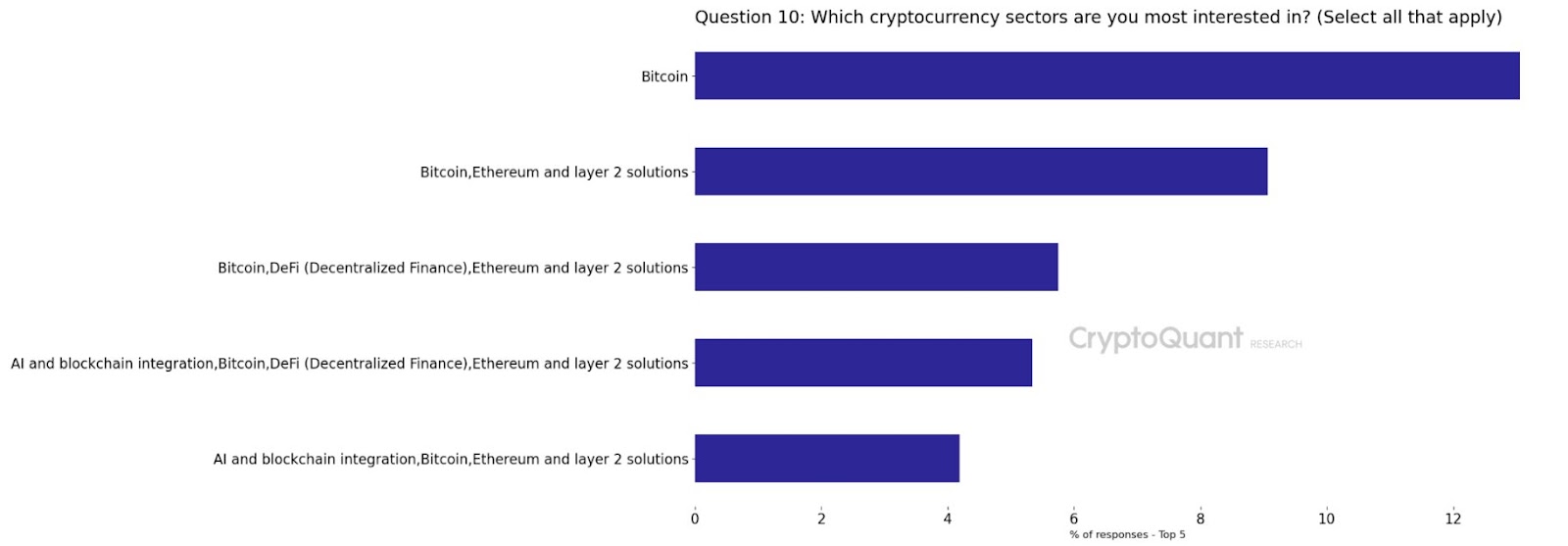
When it comes to profit generation, Bitcoin (BTC) and Ethereum (ETH) remain the market’s eye candy. The occasional surge in the popularity of memecoins or seasonal tokens wasn’t enough to sway investors’ focus. 
Investor Interest Survey | CryptoQuant Research

Traders overwhelmingly preferred these established cryptocurrencies; there’s no sign they won’t do so this year. Bitcoin and Ethereum will more than likely continue to lead the charge in 2025.

That said, the survey notes an emerging trend: the growing interest in artificial intelligence (AI) blockchain integrations. Currently valued at approximately $15 billion, AI tokens saw a remarkable price uptrend in the final quarter of 2024, experiencing a 222% growth. 

Gracy Chen, CEO of the crypto exchange Bitget, believes the AI token market could hit a market capitalization of $60 billion by 2025. As reported by Cryptopolitan, this trend is still in its early stages, but it has the potential to disrupt financial markets in the coming years, though not as soon as 2025.

A Step-By-Step System To Launching Your Web3 Career and Landing High-Paying Crypto Jobs in 90 Days.

Disclaimer: For information purposes only. Past performance is not indicative of future results.
placeholder
Gold Price Forecast: XAU/USD drifts higher above $4,200 as Fed delivers expected cutGold price (XAU/USD) gains momentum to around $4,235 during the early Asian session on Thursday. The precious metal extends its upside after the US Federal Reserve (Fed) delivered an expected third consecutive interest rate cut and maintained its outlook for just one cut in 2026.
Author  FXStreet
Dec 11, Thu
Gold price (XAU/USD) gains momentum to around $4,235 during the early Asian session on Thursday. The precious metal extends its upside after the US Federal Reserve (Fed) delivered an expected third consecutive interest rate cut and maintained its outlook for just one cut in 2026.
placeholder
Gold remains bid as lack of Fed clarity and geopolitical frictions persistGold (XAU/USD) advances modestly on Friday as traders seem to book profits ahead of the weekend, yet clings to gains of over 0.51% after reaching a seven-week high of $4,353. At the time of writing, XAU/USD trades at $4,302 as traders digest comments from Federal Reserve (Fed) officials.
Author  FXStreet
Yesterday 01: 34
Gold (XAU/USD) advances modestly on Friday as traders seem to book profits ahead of the weekend, yet clings to gains of over 0.51% after reaching a seven-week high of $4,353. At the time of writing, XAU/USD trades at $4,302 as traders digest comments from Federal Reserve (Fed) officials.
placeholder
Ethereum Price Slips Lower — $3,000 Looms as the Key BattlegroundEthereum is attempting to recover from a $3,026 low but remains below $3,200 and the 100-hour SMA, with a bearish trend line near $3,175 capping rebounds as bulls need a clean break above $3,200 to target $3,250–$3,400, while a drop below $3,050 risks a retest of $3,000 and $2,940.
Author  Mitrade
Yesterday 03: 25
Ethereum is attempting to recover from a $3,026 low but remains below $3,200 and the 100-hour SMA, with a bearish trend line near $3,175 capping rebounds as bulls need a clean break above $3,200 to target $3,250–$3,400, while a drop below $3,050 risks a retest of $3,000 and $2,940.
placeholder
Macro Analysts: Hawkish Japan Could Push Bitcoin Below $70KAnalysts predict Bitcoin may face further declines towards the $70,000 mark if the Bank of Japan raises interest rates as expected.
Author  Mitrade
Yesterday 05: 48
Analysts predict Bitcoin may face further declines towards the $70,000 mark if the Bank of Japan raises interest rates as expected.
placeholder
Bitcoin Slides 5% as Sellers Lean In — Can BTC Reclaim $88,000?Bitcoin has dropped back below $88,000 after rolling over from $90,500, with price still trading under the 100-hour Simple Moving Average. The sell-off found a floor at $85,151, and BTC is now consolidating near that base, but rebounds are facing pressure from a bearish trend line around $89,000. Bulls need to retake $88,000–$89,000 to ease downside risk; failure to do so keeps $85,500–$85,000 and then $83,500 in play, with $80,000 as the deeper “line in the sand.” Bitcoin (BTC) is back in damage-control mode after a sharp pullback wiped out recent gains. The price failed to reclaim the $90,000–$90,500 band, rolled over, and slid through $88,500 before briefly dipping under $87,000. Buyers did show up around $85,000, but the rebound so far looks more like stabilization than a clear trend reversal. Bitcoin dips hard, finds a bid near $85,000(h3) BTC’s latest move lower began when it couldn’t build follow-through above $90,000 and $90,500. Once that upside stalled, sellers took control and pushed price down through $88,500. The slide accelerated enough to spike below $87,000, but the market didn’t free-fall. Bulls defended the $85,000 zone, printing a low at $85,151. Since then, Bitcoin has been consolidating below the 23.6% Fibonacci retracement of the drop from the $93,560 swing high to the $85,151 low — a clue that the bounce is still shallow and that sellers haven’t fully backed off yet. Structurally, BTC is still on the back foot: It’s trading below $88,000, and It remains below the 100-hour Simple Moving Average, keeping short-term trend pressure pointed downward. Resistance is layered, and $89,000 is the problem area(h3) If bulls try to turn this into a recovery, they’ll have to climb through multiple ceilings in quick succession. First, BTC faces resistance around $87,150, followed by a more meaningful barrier near $87,500. From there, the market’s attention snaps back to $88,000 — the level BTC just lost and now needs to reclaim. A close back above $88,000 would improve the tone, but it doesn’t solve the bigger issue: there’s a bearish trend line on the hourly BTC/USD chart (Kraken feed) with resistance near $89,000, which also lines up with the next technical hurdle. If BTC can push through $89,000 and hold, the rebound could extend toward $90,000, with follow-through targets at $91,000 and $91,500. But until price clears that $88,000–$89,000 zone, rallies are at risk of being sold rather than chased. If BTC fails to reclaim resistance, the downside path is clear(h3) The near-term bear case is simple: if Bitcoin can’t climb back above the $87,000 area and keep traction, sellers may attempt another leg lower. Support levels line up like this: Immediate support: $85,500 First major support: $85,000 Next support: $83,500 Then $82,500 in the near term Below that, the major “don’t break this” level is still $80,000. If BTC slips under $80,000, the risk of acceleration to the downside increases significantly — not because it’s magic, but because it’s the kind of psychological and structural level that tends to trigger forced de-risking. Indicators: momentum still leans bearish(h3) The intraday indicators aren’t offering much comfort yet: Hourly MACD is losing pace in the bearish zone. Hourly RSI remains below 50, suggesting sellers still have the upper hand on short timeframes. So while the $85,000 defense held for now, the market hasn’t flipped bullish — it’s just stopped bleeding.
Author  Mitrade
9 hours ago
Bitcoin has dropped back below $88,000 after rolling over from $90,500, with price still trading under the 100-hour Simple Moving Average. The sell-off found a floor at $85,151, and BTC is now consolidating near that base, but rebounds are facing pressure from a bearish trend line around $89,000. Bulls need to retake $88,000–$89,000 to ease downside risk; failure to do so keeps $85,500–$85,000 and then $83,500 in play, with $80,000 as the deeper “line in the sand.” Bitcoin (BTC) is back in damage-control mode after a sharp pullback wiped out recent gains. The price failed to reclaim the $90,000–$90,500 band, rolled over, and slid through $88,500 before briefly dipping under $87,000. Buyers did show up around $85,000, but the rebound so far looks more like stabilization than a clear trend reversal. Bitcoin dips hard, finds a bid near $85,000(h3) BTC’s latest move lower began when it couldn’t build follow-through above $90,000 and $90,500. Once that upside stalled, sellers took control and pushed price down through $88,500. The slide accelerated enough to spike below $87,000, but the market didn’t free-fall. Bulls defended the $85,000 zone, printing a low at $85,151. Since then, Bitcoin has been consolidating below the 23.6% Fibonacci retracement of the drop from the $93,560 swing high to the $85,151 low — a clue that the bounce is still shallow and that sellers haven’t fully backed off yet. Structurally, BTC is still on the back foot: It’s trading below $88,000, and It remains below the 100-hour Simple Moving Average, keeping short-term trend pressure pointed downward. Resistance is layered, and $89,000 is the problem area(h3) If bulls try to turn this into a recovery, they’ll have to climb through multiple ceilings in quick succession. First, BTC faces resistance around $87,150, followed by a more meaningful barrier near $87,500. From there, the market’s attention snaps back to $88,000 — the level BTC just lost and now needs to reclaim. A close back above $88,000 would improve the tone, but it doesn’t solve the bigger issue: there’s a bearish trend line on the hourly BTC/USD chart (Kraken feed) with resistance near $89,000, which also lines up with the next technical hurdle. If BTC can push through $89,000 and hold, the rebound could extend toward $90,000, with follow-through targets at $91,000 and $91,500. But until price clears that $88,000–$89,000 zone, rallies are at risk of being sold rather than chased. If BTC fails to reclaim resistance, the downside path is clear(h3) The near-term bear case is simple: if Bitcoin can’t climb back above the $87,000 area and keep traction, sellers may attempt another leg lower. Support levels line up like this: Immediate support: $85,500 First major support: $85,000 Next support: $83,500 Then $82,500 in the near term Below that, the major “don’t break this” level is still $80,000. If BTC slips under $80,000, the risk of acceleration to the downside increases significantly — not because it’s magic, but because it’s the kind of psychological and structural level that tends to trigger forced de-risking. Indicators: momentum still leans bearish(h3) The intraday indicators aren’t offering much comfort yet: Hourly MACD is losing pace in the bearish zone. Hourly RSI remains below 50, suggesting sellers still have the upper hand on short timeframes. So while the $85,000 defense held for now, the market hasn’t flipped bullish — it’s just stopped bleeding.
goTop
quote