

Ethereum Prognose: Vorübergehende Schwäche und Chance auf neue Kursrekorde?

Source Newsbtc

Ethereum zählt nicht umsonst zu den wichtigsten Kryptowährungen der Welt. Die aktuelle Nummer 2 der Kryptowelt punktet vorwiegend mit seinen Anwendungen für ein dezentralisiertes Finanzwesen.

Hier stehen die sogenannten „Smart Contracts“ im Mittelpunkt des Interesses der Wirtschaft. Die „automatisierten“ Verträge benötigen keine zentrale Instanz mehr und schließen Banken zunehmend aus dem Finanzkreislauf aus.

Kurskorrektur vor dem nächsten Aufschwung

Angesichts dieser Innovation ist es nicht verwunderlich, dass das Ethereum-Netzwerk als zukunftssicher gilt. Trotzdem musste dessen Kryptowährung Ether zuletzt einen Einbruch von rund 10 Prozent hinnehmen. Jetzt befürchten die Anleger einen weiteren Kursrutsch.

Angesichts der bevorstehenden Amtsübernahme von Donald Trump in den USA hatten viele Investoren gehofft, dass es ab sofort nur noch bergauf gehen würde. Doch der Backlash kam, wie erwartet, schließlich gehören Korrekturen zur hohen Volatilität bei Kryptos.

Zusätzlich sorgte ein Ethereum-Wal für Unruhe, er schien die Geduld verloren zu haben und trennte sich von einem Teil seiner Positionen und nahm damit sogar Verluste in Kauf. Das ist erstaunlich, schließlich scheint die Krypto-Zukunft zumindest auf dem Papier rosig zu sein.

Kursgewinne vorweggenommen

Ethereum kann schließlich, genau wie Bitcoin, auf die ersten zugelassenen Spot-ETFs verweisen, die für eine stärkere Durchdringung der Märkte mit Ether sorgen sollten. Der ehemals unerbittliche Gegner Gary Gensler, seines Zeichens Chef der amerikanischen Wertpapierbehörde SEC, ist zurückgetreten und Donald Trump will alles unternehmen, um Krypto in den USA zu stärken.

Trotzdem zeigt Ethereum Schwäche und ist von seinem Allzeithoch weit entfernt. Mit der Zulassung des ersten ETH-Spot-ETFs stieg der Kurs zwar kurzfristig über die 4.000-Dollar-Marke, doch seither ging es bergab.
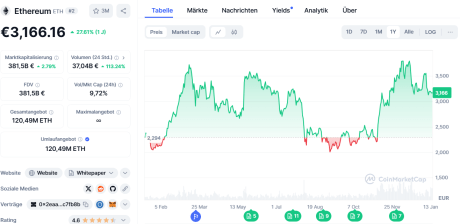
Lediglich vor einer Woche erlebte Ethereum wieder einen Aufstieg, der jedoch nur von kurzer Dauer war. Doch diese Entwicklung war auch bei der Zulassung der ersten Bitcoin-Spot-ETFs zu beobachten.

Die Märkte hatten die erhofften Kurssteigerungen schon zuvor vorweggenommen und benötigten einige Zeit, um die weiteren Entwicklungen zu analysieren und darauf zu reagieren. Das wird bei Ethereum offenbar nicht anders sein.

Neuer Schub nach Amtseinführung von Trump?

Die Geschichte von Ethereum zeigt jedenfalls, dass sich ETH im Januar eines Jahres zumeist als bullish erweist. Angesichts dieser Historie käme es nicht überraschend, wenn der Coin in den nächsten zwei Wochen wieder zulegen würde.

Rede Donald Trump

Zahlreiche Analysten zeigen sich jedenfalls optimistisch, dass mit der Inkraftsetzung der ersten Deregulierungsmaßnahmen der neuen US-Regierung der Kryptomarkt und damit auch Ethereum wieder deutliche Kursgewinne einfahren werden.

Alternative Solaxy

Wer als Investor hingegen eine Alternative zu Ethereum sucht, der könnte einen Blick auf den neuen Meme-Coin Solaxy ($SOLX) werfen. Dieser absolviert derzeit seinen Presale auf Ethereum, bildet jedoch aufgrund seiner technischen Ausgestaltung eine Brücke zur Blockchain von Solana.

Dort nutzt er als Multi-Chain-Coin günstige Kosten und Geschwindigkeit, um das Beste aus beiden Welten für sich zu generieren. 10 Millionen Euro sind innerhalb kürzester Zeit in das neue Projekt geflossen, das beweist, dass die Anleger an die Idee von Solaxy glauben.

Mit einem Preis von nur 0,0016 Dollar für 1 Solaxy ($SOLX) ist der Token noch preiswert, das könnte sich dramatisch ändern, wenn der Coin erst einmal auf einer der Kryptobörsen zum Kauf gelistet wird.

Alle Informationen zu Solaxy ($SOLX) finden sich auf den entsprechenden Seiten von X und Telegram.


Disclaimer: For information purposes only. Past performance is not indicative of future results.
placeholder
Gold Price Forecast: XAU/USD drifts higher above $4,200 as Fed delivers expected cutGold price (XAU/USD) gains momentum to around $4,235 during the early Asian session on Thursday. The precious metal extends its upside after the US Federal Reserve (Fed) delivered an expected third consecutive interest rate cut and maintained its outlook for just one cut in 2026.
Author  FXStreet
Dec 11, Thu
Gold price (XAU/USD) gains momentum to around $4,235 during the early Asian session on Thursday. The precious metal extends its upside after the US Federal Reserve (Fed) delivered an expected third consecutive interest rate cut and maintained its outlook for just one cut in 2026.
placeholder
Gold remains bid as lack of Fed clarity and geopolitical frictions persistGold (XAU/USD) advances modestly on Friday as traders seem to book profits ahead of the weekend, yet clings to gains of over 0.51% after reaching a seven-week high of $4,353. At the time of writing, XAU/USD trades at $4,302 as traders digest comments from Federal Reserve (Fed) officials.
Author  FXStreet
Yesterday 01: 34
Gold (XAU/USD) advances modestly on Friday as traders seem to book profits ahead of the weekend, yet clings to gains of over 0.51% after reaching a seven-week high of $4,353. At the time of writing, XAU/USD trades at $4,302 as traders digest comments from Federal Reserve (Fed) officials.
placeholder
Ethereum Price Slips Lower — $3,000 Looms as the Key BattlegroundEthereum is attempting to recover from a $3,026 low but remains below $3,200 and the 100-hour SMA, with a bearish trend line near $3,175 capping rebounds as bulls need a clean break above $3,200 to target $3,250–$3,400, while a drop below $3,050 risks a retest of $3,000 and $2,940.
Author  Mitrade
Yesterday 03: 25
Ethereum is attempting to recover from a $3,026 low but remains below $3,200 and the 100-hour SMA, with a bearish trend line near $3,175 capping rebounds as bulls need a clean break above $3,200 to target $3,250–$3,400, while a drop below $3,050 risks a retest of $3,000 and $2,940.
placeholder
Macro Analysts: Hawkish Japan Could Push Bitcoin Below $70KAnalysts predict Bitcoin may face further declines towards the $70,000 mark if the Bank of Japan raises interest rates as expected.
Author  Mitrade
Yesterday 05: 48
Analysts predict Bitcoin may face further declines towards the $70,000 mark if the Bank of Japan raises interest rates as expected.
placeholder
Bitcoin Slides 5% as Sellers Lean In — Can BTC Reclaim $88,000?Bitcoin has dropped back below $88,000 after rolling over from $90,500, with price still trading under the 100-hour Simple Moving Average. The sell-off found a floor at $85,151, and BTC is now consolidating near that base, but rebounds are facing pressure from a bearish trend line around $89,000. Bulls need to retake $88,000–$89,000 to ease downside risk; failure to do so keeps $85,500–$85,000 and then $83,500 in play, with $80,000 as the deeper “line in the sand.” Bitcoin (BTC) is back in damage-control mode after a sharp pullback wiped out recent gains. The price failed to reclaim the $90,000–$90,500 band, rolled over, and slid through $88,500 before briefly dipping under $87,000. Buyers did show up around $85,000, but the rebound so far looks more like stabilization than a clear trend reversal. Bitcoin dips hard, finds a bid near $85,000(h3) BTC’s latest move lower began when it couldn’t build follow-through above $90,000 and $90,500. Once that upside stalled, sellers took control and pushed price down through $88,500. The slide accelerated enough to spike below $87,000, but the market didn’t free-fall. Bulls defended the $85,000 zone, printing a low at $85,151. Since then, Bitcoin has been consolidating below the 23.6% Fibonacci retracement of the drop from the $93,560 swing high to the $85,151 low — a clue that the bounce is still shallow and that sellers haven’t fully backed off yet. Structurally, BTC is still on the back foot: It’s trading below $88,000, and It remains below the 100-hour Simple Moving Average, keeping short-term trend pressure pointed downward. Resistance is layered, and $89,000 is the problem area(h3) If bulls try to turn this into a recovery, they’ll have to climb through multiple ceilings in quick succession. First, BTC faces resistance around $87,150, followed by a more meaningful barrier near $87,500. From there, the market’s attention snaps back to $88,000 — the level BTC just lost and now needs to reclaim. A close back above $88,000 would improve the tone, but it doesn’t solve the bigger issue: there’s a bearish trend line on the hourly BTC/USD chart (Kraken feed) with resistance near $89,000, which also lines up with the next technical hurdle. If BTC can push through $89,000 and hold, the rebound could extend toward $90,000, with follow-through targets at $91,000 and $91,500. But until price clears that $88,000–$89,000 zone, rallies are at risk of being sold rather than chased. If BTC fails to reclaim resistance, the downside path is clear(h3) The near-term bear case is simple: if Bitcoin can’t climb back above the $87,000 area and keep traction, sellers may attempt another leg lower. Support levels line up like this: Immediate support: $85,500 First major support: $85,000 Next support: $83,500 Then $82,500 in the near term Below that, the major “don’t break this” level is still $80,000. If BTC slips under $80,000, the risk of acceleration to the downside increases significantly — not because it’s magic, but because it’s the kind of psychological and structural level that tends to trigger forced de-risking. Indicators: momentum still leans bearish(h3) The intraday indicators aren’t offering much comfort yet: Hourly MACD is losing pace in the bearish zone. Hourly RSI remains below 50, suggesting sellers still have the upper hand on short timeframes. So while the $85,000 defense held for now, the market hasn’t flipped bullish — it’s just stopped bleeding.
Author  Mitrade
10 hours ago
Bitcoin has dropped back below $88,000 after rolling over from $90,500, with price still trading under the 100-hour Simple Moving Average. The sell-off found a floor at $85,151, and BTC is now consolidating near that base, but rebounds are facing pressure from a bearish trend line around $89,000. Bulls need to retake $88,000–$89,000 to ease downside risk; failure to do so keeps $85,500–$85,000 and then $83,500 in play, with $80,000 as the deeper “line in the sand.” Bitcoin (BTC) is back in damage-control mode after a sharp pullback wiped out recent gains. The price failed to reclaim the $90,000–$90,500 band, rolled over, and slid through $88,500 before briefly dipping under $87,000. Buyers did show up around $85,000, but the rebound so far looks more like stabilization than a clear trend reversal. Bitcoin dips hard, finds a bid near $85,000(h3) BTC’s latest move lower began when it couldn’t build follow-through above $90,000 and $90,500. Once that upside stalled, sellers took control and pushed price down through $88,500. The slide accelerated enough to spike below $87,000, but the market didn’t free-fall. Bulls defended the $85,000 zone, printing a low at $85,151. Since then, Bitcoin has been consolidating below the 23.6% Fibonacci retracement of the drop from the $93,560 swing high to the $85,151 low — a clue that the bounce is still shallow and that sellers haven’t fully backed off yet. Structurally, BTC is still on the back foot: It’s trading below $88,000, and It remains below the 100-hour Simple Moving Average, keeping short-term trend pressure pointed downward. Resistance is layered, and $89,000 is the problem area(h3) If bulls try to turn this into a recovery, they’ll have to climb through multiple ceilings in quick succession. First, BTC faces resistance around $87,150, followed by a more meaningful barrier near $87,500. From there, the market’s attention snaps back to $88,000 — the level BTC just lost and now needs to reclaim. A close back above $88,000 would improve the tone, but it doesn’t solve the bigger issue: there’s a bearish trend line on the hourly BTC/USD chart (Kraken feed) with resistance near $89,000, which also lines up with the next technical hurdle. If BTC can push through $89,000 and hold, the rebound could extend toward $90,000, with follow-through targets at $91,000 and $91,500. But until price clears that $88,000–$89,000 zone, rallies are at risk of being sold rather than chased. If BTC fails to reclaim resistance, the downside path is clear(h3) The near-term bear case is simple: if Bitcoin can’t climb back above the $87,000 area and keep traction, sellers may attempt another leg lower. Support levels line up like this: Immediate support: $85,500 First major support: $85,000 Next support: $83,500 Then $82,500 in the near term Below that, the major “don’t break this” level is still $80,000. If BTC slips under $80,000, the risk of acceleration to the downside increases significantly — not because it’s magic, but because it’s the kind of psychological and structural level that tends to trigger forced de-risking. Indicators: momentum still leans bearish(h3) The intraday indicators aren’t offering much comfort yet: Hourly MACD is losing pace in the bearish zone. Hourly RSI remains below 50, suggesting sellers still have the upper hand on short timeframes. So while the $85,000 defense held for now, the market hasn’t flipped bullish — it’s just stopped bleeding.
goTop
quote