


Bitcoin exchange reserves hit 7-year low
Bitcoin (BTC) exchange reserves have dropped to levels not seen since 2018, with the total supply on cryptocurrency exchanges standing at 2.35 million BTC as of January 13, according to CryptoQuant. The decline marks a near seven-year low and is believed to be driven by institutional investors accumulating Bitcoin at discounted prices.
The largest token by market cap has faced sharp fluctuations over the past week, struggling to maintain its position above the $100,000 mark. After starting the week on a strong note, Bitcoin climbed to $102,000 on Tuesday but dropped over $10,000 in the following 48 hours, reaching a low of $91,250 on Thursday on the Bitstamp crypto exchange.
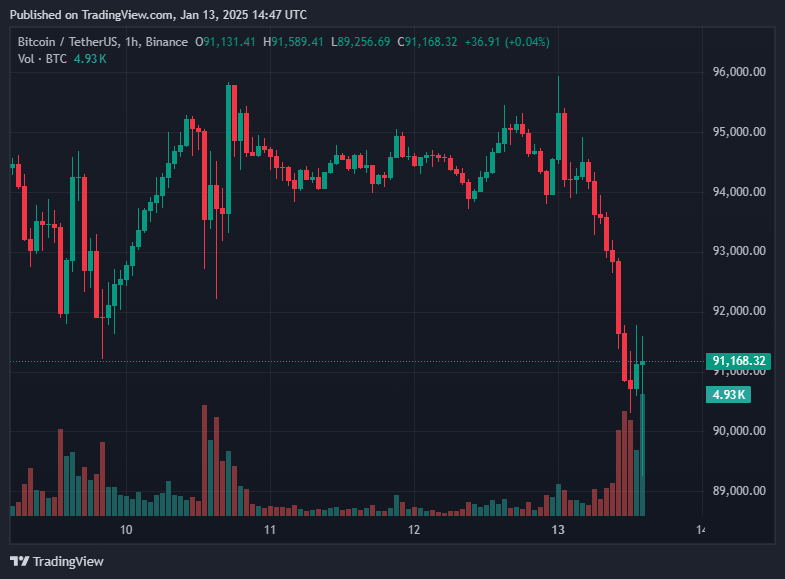
Bullish efforts to regain momentum today were thwarted, as Bitcoin’s price briefly recovered to $96,000 before encountering renewed bearish pressure. At press time, the cryptocurrency has been trading between $91,000 and $93,000.
Network activity levels go low, liquidations continue
CryptoQuant data shows BTC exchange reserves have been on the decline since the start of December, when the coin’s price started consolidating between $95,000 to $96,000.
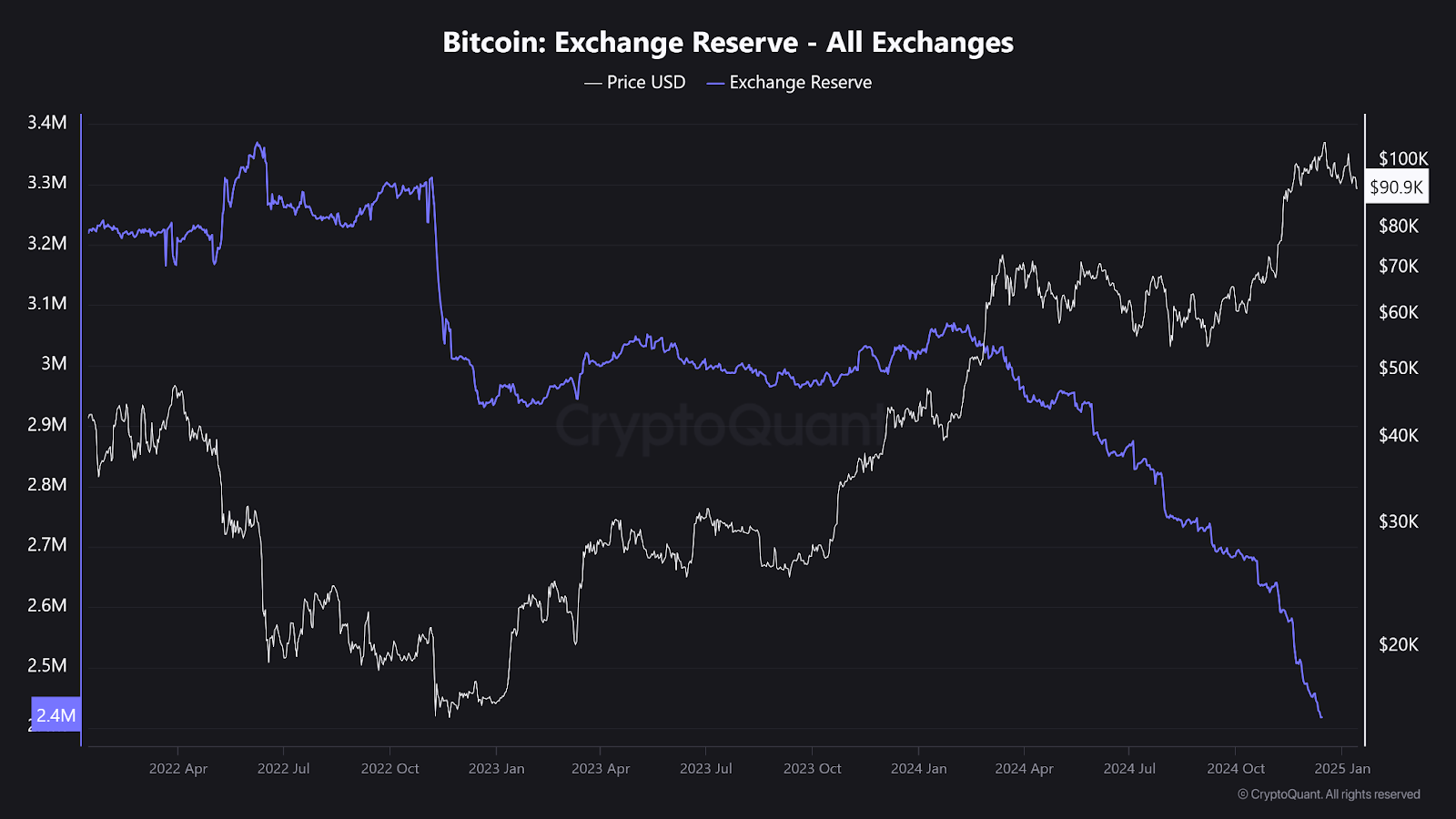
In addition to declining exchange reserves, Bitcoin’s network activity has reached its lowest level since November 2024. Metrics like the Short-Term Holders’ Spent Output Profit Ratio (SOPR) have fallen below 1, indicating that many short-term investors are selling at a loss.
This behavior reflects growing unease among retail participants as Bitcoin faces pressure at key support levels. Market observers suggest that a failure to maintain current price thresholds could lead to further downward pressure.
The turbulent price movements have triggered significant liquidations across the cryptocurrency market. Data from Coinglass revealed that total crypto liquidations amounted to $670 million over the past 24 hours, with long positions accounting for $588 million, or 87.7% of the total.
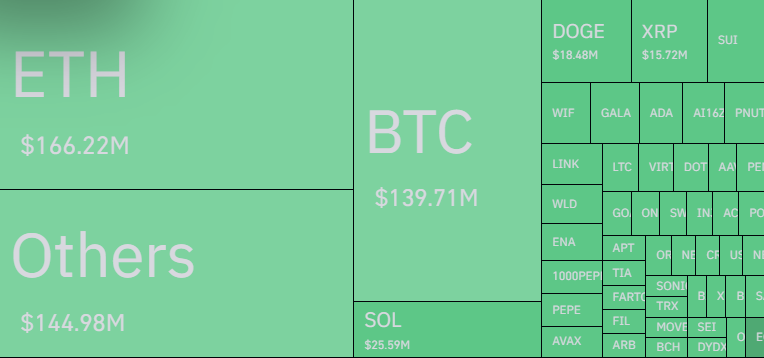
Bitcoin alone contributed $139.71 million in liquidations, with the largest order, valued at $8.21M, happening on Binance. The exchange also recorded the highest liquidation volume, at $88.27 million, followed by HTX and OKX, which reported $47.30 million and $42.66 million, respectively.
Short BTC liquidation positions saw comparatively smaller liquidations, totalling $22.13 million, as bears took charge of the overall market sentiment.
Hedge funds accumulate BTC, and institutional interest goes high
André Dragosch, head of research at Bitwise, highlighted this trend in a post on X, emphasizing the increasing exposure of crypto hedge funds to Bitcoin. “Global hedge funds’ beta performance to BTC has risen significantly, signaling growing market exposure to Bitcoin and other crypto assets,” he noted.
JUST IN: Global crypto hedge funds are apparently buying the bitcoin dip.🔥
— André Dragosch, PhD | Bitcoin & Macro ⚡ (@Andre_Dragosch) January 13, 2025
1M beta of global hedge funds' performance to BTC has increased from its recent cycle lows signalling increasing market exposure to bitcoin & other cryptoassets. pic.twitter.com/kJnrKNylpn
The dwindling supply on exchanges has raised speculation about a potential “supply shock.” This phenomenon occurs when strong buyer demand meets a decreasing amount of Bitcoin available for sale, often leading to upward price momentum.
Meanwhile, on the one-year anniversary of US spot BTC exchange-traded funds’ approval, the funds continue with their impressive performance. According to data from SoSoValue, Bitcoin ETFs pulled in $307.2 million during the week ending January 10, 2025.
Despite facing three days of outflows amounting to over $700 million, the funds continued to perform well, with the week’s total net inflows exceeding $1 billion.
From Zero to Web3 Pro: Your 90-Day Career Launch Plan
Recommended Articles


