

Ethereum Oversold? Researcher Predicts Speculative Surge Could Spark Market Revival

Source Newsbtc

Ethereum has had a rough year, but recent insights from industry insiders indicate a possible comeback. Matthew Sigel, VanEck’s Head of Digital Assets Research, recently indicated that Ethereum is oversold.

He thinks that raising speculative interest in the altcoin will enable its comeback. This comes as Ether tries to catch up with rivals such as Bitcoin and Solana, which far exceeded it in 2024.

A Shift In Market Sentiment

Sigel spoke on The Tie’s latest episode in which he hopes Ethereum will go in the right direction. He also noted that, although Ethereum faces problems, particularly regarding EIP-4844 in which it changes its economic model, opportunities can still emerge for a “bottom.”

The market is now a little conservative, but Sigel sees the commodity drifting back into speculation, bringing price back up and advocates to the trade again.

That also places it in line with larger Ethereum expectations. Analysts are even expecting ETH to trade between $2,199 and $3,019 in 2024, with some expecting a spike to above $5,000 by 2025.

Excitement generated earlier this year by acceptance of spot Ethereum ETFs has brought a regulated gateway to investors for entering the market, both retail and institutional investors. This development may cause massive inflows into Ethereum with enormous financial inflows, further buttressing its price.

Technical Analysis And Price Predictions

According to the latest technical analysis, Ethereum must break above $3,000 to sustain its bullish sentiment, and many analysts believe this may well open roads for a new record high. According to the Ethereum Rainbow Chart, we can see all sorts of possible prices for the following years, with estimates reaching as high as $12,000 by 2030.
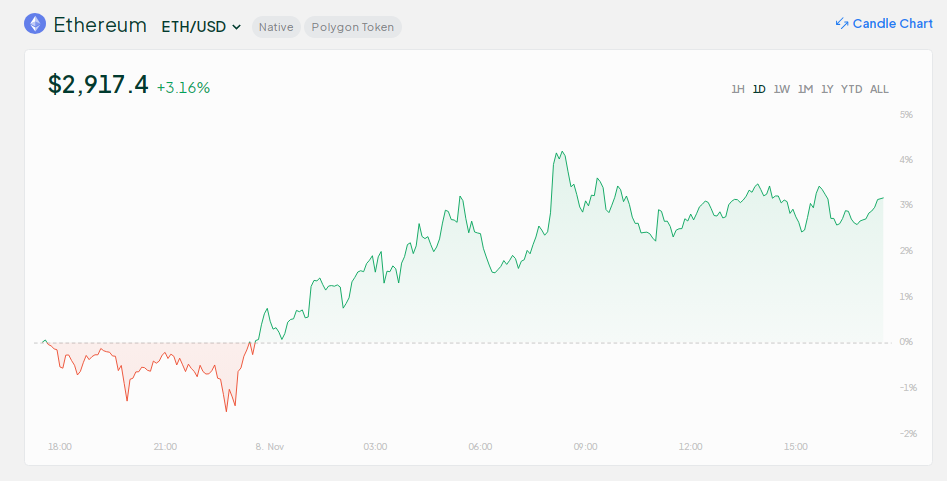
However, some are concerned about Ethereum’s long-term economic strategy. Sigel said that Layer-2 networks have started to claim more of Ethereum’s blockspace, resulting in lower transaction fees and income.

This development has led some investors to lose faith in Ethereum as a deflationary asset. If this trend continues without changes to link Layer-2 networks more closely with Ethereum’s ecosystem, VanEck’s long-term price targets may be jeopardized.

The Road Ahead For Ethereum

Despite these problems, commentators express a genuine feeling of optimism about Ethereum’s future. The prospect of fresh speculative activity, along with the regulatory certainty given by ETF approvals, could be exactly the spark for a significant comeback. As the market evolves and reacts to these developments, investors are looking for signals that a positive trend will return to Ethereum.

While Ethereum confronts challenges, experts believe that a combination of increasing interest and good market conditions might pave the way for a resurgence in 2024 and beyond.

Featured image from DALL-E, chart from TradingView

Disclaimer: For information purposes only. Past performance is not indicative of future results.
placeholder
Big Tech's $800 billion AI bill faces its first real test — free cash flow is the judgeAlphabet and Microsoft report after the close on October 28, Amazon on October 29, with hyperscaler AI capex running near $800 billion a year. Meta's negative free cash flow and 9.40% drop on October 22 was the warning; this week's prints decide whether cloud growth and backlog can pay for the buildout. Here are the consensus numbers, the free-cash-flow table and the two-sided test.
Author  Irene Q.
Oct 26, Mon
Alphabet and Microsoft report after the close on October 28, Amazon on October 29, with hyperscaler AI capex running near $800 billion a year. Meta's negative free cash flow and 9.40% drop on October 22 was the warning; this week's prints decide whether cloud growth and backlog can pay for the buildout. Here are the consensus numbers, the free-cash-flow table and the two-sided test.
placeholder
Anthropic files for a $2 trillion IPO — the $80.7 billion loss is the decoy, the $450 billion compute bill is the riskAnthropic publicly filed its S-1 on October 26, revealing $16.29 billion of first-half revenue (+1,304% year over year) and a $80.7 billion net loss — of which $72.4 billion is a non-cash convertible-note charge. The real number is the $450 billion of signed, mostly non-cancelable compute commitments. Here is what the filing says, why NVDA, ARM and MU are the tradeable read-through, and the conditions that decide whether the AI trade passes its first public valuation test.
Author  Irene Q.
Oct 27, Tue
Anthropic publicly filed its S-1 on October 26, revealing $16.29 billion of first-half revenue (+1,304% year over year) and a $80.7 billion net loss — of which $72.4 billion is a non-cash convertible-note charge. The real number is the $450 billion of signed, mostly non-cancelable compute commitments. Here is what the filing says, why NVDA, ARM and MU are the tradeable read-through, and the conditions that decide whether the AI trade passes its first public valuation test.
placeholder
Fed October Rate Decision Preview: Rate Hike Pause Has Become Consensus, How Will US Stocks, Dollar, and Gold React?The Federal Reserve will announce its October interest rate decision at 14:00 Eastern Time on October 28, and Fed Chair Warsh will hold a press conference at 14:30. Markets currently wide
Author  TradingKey
Oct 27, Tue
The Federal Reserve will announce its October interest rate decision at 14:00 Eastern Time on October 28, and Fed Chair Warsh will hold a press conference at 14:30. Markets currently wide
placeholder
Bitcoin is back above $80,000 — but 75% of the bounce was shorts, not buyersBitcoin trades at $80,669, back above the $80,000 line after touching $79,145 on October 24. But 75.4% of the last 24 hours of futures liquidations were shorts, CME open interest fell 36,545 BTC in October, and spot ETFs lost $773.5 million on October 22-23. Price is up; positioning is down. Here is why the bounce is a squeeze, and the four things that would make it real.
Author  Suzie
Yesterday 05: 54
Bitcoin trades at $80,669, back above the $80,000 line after touching $79,145 on October 24. But 75.4% of the last 24 hours of futures liquidations were shorts, CME open interest fell 36,545 BTC in October, and spot ETFs lost $773.5 million on October 22-23. Price is up; positioning is down. Here is why the bounce is a squeeze, and the four things that would make it real.
placeholder
Brent's $115 front month sits $4.6 above January — the $14 spread to WTI is the supply-risk premiumDecember Brent trades at $115.29 while January is $110.71, a $4.58 backwardation. The December Brent-WTI spread is $14.2, versus a $3-5 normal. That gap, not the headline, is where the Middle East supply risk is priced. Here is what the curve says, why the December contract's expiry on October 30 will mechanically cut the headline by $4.6, and the 108.81 neckline that decides the next move.
Author  Irene Q.
Yesterday 06: 21
December Brent trades at $115.29 while January is $110.71, a $4.58 backwardation. The December Brent-WTI spread is $14.2, versus a $3-5 normal. That gap, not the headline, is where the Middle East supply risk is priced. Here is what the curve says, why the December contract's expiry on October 30 will mechanically cut the headline by $4.6, and the 108.81 neckline that decides the next move.
goTop
quote